Introduction
On Day 3, the Supreme Court of India resumed the long- pending Sabarimala reference issue that has the capacity to redefine the relationship between religious freedom and fundamental rights in India.
The trial again raised the profound constitutional issues at play, particularly those in the rights of women, the freedom of religious denominations, and the jurisdiction of the courts in the religious realm.
Background of the Sabarimala Dispute.
The Sabarimala case started with the legendary decision of the year 2018 in Indian Young Lawyers Association v. State of Kerala when the Supreme Court permitted women of menstrual age to enter the Sabarimala temple.
Nevertheless, the ruling provoked mass protests and petitions to review. In 2019, the Court took more expansive constitutional questions to a larger bench without staying the original judgment.
The current source is not only related to Sabarimala but also related to other faiths.
Day 3 Hearing Focus.
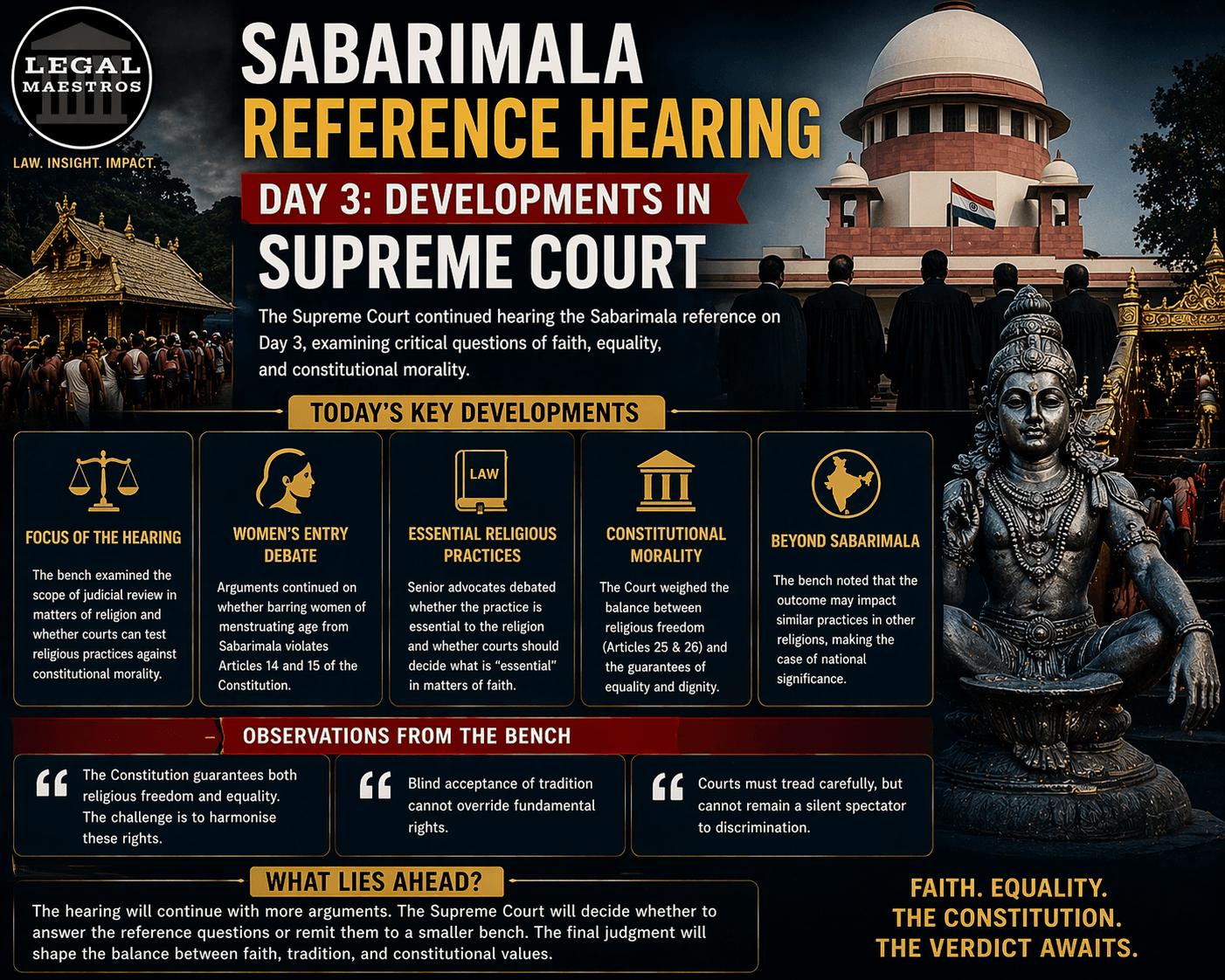
On the third day, the Court concentrated on whether there is a limit in the judicial review on religious issues.
The senior advocates who were representing various parties debated on whether the courts should exercise the authority to interfere in the religious traditions, which were long established and in cases where the religious practices were said to be vital in a specific religion.
The case challenged whether the judiciary could question religious practices in the light of constitutional morality.
The Discussions about Essential Religious Practices.
The doctrine of essential religious practices was one of the main controversies.
Counsel conceded that not all religious practices could be safeguarded in Articles 25 and 26 of the Constitution.
It was argued that the constitutional protection should be granted only to the practices that are essential, fundamental to a religion.
Meanwhile, counterarguments emphasized that courts were not supposed to determine the nature of what was considered essential in a religion, as they would have been usurping their authority.
Discussion of Women-Entry.
The question of women entering Sabarimala continued to be the focus of the debate.
It was argued that limiting female access is a violation of the right to equality in Article 14, and is discriminatory.
Conversely, they said that the temple is of a religious nature and that the prohibition is founded on a long-time tradition related to the nature of the deity.
The Court challenged the possibility of such exclusion to be justified in a constitutional democracy.
Moral of Constitution.
The concept of constitutional morality was also discussed in detail.
Other lawyers claimed that the constitutional values should be superior to any form of discrimination.
Others warned that attempting to promote constitutional morality on religious practices can cause social disharmony and unwarranted conflicts.
These conflicting issues seemed to be balanced well by the Court.
Impact Beyond Sabarimala
The court admitted that this reference decision will go beyond the Sabarimala temple.
The case might have an influence on the practice in other religions, such as matters concerning entry rules, gender roles, and religious autonomy.
The Court stated that it would have to come up with unequivocal principles that could be used across all religions.
Bench Observations.
There were a few key observations that the judges made in the hearing.
They also stressed that the Constitution not only guarantees religious freedom, but also equality and the question was how to reconcile the rights.
The Court further observed that tradition cannot be blindly accepted and supersede fundamental rights.
Meanwhile it recognized the susceptibility of religious convictions and judicial restraint.
What Lies Ahead
This hearing will probably be followed by additional arguments by various parties.
The Court can then decide to answer the reference questions or refer them to a smaller bench.
The decision will either way will significantly affect the constitutional law and religious practices in India.
The reference hearing of Day 3 on the Sabarimala case revealed that the matter is much more intricate than a mere matter of temple access.
It is a constitutional argument concerning religion, equality, and judicial restraint.
It is now upon the Supreme court to make a challenging decision which does not violate religious diversity but upholds the constitutional values.
Keywords
Sabarimala hearing, Supreme Court, women entry, essential religious practices, constitutional morality, Article 14, Article 25, religious freedom, equality, Indian constitution.