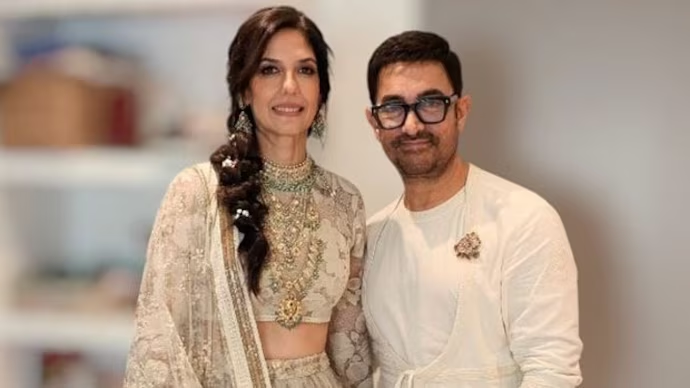
The living room of a Bandra apartment does not typically turn into a national flashpoint, but when that apartment belongs to Aamir Khan, all bets are off. On July 5, 2026, the 61-year-old actor had his name entered into a civil marriage registry, next to that of his 47-year-old bride, Gauri Spratt. It was a low-key affair; an estimated 150 guests attended, ranging from his children, Junaid and Ira, to business mogul Mukesh Ambani.
Then, the internet erupted. Within two days, online spaces were bifurcated between predictable and virulent camps. Clerics took to webcams spouting scriptural verses, while fringe political personalities held press conferences denouncing the match. The fever pitch came when a prominent Islamic cleric issued an official religious pronouncement, or fatwa, condemning the union on grounds of violating religious law as it involved an interfaith marriage.
The actor, however, didn’t call a live television press conference. Instead, he settled for a quiet, one-on-one interview, appearing weary but oddly amused by the sheer scale of vitriol directed at his domestic affairs.
The Clergy Draws A Line In The Sand
The official opposition emanated from the northern Indian state of Uttar Pradesh. Maulana Chaudhary Ifrahim Hussain, the Shahi Chief Mufti of the Muslim Personal Darul Ifta, released a video on social media channels outlining what he interpreted as sacrilegious by traditional Islamic tenets. In no uncertain terms, Hussain argued that a Muslim man marrying a non-Muslim woman was directly transgressing Sharia law, and that doing so constituted a severe sin.
The cleric specifically invoked the responsibility of public figures, suggesting that Khan, by this third marriage, was setting a dangerous precedent, twisting the narrative of Islam for his audience and, consequently, distorting it for public consumption. For days after the pronouncement, Khan’s official communications and social media channels went eerily silent. No defence was mounted. No counter-legal threats were issued.
A History Of Domestic Inclusivity
When Khan finally did break his silence in a candid conversation with journalist Subhash K Jha, he studiously sidestepped any detailed religious arguments. Instead, he brought the discourse down to the simple reality of his own extended family. Khan explained, not for the first time, that his household had always been a far cry from any singular religious entity.
Need Help With Your PhD or LLM Thesis?
Explore our thesis and dissertation writing support services for PhD and LLM students. Get subject-specific academic assistance for your research project.
Explore Our Services →His own immediate family had, in fact, long represented a tapestry of interwoven faiths. He noted that both his sisters are married to Hindu men. His daughter, Ira, recently wed her fitness instructor fiancé, Nupur Shikhare, without conversion. Even his cousin, the filmmaker Mansoor Khan, married a Christian woman decades ago.
In the actor’s view, the household has functioned on a principle of mutual respect, with individual choice outweighing rigid religious doctrine. That his latest marriage was being portrayed as a radical transgression was, in fact, mystifying. He openly acknowledged that he was increasingly finding the outrage entertaining and seemed to be increasingly amused by how far it strayed from the reality within his own home.
The Three Marriages And The Special Marriage Act
Much of the internet-based ire directed at Khan has been fuelled by a term often weaponized in the Indian political landscape: “love jihad.” The rhetoric insinuates that public figures like Khan use their clout to coerce or persuade non-Muslim women to convert their faith as a condition of marriage. Khan dismissed this characterisation outright.
He painstakingly detailed the practical, administrative, and legal facts of his romantic relationships over the past four decades. In all cases, the women he has married remained adherent to their respective faiths, a fact he stated with simple, clear-eyed sincerity.
His first marriage was to Reena Dutta, which lasted from 1986 to their amicable divorce in 2002. She was, and remains, a Hindu. His second marriage to filmmaker Kiran Rao took place under civil law in 2005, ending with a mutual separation in 2021. Rao never converted.
The latest union follows the same path. Gauri Spratt, a native of Bengaluru who has been friends with Khan for almost two and a half decades, also married him under the Special Marriage Act. In another point of clarification that confounded online detractors, Khan clarified that contrary to the widespread online assumption, Spratt is a Christian, although she is not particularly orthodox or devout in her practice.
Crossfires From Both Edges
What has made this particular controversy so unique is that Khan found himself attacked from two starkly opposite directions of societal and religious spectrums. On one side were traditional Islamic clergy such as Mufti Hussain, decrying the marriage because the bride had not converted to Islam. On the polar opposite, right-wing groups protested, burning effigies in parts of Maharashtra and labeling it as an attack on local cultural values, with a radical figure even putting a bounty on his head.
Khan’s stance, throughout, remained grounded in the legal framework of civil unions. By availing of the Special Marriage Act, he and Spratt chose a pathway designed precisely for individuals who wish to marry without the intervention of religious institutions and the stipulation of religious conversion.
The Pali Hill Sky Villa Rumors
Beyond the religious debate, the narrative quickly spiralled into the actor’s real estate portfolio, with tabloid media igniting rumours that Khan was building a sprawling 100-crore rupee ‘sky villa’ on Pali Hill, in the same neighbourhood. This structure, it was widely reported in unverified stories, was to be an elaborate vertical commune for his existing and former wives, his children and his extended family to occupy different floors of the same building.
Khan was keen to debunk this story. He explained that the building in question is not a new personal mansion for an eccentric polygamist, but simply the older apartment complex in Marina Apartments where he lives is undergoing the routine redevelopment, a common phenomenon in urban India as buildings are modernized. The decision to redevelop the twenty-four-member society was a collective one made by all residents; while Khan owns several units there, the concept of him building a grand, unified home for his diverse family members was pure fantasy.
A Steady Baseline Amid The Noise
Ultimately, the story is a potent illustration of the peculiar positions held by public figures in contemporary India, where their private domestic choices are instantly interpreted through lenses of religion and politics. Despite the threats and the religious decrees, life inside the Khan residence seemingly carries on with its established rhythm. The actor’s stance is unambiguous: his personal life operates on principles of individual choice and the laws of the state.