Section 85 of Bharatiya Nyaya Sanhita, 2023: The Successor to IPC Section 498A on Domestic Cruelty
India is experiencing a profound change in the landscape in terms of law with the creation of the Bharatiya Nyaya…
Keeping Pace with Legal Change
India is experiencing a profound change in the landscape in terms of law with the creation of the Bharatiya Nyaya…
The Honourable Supreme Court established the fact that provided there is circumstantial evidence in the case, it would suffice to convict the person of an offence provided the circumstances when joined together creates a complete and unbroken chain of guilt. Maintaining the decision made by the Chetan case, the Supreme Court has taken into consideration important precedents, supporting the view that the credible circumstantial evidence provided, together with inability of the accused to signify the facts that proved his guilt are enough to convict the case without direct witnesses.
The instance of the Thangavel Vs. The State, Through Inspector Of Police & Anr., A school official, Thangavel, was charged with abetment of suicide when the child committed suicide, after receiving a scolding on his poor behavior on a report made by one of his fellows. The Supreme Court had to think whether the scolding was an act of criminal abetment under Section 306 IPC (now Section 108 BNS). The Court referred to the action of Thangavel as reasonable use of disciplinary power without personal hostility and intent to make suicide.
Section 28 of the Bharatiya Nyaya Sanhita 2023 expresses that consent cannot be offered when taken out of fear, misapprehension, stupor, soundness of mind, or by a kid younger than twelve years in order to offer protection against duplicity, compulsion, and other subjection to justice.
Section 106 of Bharatiya Nyaya Sanhita can be called draconian that imposed harsh punishment reaching up to ten years of imprisonment to hit-and-run drivers and two years to the careless doctors as medical and transport communities protested all over India.
Section 26 of the Bharatiya Nyaya Sanhita 2023 protects individuals who act harmlessly in good faith and with consent even if their actions risk harm. It ensures that medical procedures, emergency rescues, and similar interventions performed to benefit someone and with their informed consent are not treated as criminal offences.
Section 25 of the Bharatiya Nyaya Sanhita, 2023, stipulates that an act not intended or known to likely cause death or grievous hurt is not an offense if the person harmed is over eighteen and has consented to the risk. For example, if two adults agree to fence for amusement and one is injured without foul play, no offense is committed.
Section 24 of the Bharatiya Nyaya Sanhita, 2023, addresses the issue of criminal liability in cases where an offense requires specific intent or knowledge, and the act is committed under intoxication. According to this provision, if an individual voluntarily becomes intoxicated and commits such an offense, they are held legally responsible as if they possessed the required intent or knowledge, regardless of their impaired state. However, if the intoxication was involuntary—meaning the substance was administered without their knowledge or against their will—this may serve as a defense, acknowledging that the individual lacked the capacity to form the necessary intent or knowledge due to the involuntary intoxication.
The sexual assault case in Pollachi brought to light a terrible plot in which a group of men in Pollachi, Tamil Nadu, methodically enticed young women under false pretences, sexually assaulted them, videotaped the activities without obtaining their consent, and then exploited the videos to extort additional sexual favors or money from the young ladies. The scandal, which was brought to light at the beginning of 2019, aroused significant concern regarding the protection of survivors, the safety of women in public settings, and the breaches in police procedures. In May of 2025, a special Mahila Court in Coimbatore found nine men guilty of the crime and sentenced them to life imprisonment till death. Additionally, the court ordered that the survivors get considerable compensation. This article covers the specifics of the case, the investigation, the judicial decision, the pertinent provisions of the Bharatiya Nyaya Sanhita, 2023, and the political controversies that followed, with the goal of highlighting the lessons that can be learned for the purpose of revising the law and providing assistance to victims.
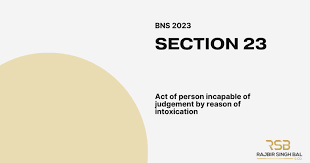
Section 23 of the Bharatiya Nyaya Sanhita, 2023, presents a sophisticated outlook on criminal liability with regard to intoxication. Distinguishing between voluntary and involuntary intoxication, the legislation ensures that people are held accountable in a fair manner, bearing in mind their state of mind and the situation causing them to become impaired.