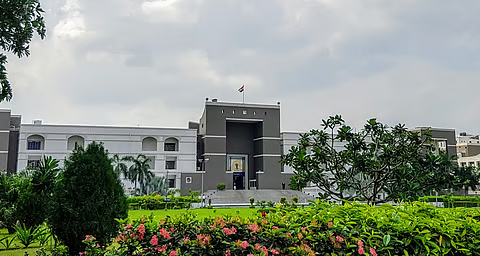
On July 7, 2026, the Gujarat High Court upheld the verdict of the trial court, four years after it had convicted several persons in the 2008 Ahmedabad serial blasts case. A Division Bench of the High Court consisting of Justices A.Y. Kogje and Samir Dave dismissed all appeals filed by the convicts against the trial court’s February 2022 judgment, and confirmed the death sentences for 38 persons and life imprisonment for 11 others.
I have carefully considered the aforesaid judgment of the Gujarat High Court, and respectfully disagree with it.
No doubt a heinous crime had been committed in the bomb blasts on 26.7.2008, in which 56 innocent persons were killed and over 240 injured.
It was the case of the prosecution that the accused persons, who are all Muslims, believed that Muslims had suffered loss of lives and damage to properties as an aftermath of the riots in Gujarat, following the incident of Sabarmati train burning known as Godhra riots. Also, due to demolition of
Babri Masjid and such other incidents, the accused had intention to take
revenge and therefore, got together under the aegis of the banned
organization SIMI.
It was alleged that the accused organized and got together at Vagamon in
Kerala, in December, 2007, where a group of accused were imparted
with physical and weapon training and, through lectures/debates,
indoctrinated with the idea of ‘jihad’, not only to take revenge, but also
to establish Islamic rule in India and for that purpose, to resort to
terrorist attacks on the general public, including mass killings.
A second ‘terror camp’ was allegedly set up in the forest of
Pavagadh in Halol in Gujarat in January, 2008. Here also, there was
physical and weapon training and also training in bomb-making. In this
camp also, there were religious speeches inciting sentiments to
get revenge for the losses suffered by Muslims and also to establish
Islamic rule. To achieve this objective, it was decided to spread anarchy
by attacking the public at large, especially of the Hindu community, to achieve the objective of
jihad.
The bomb blasts were consequent to all this.
I have no sympathy for terrorists, and believe they should be given harsh punishment. The question however remains of identifying the real culprits. Unfortunately in India the real culprits get away scot free, while innocents are charged and convicted.
Criminal investigation is a science. If we read the stories of the fictional Sherlock Holmes we see how Holmes solves crimes, by going on the spot, collecting evidence of blood stains, ashes, footprints, etc and by using logical deductions.
Similarly, on YouTube, we see how the police in modern countries like America solve crimes, by collecting evidence of fingerprints, fibres, bullet casings, semen, blood, ashes, etc and taking them to scientific laboratories where these are analyzed by experts, and by modern methods of interrogation of witnesses and suspects. Fingerprints, DNA etc are fed into a national database to try to get a match.
In India, on the other hand, most policemen are not trained in scientific investigation nor provided with scientific equipment for this, and yet are under pressure from their superiors or politicians to solve the crime, failing which they may be suspended. So what do they do? They often resort to the time tested method of torture of suspects, e.g. using the danda ( stick ). Torture is such a terrible thing that one will admit to anything under torture. Joan of Arc admitted to being a witch under torture.
There are often terror related incidents in India, e.g. bomb blasts. There is great pressure on the police to solve such crimes. But since our policemen are usually not trained in scientific investigation nor provided with scientific equipment for this purpose, the real culprits are often never apprehended, and instead innocent persons are arrested, charged, and convicted, often on the basis of fabricated evidence, alleged ‘confessions’ of the accused, and statements of approvers ( accomplices who turn prosecution witnesses in order get a pardon or a lighter sentence ).
Let us now come to the present case.There were no eye witnesses of the planting of the bombs or exploding them by the accused. The evidence against them consisted of :(1) Confessions of PW 1151/8265 Riyaz Husain ( for conspiracy ), PW 1115/8002 Mohd Usman ( for meeting and hate speech ), PW 1117/8019 Asif Usmanbhai Sheikh ( for meeting and hate speech ), PW 1131/8118 Mohd Rafiq ( for meeting and hate speech ), confessions of Manzer Islam, accused number 2 Imran Ibrahim Sheikh, accused number 21 Mehndihasan Ansari, and accused number 35 Rafiuddin Kapadia(2) Evidence of approver PW 1141/8191 ( for conspiracy, and renting houses to prepare bombs, and provide accomodation to other accused
)
(3) Panchnamas
(4) Test identification parade of 3 accused.As regards (1), I have already mentioned the method often used by the police of obtaining confessions in India i.e. by duress under torture. Most of the ‘confessions’ in the present case were recorded after long police custody ( and therefore giving ample time to the police to administer the ‘danda’ and use other hideous methods ), and no legal aid was provided to the accused explaining the consequences of their ‘confessions’.PW 1151 Riyazhusain Sissique, who is said to have confessed, later stated that he was tortured, and his statement obtained under duress. Hence he was declared hostile by the prosecution.As regards (2), I have already mentioned above how and why an accused becomes an approver.As regards (3), accused Mohd Ismail, Abdul Rajik, Musaf, Furqan Md and Ishaq Mansuri allegedly made voluntary confessions in panchnamas, but their ‘confessions’ were not recorded before a judicial magistrate under section 164 CrPC, apparently because the police wanted to manufacture evidence. The alleged disclosure panchnama of accused no.1 Jahid@Javed Kutbuddin Sheikh was made 11 days after his arrest, and 9 days after the investigating officer allegedly came to know of the alleged terrorists camp at Halol. Hence there was no ‘disclosure’ of a new fact to treat the panchnama as a disclosure panchnama under section 27 of the Indian Evidence Act. Also, the very same place was later on pointed out by 6 different persons at least 6 times. Several panchnamas were verbatim reproductions and overlapping.As regards (4), it is well known that in India these are worthless, as the police identifies beforehand to the witnesses whom they must point out.Apart from the above, there are many other flaws in the judgment. For instance, the mobile phones of several accused had been seized by the police. These could have been clinching evidence of the accused being in touch with each other for the conspiracy, yet the prosecution did not produce the CDR. Under section 114(g) of the Evidence Act, if important evidence is not produced, there is a strong presumption against the prosecution.Other flaws are : There was failure to put facts and evidence to the accused as required by section 313 CrPC, yet they were used against them, section 161 CrPC statements to the police are non-admissible, yet they were relied upon as substantive evidence, etcAll this was dismissed by the High Court by observing ” The prosecutor is master of the prosecution ( vide para 11.64 of its judgment ). The Court should have rembered that even if the prosecutor is the master of the prosecution, he is not the judge.I conclude by quoting from the famous dissenting judgment of Justice Hugo Black of the US Supreme Court in Dennis vs US, 1951, which transcended law and entered into the field of literature :”
Public opinion being what it now is, few will protest the conviction of these Communist petitioners. There is hope, however, that, in calmer times, when present pressures, passions and fears subside, this or some later Court will restore the First Amendment liberties to the high preferred place where they belong in a free society ”.All that needs to be done to this statement, is to substitute the word ‘Communist’ by the word ‘Muslim’
Attachments area