Introduction
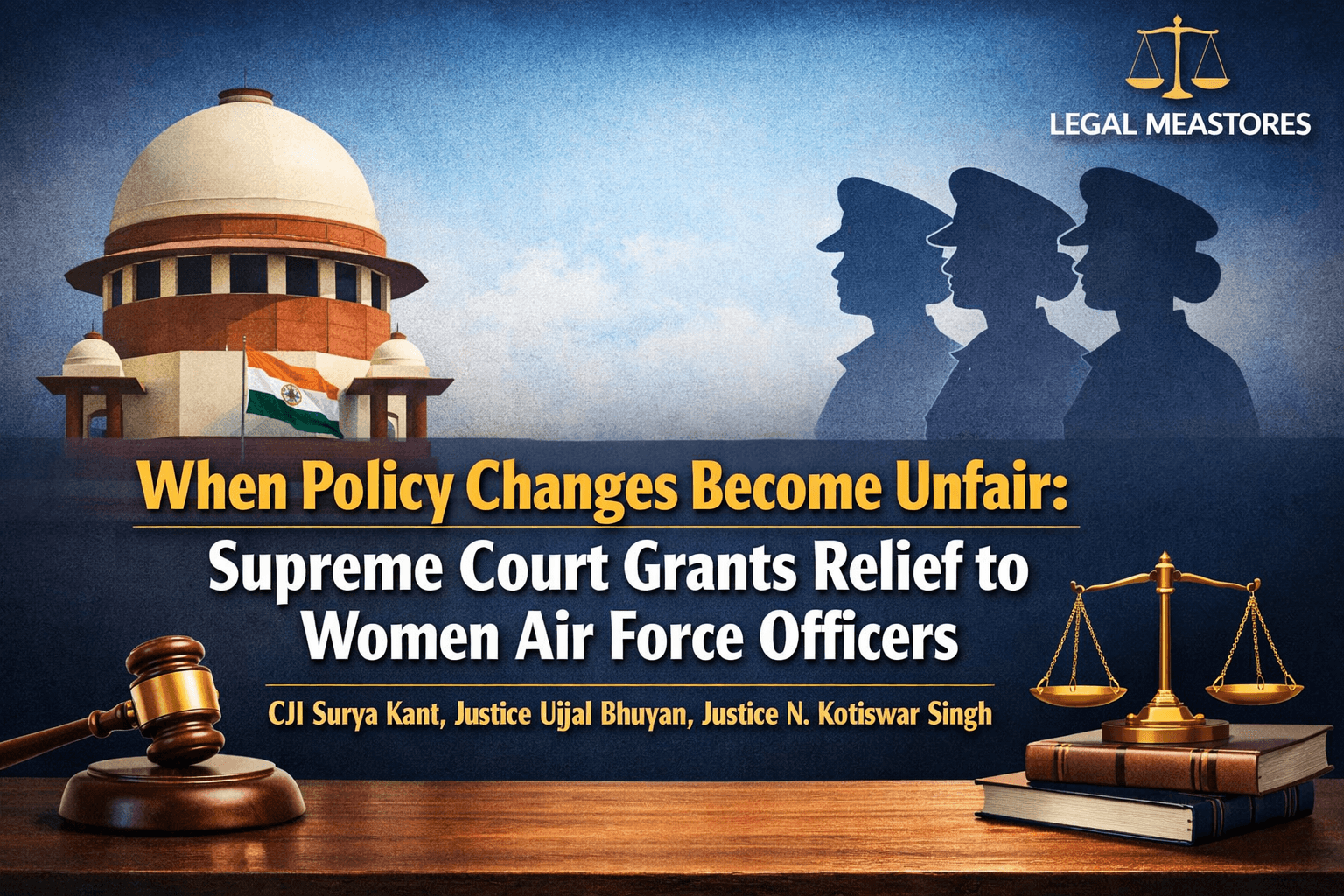
The Supreme Court of India made a decision on 24 March 2026. This decision helps women officers in the Indian Air Force who were unhappy with a policy change. The case of Wg. Cdr. Sucheta EDN vs Union of India questioned if a policy change was fair.
The Supreme Court justices, Chief Justice Surya Kant, Justice Ujjal Bhuyan and Justice Nongmeikapam Kotiswar Singh made this decision.
This case is important because it shows that even neutral policies can be unfair if not planned properly.
Background of the Case
The case is about women officers in the Indian Air Force who served under the Short Service Commission (SSC). They wanted to become Permanent Commission (PC) officers, which would let them serve until retirement.
For years a policy said officers recruited after 2006 could not apply for Permanent Commission.. In 2019 this policy was changed. Now these officers could apply for PC.
The problem was that the new policy had performance rules. Officers had to compete based on records that were not meant for long-term career evaluation.
What the Officers Argued
The officers said the system was unfair.
They said their performance reports, called ACRs were written when they did not think they would get Permanent Commission. So these reports did not show their potential.
They also said new requirements like course scores and categorisation were introduced suddenly. They did not have time to improve or meet these standards.
Some officers lost opportunities because they took pregnancy or maternity leave. This affected their category and performance grading.
The officers said the process was unfair and did not give them a chance.
What the Government Argued
The government said the Air Force can set performance standards.
It said the selection process was based on merit and all officers, male or female were treated equally. It also said there were vacancies so competition was necessary.
The government said courts should not interfere in policies unless they are clearly unreasonable.
Key Issues Before the Court
The Court looked at three questions.
First were the performance reports (ACRs) unfairly used against the officers?
Second was the introduction of new eligibility conditions unfair?
Third was the overall selection system fair and transparent?
Court’s Analysis
The Court carefully examined the system.
It found that ACRs were written when officers were not expected to continue term. So using these reports to judge their suitability for Permanent Commission was unfair.
The Court also criticised the introduction of new criteria in 2019. Officers had time to meet these requirements making the process unfair.
The Court said the first selection board was conducted quickly after the policy change. This deprived officers of a chance to prepare.
The Court emphasised that fairness is not about rules but also about how those rules are applied.
Judgment of the Court
The Supreme Court ruled in favour of the officers. It set aside the decisions of the Armed Forces Tribunal and the Delhi High Court.
Of ordering reinstatement the Court provided a balanced solution.
It said all affected officers would be treated as if they had completed 20 years of service. They would get pension and related benefits. Not back pay.
The Court also directed that future selection processes must be more transparent. Clear information about vacancies and evaluation criteria must be shared in advance.
Why This Judgment Matters
This judgment is important because it recognises that fairness in law is not about equality but also about context.
Even if a rule applies equally to everyone it can still be unfair if it ignores realities. The Court acknowledged that policies cannot be applied mechanically without considering their impact on individuals.
The decision also highlights the need for transparency and proper planning in government policies in sensitive areas like the armed forces.
Conclusion
The Supreme Court’s decision sends a message that fairness must be at the heart of every policy.
By granting benefits and correcting the injustice the Court ensured that these officers were not left without recognition, for their service.
At the time it respected the operational needs of the Air Force by avoiding disruption in its structure.
This judgment stands as an example of balancing institutional discipline with individual rights.
Keywords
Supreme Court of India, Permanent Commission, Indian Air Force, SSCWOs, ACR grading, military policy, gender justice, administrative fairness, pension benefits HRP 01/2019