Introduction
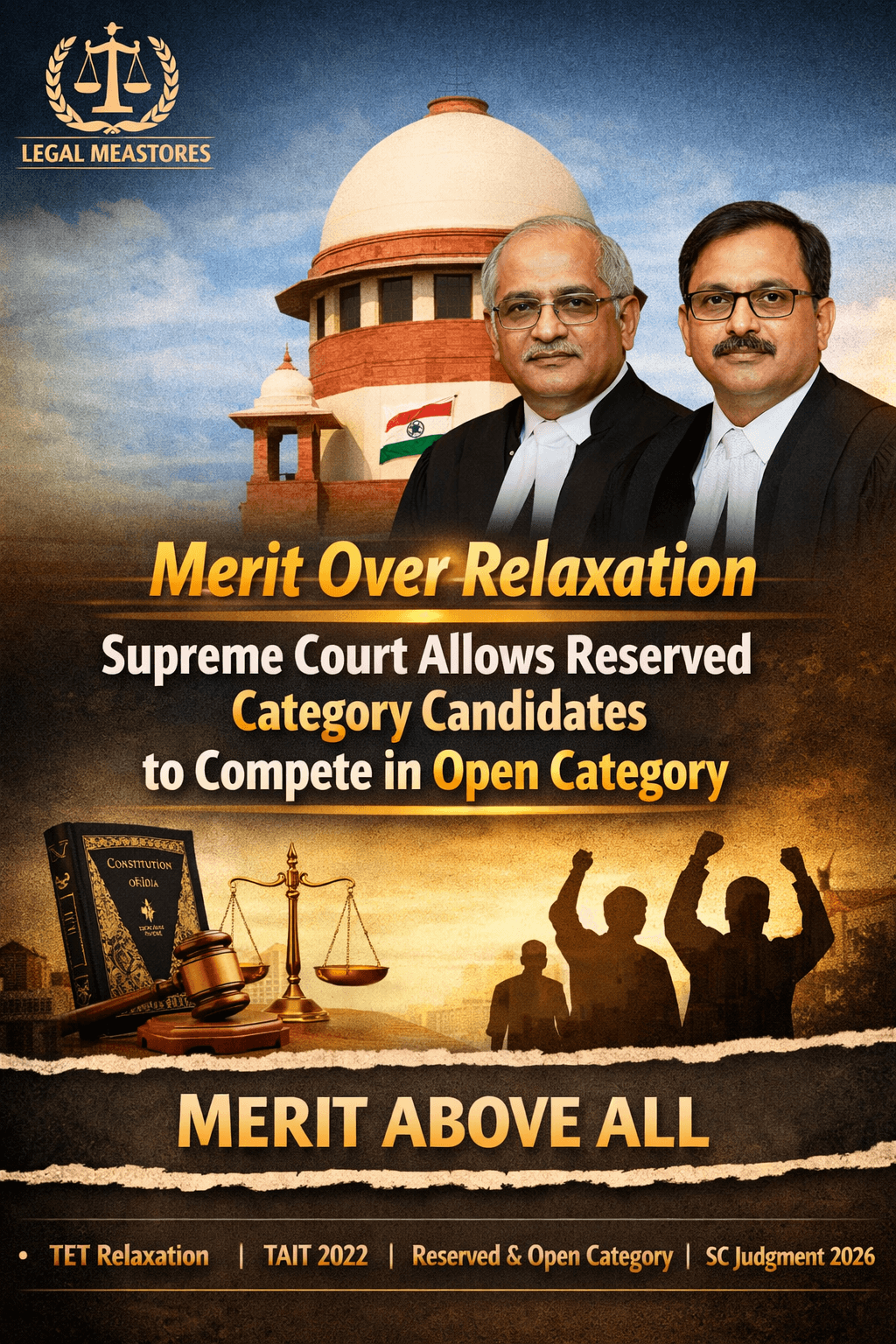
The Supreme Court of India made a decision on 23 March 2026. This decision is a case called Chaya & Ors. Vs State of Maharashtra & Anr. It is about whether candidates from categories can compete in the open category based on their merit.
The Supreme Court said that once candidates start competing their merit should decide the outcome.
Background of the Case
The case started with a recruitment of teachers in Maharashtra through the Teachers Aptitude and Intelligence Test (TAIT) 2022. Candidates had to qualify the Teacher Eligibility Test (TET).
The appellants were from categories and had cleared the TET with lower marks. However in the exam (TAIT) they scored higher marks than some general category candidates.
Their names were not in the general merit list. The reason was that they had marks in TET.
Decision of the High Court
The Bombay High Court (Aurangabad Bench) said that the TET is not a qualifying exam. It is part of the recruitment process.
The High Court said that if a candidate uses marks in TET they cannot be in the general category.
Issue Before the Supreme Court
The main question was: Can a reserved category candidate who used marks in a qualifying exam still be selected in the open category if they score higher marks in the final exam?
Arguments by the Parties
The appellants said that lower marks in TET only helps a candidate become eligible. It does not affect their performance in the exam.
The State said that allowing such candidates to compete would give them two benefits of reservation.
Understanding the Legal Principles
The Supreme Court analysed judgments. It said that lower marks in a qualifying exam like TET only helps a candidate enter the competition. It does not give any advantage in the selection.
The Court said that merit must be judged independently of eligibility.
Supreme Court’s Analysis
The Court noted that the TET is an eligibility condition. The final selection was based on TAIT marks.
The rules did not prohibit category candidates from competing in the open category.
Final Judgment
The Supreme Court said that reserved category candidates who scored marks than general category candidates in the main exam must be allowed to be selected in the open category.
The exclusion of candidates was wrong.
The judgment of the High Court was set aside. The State was directed to revise the merit list.
Names of the Justices
The judgment was delivered by:
Justice Pamidighantam Sri Narasimha
Justice Alok Aradhe
Why This Judgment Matters
This judgment is important. It protects the principle of fairness in employment.
It makes it clear that reservation is meant to provide opportunity not to restrict merit.
Conclusion
The Supreme Court has reaffirmed an idea: eligibility and merit are two different stages of selection. Lower marks help candidates reach the starting line. The race is decided by performance.
This judgment will have an impact on future recruitment processes, across India.
Supreme Court judgment 2026, reservation law India, TET relaxation case, TAIT recruitment Maharashtra, open category vs reserved category, merit vs eligibility, Chaya vs State of Maharashtra, teacher recruitment law, constitutional equality, public employment India