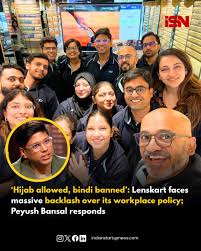
An incidental screenshot can become a nightmare at the corporation overnight. This was discovered by Lenskart halfway through April 2026. A style guide belonging to the giant eyewear company was leaked on social media, triggering a furor at its core. The grooming rules of the retail staff were described in the document, and people soon saw a blatant discrepancy. The text strictly prohibited the wearing of bindis, tiltaks and sacred wrist threads such as kalawa among the employees. At the same time, the same document allowed wearing hijabs and turbans with certain color and style requirements. The internet erupted. The hashtags that required a boycott began to trend in just a few hours as people were accusing the company of hypocrisy and anti-Hindu sentiment. The pressure had boiled to the extent that, CEO Peeyush Bansal had to directly intervene to manage the fallout. He described the viral document as an old draft, and that it was not a reflection of the present mindset of the brand. Lenskart hastened to produce a new, entirely unambiguous style guide, by April 18. The new version directly embraced every symbol of religion, with names such as mangalsutra, kada, bindi and sindoor placed directly beside hijabs and turbans.
To Delineate the State and office.
This rapid company retreat is a legal can of worms to consider. And does that mean that a private company is entitled to tell you what religious symbols you bring to the office? Article 25 of the Constitution in India is the guarantee of the freedom of professing and practicing religion. What people think is that this right is a blanket shield that protects against any rule that one does not like. That is an enormous fallacy. Basic rights can only be enforced on the government, not on your local retail manager. A constitutional violation would be obvious and immediate in case a state-run enterprise asked an employee to wipe off a tilak. The sphere of the work of private companies is another legal field. Work in the corporate world is essentially a contractual one. Under a contract that you sign with an offer letter, you submit to follow the internal policies that the human resources department develops. You are ready to give up some degree of individual freedom in exchange of a salary. As a result, it will be necessary to address sophisticated labor legislation when a private organization is dragged to court to answer a dress code infraction, as opposed to just holding the Constitution over the face of a judge.
The Uniformity Business Case.
Leaders of corporations tend to justify stringent dress codes with reference to brand names. As a customer enters a retail store, the executives would wish that he or she feels a harmonious, homogenous atmosphere. It is micromanaged, down to the color of the polo shirts, and what the staff must say to you. This homogeneity is disrupted by personal religious symbolism. Other HR managers say that having a totally neutral visual image will not alienate customers and keep the business environment secular. They do not want the emphasis put in the personal ideologies of the person who is selling the product but rather the product itself. This drive of standardization goes directly against the firmly rooted cultural identities of the Indian workforce. An Indian professional may not be easily separated with his or her cultural markers. To most, a kada or a kalawa is not a fashion accessory. It is a continuation of their physical self. Compelling employees to dispose of these items at the office door leaves employees in a dilemma on whether to stick to their faith or to earn a living.
Essential Practices Test.
Should there be a dispute concerning a religious symbol at the workplace that might lead to the higher courts, the judges will normally depend on a widely disputed legal measure. They examine the doctrine of the essential religious practices. This test attempts to tell whether a certain ritual or symbol is absolutely basic to the religion under consideration. When the removal of the symbol essentially changes the religion, then it is given strong legal safeguarding. The Sikh men turbans are a definite fit in this category of protection. The legal position of other objects becomes ambiguous within a short period of time. The issue of whether the hijab is a necessary practice in Islam has taken years to be debated in the courts, and as a result, judgments have been conflicting depending on the state. It is further complicated by Hindu symbols such as the bindi or tilak. These indicators tend to blur the distinction between religious imperative and general cultural custom. A company can claim that bindi is just a cultural make-up, and thus they have the right to prohibit it in the name of a clean retail appearance. Convincing a court of law that a certain thread or mark on the forehead is a religious prerequisite is a hard task to prove.
The Digital Backlash New Power.
The Lenskart incident demonstrates that corporate policy is not being written in closed board rooms only. Social media has become an enforcer of workplace regulations, in real-time and aggressively. Viral outrage is frightening companies. Millions of dollars of progressive, youth friendly image can be built on a brand only to burn down under one leaked memo. This fear is proactively redefining the way human resources departments work throughout the country. They are becoming aware that being hard neutral on an issue may not be the best business in case it hurts the cultural sensibility of the majority group. A tremendous change in the corporate strategy is occurring. The companies are being pushed toward visible diversity as opposed to a sterile and homogenous workforce. They are writing broad-based guidelines not so much because they are strongly motivated by the constitution, but because they simply need to survive in a highly interdependent marketplace. Bansal and his quick apology/policy reversal indicates a new reality where popular opinion is much more immediate in its power over individual firms than any slow legal process.
Lenskart Style Guide Revision After the Bindi and Tilak Backlash.
This broadcast discontinues the chronology of the leaked document and the ensuing corporate coursework re-evaluation.
http://googleusercontent.com/youtube_content/1