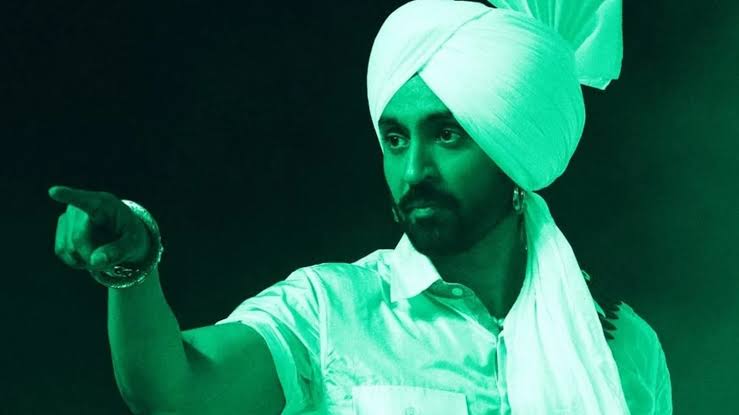
Diljit Dosanjh just can’t escape the online chaos that follows him, no matter how far the world-spanning music brings him. It happens with a predictable rhythm; just a few months pass before the social media algorithms heave another viral clip into public view suggesting the global Punjabi superstar harbors hidden sympathy for the Khalistan cause. More often than not, however, the claims are factually nonsensical. He’s suspended in this infuriating limbo where right-wing Indian outlets demonize him as a separatist, and actual separatist groups simultaneously threaten him for being insufficiently radical.
The allegations truly took off in late 2020 during the huge farmer’s protests that paralyzed India for months. Dosanjh vociferously supported the protesting farmers, providing money for essential supplies and spending days camping with them outside the capital in brutal cold. The immediate reaction was a firestorm of online campaigns painting him as a Khalistani – a label that latched on tight within online echo chambers.
He has never been demonstrably linked to any separatists; he just happened to align himself with a monumental protest that included a large contingent from his home state, Punjab.
Nuance tends to evaporate quickly online; a powerful narrative took hold and hasn’t let go since.
The Orchestrated Coachella Disinformation Campaign
It was April 2023. The Punjabi artist made history performing at the Coachella music festival in California, a momentous cultural milestone. Then, a highly edited snippet emerged on Twitter, shared by influential accounts that went viral instantly.
A short, disjointed clip showed a woman in the audience holding an Indian flag as Dosanjh spoke in Punjabi.
The accompanying captions asserted he’d chided the woman, even saying the music belonged to no country, and thus she was disrespecting the tricolor. The online outrage was swift and completely manufactured. He was labeled a traitor and demands to ban him from India flooded the internet.
The unedited footage and full transcripts later revealed the complete opposite. Dosanjh, upon seeing the Indian flag, had excitedly told the fan (whose identity was never revealed) that the performance was “for my Punjabi brothers and sisters” and was dedicated to “my nation.” He went on to add a generally positive statement about avoiding negativity and emphasizing music’s universal reach.
He was unequivocally embracing his heritage and dedicating his performance to India.
The fabricated clip served to fuel the already pre-existing narrative of him being anti-India.
Chaos Erupts During the North American 2026 Aura Tour
The tensions ratcheted up significantly during his massive 2026 North American Aura tour. A large show in Calgary was disrupted by a small contingent of protesters waving Khalistani flags and verbally harassing other concertgoers. Dosanjh halted the music mid-song, addressing the crowd directly and emphasizing that any disturbance would lead to removal.
He reiterated his intention to entertain fans and represent his culture, not espouse political agendas.
Such events are often flashpoints within diaspora communities where concerns about Khalistani extremist groups remain a significant security issue.
Following his response in Calgary, Sikhs for Justice, an organization often linked to the separatists, threatened further opposition. Their leader, Gurpatwant Singh Pannun, publicly warned of actions to disrupt Dosanjh’s upcoming shows in the United States, urging a boycott.
Just weeks later, in June 2026, a planned San Francisco stop at the Chase Center experienced an unprecedented breach. A lone Khalistani protester managed to bypass security and hop onto the stage directly alongside Dosanjh, dancing provocatively with a Khalistan flag. Dosanjh remained unflustered, calmly sidestepping as security quickly apprehended the individual, who was then handed over to local law enforcement. Unfazed, the singer did not miss a beat, resuming the performance immediately.
The Unlikely Amitabh Bachchan Backlash
This episode perfectly encapsulates the double-edged nature of the hate Dosanjh faces. The artist recently filmed an episode of Amitabh Bachchan’s popular quiz show “Kaun Banega Crorepati,” participating in a celebrity special aimed at raising funds for flood relief in Punjab. On set, Dosanjh paid the veteran actor a deep and traditional sign of respect by touching his feet.
Bachchan has been the target of relentless allegations for years from certain segments of the Sikh community in relation to the 1984 anti-Sikh riots, although he has consistently and firmly denied all such claims.
Still, the separatist elements disregard any denials or legal exonerations and immediately targeted Dosanjh for honoring Bachchan on national television.
Thus, the ironic situation stands: India’s nationalists label him a Khalistani based on intentionally manipulated video evidence. Meanwhile, active separatist movements vilify him for showing deference to an Indian film icon. He is ensnared in a conflict where no gesture seems to be the “correct” one for any faction.
Navigating the Treacherous Waters of Public Opinion
Dosanjh’s approach to this contentious environment is to speak directly from the stage, eschewing traditional political interviews. In a recent concert in Edmonton, a teenager in the crowd shouted a popular catchphrase, prompting Dosanjh to address the peculiar paradox of his public life. He told the assembled thousands that while back in India he’s called a Khalistani, whenever he tours Canada or the United States, the separatists accuse him of being an Indian operative.
He openly admits to receiving abuse from all sides and feeling adrift regarding where he’s supposed to stand.
Prior to his Indore concert, faced with protest threats, he cited the poet Rahat Indori: “Kisi ke baap ka Hindustan thodi hai” (This India doesn’t belong to anyone’s father), asserting his inherent right to belong.
The verifiable facts paint a portrait of an artist dedicated to elevating Punjabi culture and language globally. His appearances on international talk shows, like “The Tonight Show Starring Jimmy Fallon,” extend beyond music, involving meaningful dialogue and the educational dissemination of history, such as discussing the tragic 1914 Guru Nanak Jahaz incident. He leverage his massive social media presence to celebrate and promote his roots. Allegations of his pro-Khalistani inclinations remain demonstrably unfounded, suggesting he’s instead caught in a brutal crossfire between online agitators and fringe political extremists, each desperate to co-opt his enormous fame for their own agendas.