It should have been an easy celebration. Get degree, toss cap, take pictures with family. But for the 2026 class of NALSAR University of Law in Hyderabad, their upcoming convocation turned into a heavier subject. The students weren’t thrilled about having Chief Justice of India, Surya Kant, award them their degrees.
The story broke around the beginning of August. A bunch of soon-to-be lawyers, basically put their foot down. No stones thrown, no windows broken; instead, emails.
At least six formal complaints were written to the university, the first on July 23.
The support for these letters, ranging hundreds of students, apparently said, “We just don’t feel right receiving diplomas from a dignitary whose recent statements have clashed with everything we have spent years learning.”
The Spark in the Courtroom
This wasn’t a random grudge against the person with the most prestigious title in the judiciary. The animosity actually began within the hallowed walls of the Supreme Court.
On July 20, a large protest was organized in New Delhi that marched toward Parliament. The protesters alleged the police response was excessive and brutal. Two days later, a lawyer stood before a Supreme Court bench headed by Chief Justice Surya Kant and requested immediate, suo motu action from the bench-meaning, the court takes action without a lengthy process of a formal lawsuit. The lawyer then tried to present video evidence of alleged police brutality on the spot.
The bench refused, and in fact, it wasn’t just the refusal that aggravated the law students. It was what Chief Justice Surya Kant reportedly said after the offer to present the evidence. The Chief Justice allegedly stated that he “was not interested in videos” and that he “didn’t have time to watch” them, and told the lawyer to file a proper petition instead, further instructing the lawyer not to “waste our time and don’t waste your time.”
For students who spent their nights studying various case files and trying to grasp concepts like justice, human rights, and the role of courts to protect the rights of citizens, such words had quite a different impact. The NALSAR students conveyed this directly in their letters to the university: receiving degrees from a dignitary who was “indifferent to serious allegations of police brutalities against citizen protesters” just didn’t “sit right.”
The Pushback
The events rapidly escalated, and unexpectedly. The immediate retaliation against the students wasn’t from the university, but rather from the Bar Council of India (BCI), the regulatory body for the country’s legal profession.
On August 13, the BCI issued a decree that rocked many academic and professional circles. Led by chairman Manan Kumar Mishra, a letter was dispatched to NALSAR, ordering state bar councils to halt the enrollment of all 2026 graduates of the university. These students, only hours before about to start their careers in law, were effectively barred from being called to the bar.
But the BCI didn’t stop there. They also demanded that the university vice-chancellor investigate the issue and name names-identifying “who is being the originator of the proposal, who is drafting and who is campaigning for it”. Furthermore, the chairman went as far as calling it a case of “dirty politics”, attributing it to “groupism” among academic faculty “instigating the student community”.
The move was astounding. Entire careers were suspended over an expressed dissent to a chief guest. The reaction was swift, and even the president of the Supreme Court Bar Association, Vikas Singh (while stating that he personally did not support the students’ boycott), criticized the BCI’s directive as arbitrary and illegal.
Soon enough, hours after withdrawing the ban against the students’ enrollment, saying no student should be made to suffer “without any fault on his part”, the BCI held their ground and reaffirmed their decision to proceed with the inquiry on the origin of the protest.
The Chief Justice Responds
But the one person who unequivocally voiced criticism of the Bar Council’s actions was the Chief Justice himself.
On August 14, the Supreme Court officially addressed the situation. Chief Justice Surya Kant lambasted the BCI’s stance as “absolutely uncalled for.” “It is a dialogue between students and me,” the Chief Justice stated in court, “who are they (BCI) to interfere?”
He highlighted that it is the students’ right to hold a peaceful protest and that the Bar Council had no business interfering with it in such an aggressive manner.
He even invoked memories of his own student activism. The Supreme Court then stayed any disciplinary action against NALSAR students or faculty by the BCI.
A few days later, on August 17, Chief Justice Kant added another interesting development to the story; he claimed that he “had never consented” to the invitation from NALSAR, rendering the entire issue “moot”. “The question of me attending the convocation does not arise”, he said.
A Bigger Pattern?
The Bar Council incident is far from an isolated event. Other prominent events that he was expected to attend also seemingly got canceled around the same time, including the O.P. Jindal Global University law school’s convocation at the end of July.
Even a high-profile memorial lecture scheduled to be given in New Delhi was rescheduled abruptly.
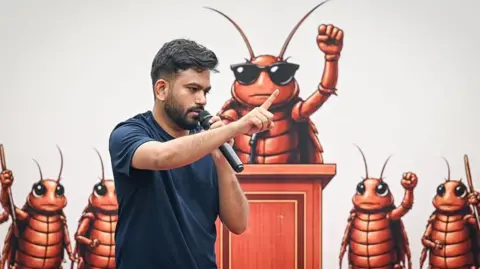
Additional controversies also surfaced, including prior remarks by the Chief Justice at some hearings calling people “parasites” and “cockroaches,” which had already sparked significant outrage.
What unfolded at NALSAR is far from being about just a single graduation or the response of a single court. It is about a current tension in the legal fraternity; the extent to which students who are learning the principles of constitutional law and justice will protest, even when it comes to being addressed by the Chief Justice of India. When they see inconsistencies between their education and the reality, they are proving to be quite vocal-even if it means telling him they don’t want their picture taken with their law degrees.