Introduction
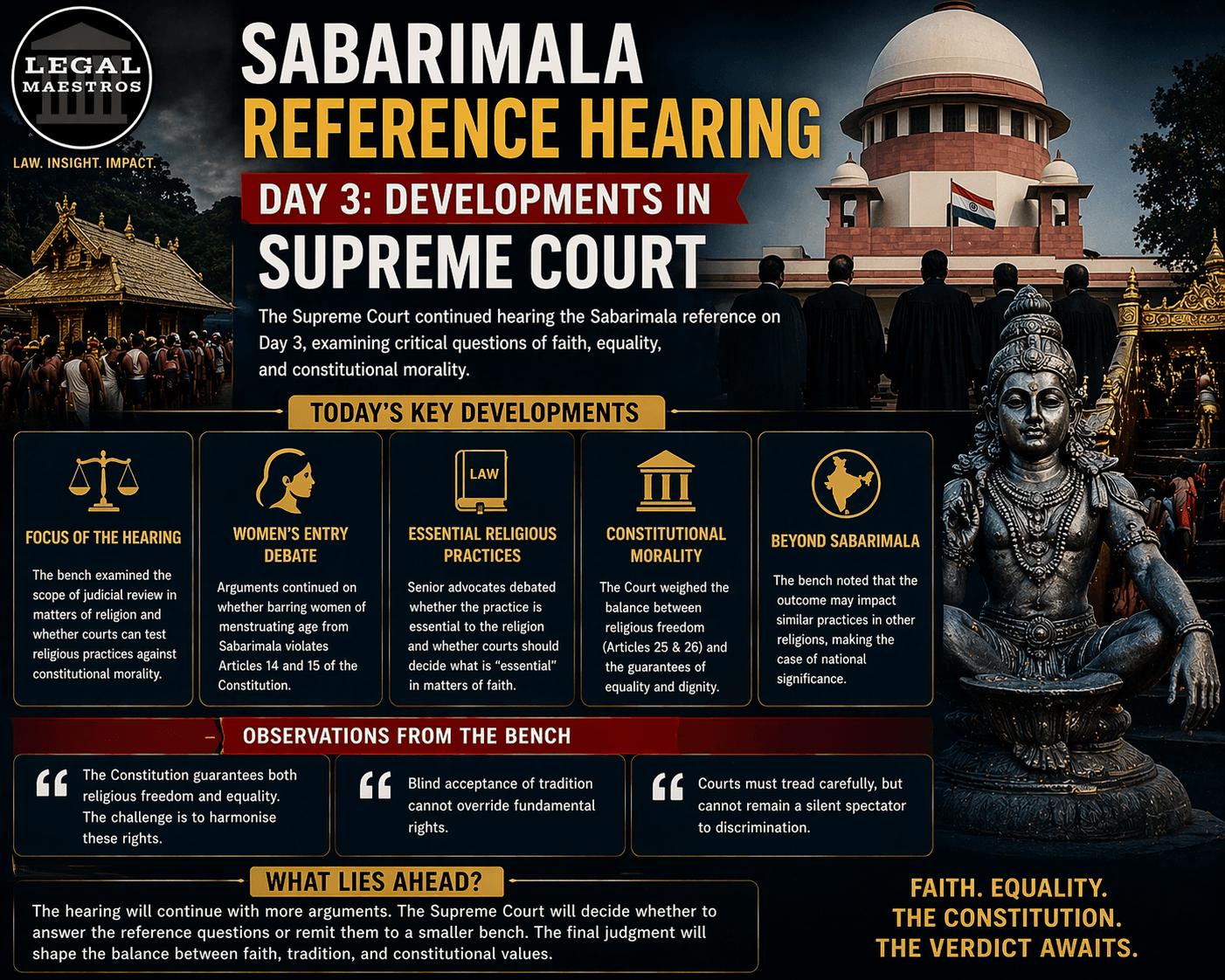
This time, we focus on the Supreme Court of India that is deliberating over the matters of the 2018 landmark verdict in Sabarimala. There is an increasingly rising debate that the Court can reconsider its previous decision that had granted women of any age entry into the Sabarimala Temple.
Background of the 2018 Judgment.
The Supreme Court in 2018 invalidated the ancient tradition that limited access of women of menstruating age (1050 years old) to the Sabarimala Temple. The Court believed that this exclusion was an infringement of basic rights, such as equality and religious freedom.
The ruling was regarded as a significant move to gender justice, yet it prompted numerous demonstrations and discussions nationwide.
Review Petitions and Still Debated.
After the 2018 decision, multiple review petitions were submitted against the decision. The petitioners presented the argument that the practice was a vital religious practice and should be safeguarded under the Constitution.
The Court has been looking at larger issues pertaining to the freedom of religion, what is necessary in terms of religion and how far the judiciary can interfere.
Key Legal Issues
The case brings up serious constitutional issues. These are the equality right to equality and the right to religion right to freedom, which are in Articles 14 and 25 respectively.
The other important question is that should courts meddle with religious practices that are said to be fundamental to a certain religion.
Potential to Review the Verdict.
Although the final ruling is yet to be settled, it has been observed in hearings that the Court might want to re-examine some of the points about the 2018 ruling.
Any shift in the judgment might possibly reinstate limits or re-characterize the assessment of such religious practices by constitutional law.
Broader Constitutional Impact
The decision of this case is expected to have far-reaching implication other than Sabarimala. It can shape the treatment of the cases of religious practices and gender privileges by the courts in other societies.
The ruling might also help define the extent of the doctrine of essential religious practices.
Social Reactions and Public.
This has always been a sensitive issue that has touched the deepest religious feelings and the strongest points of arguments of gender equality.
Any decision made by the Supreme Court will have a tremendous response among various sections of the society.
The potential rethinking of the Sabarimala judgment indicates the stalemate existing between tradition and constitutional values. The ultimate ruling of the Supreme Court will have an important role in determining the future of the Indian religious freedom and gender justice.
Keywords
Sabarimala case, Supreme Court of India, women entry temple, religious freedom India, Article 14 equality, Article 25 religion, constitutional law India, review petition, essential religious practice, legal news India.