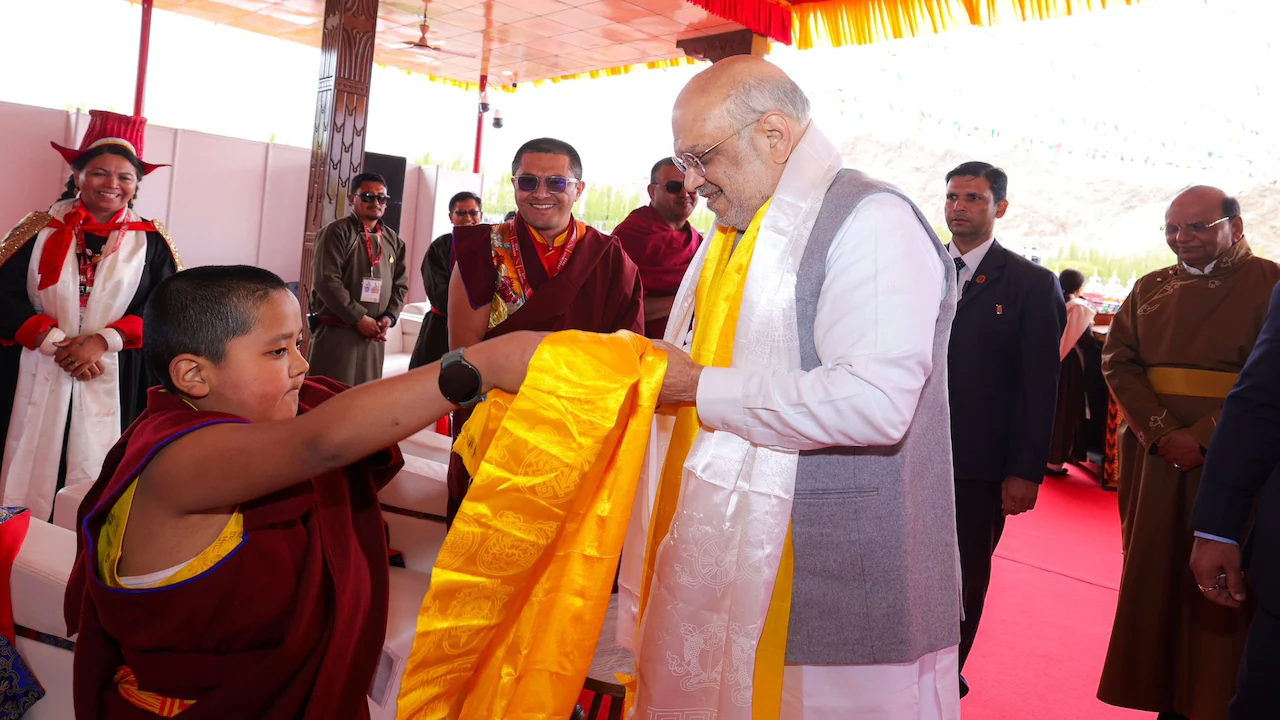
Political showers have finally begun to ease in the high altitudes desert of Ladakh. Union home minister Amit Shah recently completed a pivotal visit to Leh, with the view of eliminating an impasse for years. He met with key leaders and climate activist Sonam Wangchuk to reignite stalled dialogues. The meeting is being seen as a significant confidence-building measure by the central government. Authorities are getting ready for a formal sub-committee discussion May 22nd
The Call for an Open Mind
In the course of the discussions, the Home Minister demanded that all stakeholders come to the forthcoming talks with a “wide open mind.” The dialogue process was at a standstill late last year. Following a series of riotous street protests, trust was very low between the administration and local civil society groups. The New Delhi authorities are now attempting to change the entire narrative. They hope the Leh Apex Body and Kargil Democratic Alliance will present on table some viable and workable agenda.
The National Security Act in the Shadow of.
No one can speak of these talks without referring to the huge controversy involving them last autumn. The pact of ‘Ladakh’ soured as soon as the police arrested Wangchuk in September twenty twenty five. He was not only charged with commonplace public order offences. They resorted to the harsh provisions of the National Security Act to detain him. He was finally detained in the Jodhpur Central Jail in Rajasthan for almost six months.
Questions focus on the detention.Questions are directed at the detention.
The use of the NSA against a leading teacher and Ramon Magsaysay Award winner raised a lot of debates in the country. The law is essentially targeted at preventive detention in extreme cases where there is a serious threat to the country. Immediately, legal experts and activists were left wondering how a peaceful demand for statehood could be a national security threat. The government, at first, justified the action on the grounds of maintaining public order in the border area that was considered sensitive. They said that drastic steps were needed if there was to be any near mass protest.
The Supreme Court Intervention
The litigious dispute over his incarceration wound its way all the way up to the Supreme Court of the United States. Harsh actions by the central government brought Wangchuk’s wife to file a Habeas Corpus petition. The arguments before the Supreme Court drew fire from senior advocate Kapil Sibal, who lambasted the government’s line of thinking. He claimed the police used “outdated police reports” and “misinterpreted” the activist’s public speeches. Sibal said the state was attempting to suppress “real democratic opposition” with a “dreadful legal weapon.
The Revocation Order
Earlier this year it seemed the pressure from the courts finally got to the government. The ministry of home affairs suddenly changed its tune just days before the Supreme Court hearing. On the fourteenth of March they officially lifted the NSA detention order. The government wanted to promote a climate of peace and mutual confidence, the official press release said. The minimum for local leaders to come back to the negotiating table was walking Wangchuk out of the Jodhpur jail.
What are Core Demands?
The conflict in the area is about four unalterable demands of the local people. Ever since Ladakh was separated as a Union Territory in twenty nineteen, the people have been politically marginalized. They have asked for “full statehood” to enable them to have local legislative control. They also demand to be included immediately in the Sixth Schedule of the constitution. This particular clause grants special administrative safeguards for areas where the majority of the population is tribal in terms of land and employment.
Fears Over Land and Jobs
The concerns of the area have also mushroomed in recent years. Ladakhi youth fear that they will lose their jobs from the government to outsiders in absence of the old constitutional protection. There is also a profound concern that big business will enter into the picture and acquire the precarious high-altitude land. Environmentalists say that without proper management of industrial development the area’s fragile ecology will be lost. It is these raw, emotional issues that motivated thousands of people to go onto the streets in the first place.
The Remaining Two Demands
The civil society groups have two other significant demands other than statehood and the Sixth Schedule. They are strongly advocating for formation of a separate Public Service Commission for the region of Ladakh. This would make it easier to recruit people for local government jobs. Lastly, they want to be represented by two separate Parliamentary seats. At present, this vast region has a single MP in New Delhi.
The September Clashes
Last year’s breaking point for the administration was on Sept. 24. Leh saw serious street violence that resulted in the death of four civilians and more than 80 people were injured, including security forces. The local police completely lost control of the situation as thousands mobilized. Internet services were immediately suspended and tight measures put in place for enforcing the curfews over the entire district. The police rounded up dozens of young protesters along with Wangchuk after the violence.
This is a history of peaceful protests
Wangchuk had been reaching out to New Delhi for years in a non-violent manner until the eruption of violence. The man considered to be the inventor of the Ice Stupa technique had previously gone on numerous hunger strikes. He was able to endure a massive climate fast with cold open sky in January and February 2224. He often resorted to an appeal to the Prime Minister that would be posted all over social media platforms. He always sounded the alarm on the fact that the people were getting fed up with false promises from politicians.
The Administration’s Counter-Claims
The government lawyers presented a different view in court. They charged Wangchuk with “deliberate efforts to stir up younger protestors to riot. During his speeches he was inciting anger against aggressive foreign political movements, the Centre alleged. They said he was trying to organize a rally in the region where the Arab Spring started. The entire basis of his being slapped with the National Security Act was these particular allegations.
The September Clashes
The tipping point for the administration was on September 24th last year. Leh saw intense street violence resulting in four civilians and more than eighty people being injured, including security guards. The local police completely lost control of the situation as thousands mobilized. The administration had immediately instituted strict curfews in the district and cut off Internet connections. After the violence, dozens of young protesters were rounded up with Wangchuk.
A History of Peaceful Protests
Wangchuk had been working towards getting New Delhi’s attention non-violently for years before the violence erupted. The man who invented the “Ice Stupa” technique has gone on several extended hunger strikes. He has endured a giant twenty-one day fast in the open air under freezing temperatures in the early part of twenty twenty-four. His very direct requests to the Prime Minister often went viral on social media. He always cautioned against the citizens’ growing impatience with the failures of political promises.
The Administration’s Counter-Claims
The government attorneys presented a drastically different scenario during the trial. They claimed Wangchuk was actively encouraging younger protesters to take to the streets to riot. According to the Centre, he was stirring up anger with his speeches using aggressive foreign political movements. He was trying to stir up some of these border areas, they said, where they can easily stir up some kind of Arab Spring mobilization. Those were the only allegations that he was slapped with the National Security Act on.
The Buddha Purnima Background
Shah’s recent trip to the region was not strictly political in nature. The visit was a very important occasion for the local Buddhist community. He reached here to pay his reverence at the exposition of the Holy Relics of Lord Buddha, brought to Leh for a special two week exposition. The event was a huge cultural one that was an ideal backdrop for the government to try for a soft political reset. It gave the Home Minister an opportunity to meet the local people in a completely non-confrontational environment.
The Lieutenant Governor’s Announcement
Ladakh Lieutenant Governor Vinai Kumar Saxena opened the way for the forthcoming talks in May. He officially declared the resumption of dialogue just days before Shah was whizzing in on his plane to Leh. The Home Ministry is prepared to hold constructive and democratic discussions, Saxena said. Often he has pointed out that the desire is to secure a lasting solution that would reflect the aspirations of the Ladakhi people. The official statement was a sign that the central government was prepared to take steps to put the arrests behind them.
The twelfth day of May is also known as “Waiting for May Twenty-Second.”
The scheduled sub-committee meeting in the national capital now has all the eyes of the world on it. KDA and LAH are working on their draft proposals. They filed comprehensive documents late last year that explained in detail how the Sixth Schedule could be implemented locally. The earlier negotiations, last October and February, were totally unsuccessful. Both sides stood firm and would not budge.
This is the Stakes for New Delhi.This is the Stakes for New Delhi.
The central government is in a very difficult situation in these negotiations. If the statehood for Ladakh or Sixth Schedule status is granted it will create a precedent on a much bigger political scale. It may well lead to more similar demands from other U.T.’s throughout the country. But disregard of the demands could lead a very strategic border area back into complete unrest. The administration is in a tight spot, fighting a continuing insurgency on the actual line of control and needing to establish a stable local setting.
Tense Waiting Game
The street in Leh and Kargil is not yet too busy. To see if New Delhi is serious about concessions, the local population is waiting with bated breath. At the next meeting, there will be a decision as to whether the acts of good will are to be translated into concrete constitutional protections. A failure of the talks to reach a compromise could easily set the stage for another round of protests and harsh police crackdowns in the region. The fate of the high desert is totally uncertain now.