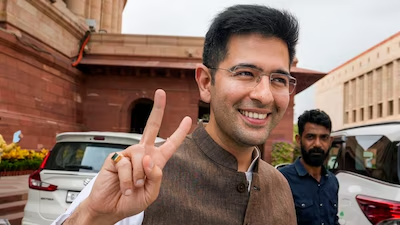
New Delhi has been in shock after a massive change in late April. 7 members of Aam Aadmi Party decided to break away from the association with Aam Aadmi Party. This is a high profile exit from the party ranks, led by Raghav Chadha and Sandeep Pathak. They soon joined hands with the Bharatiya Janata Party in the capital at a press conference. Naturally, this dramatic wave of departures has caused a lot of discussion as to whether there are rules that govern elected representatives. The shift dramatically reversed the balance of power in the upper house of parliament in an instant
The 10th Schedule of the Constitution
The Anti-Defection Law comes in the news every time there is a sudden change in government allegiance. The presence of this legal framework is in the Tenth Schedule of the Indian Constitution. The addition was originally made in 1985 by the forty-ninth amendment. The key objective was to prevent the wholesale change of heart among politicians for political or financial motives. During this period, in the late 1960s and 1970s, the usually stable state governments were frequently shaken by a series of frequent party changes
How the Disqualification Process Works
The basic principle of the existing legislation for any elected representative of a legislative body is pretty simple. A lawmaker who resigns from his or her party is disqualified for office upon resignation. The same strict punishment is reserved for those who do not vote according to the official “whip” set by their party’s leaders. You’re not allowed to walk over the line from one party symbol to the other the following morning having been elected. Political parties are required by law to retire from public office and have to be re-elected if they want to change their allegiance
The Magic Number: The Two Thirds Rule
The bill has, however, a very controversial loophole, which is intended to cover the true case of a change in political alignments. Legislators may change their party affiliation without losing seats if they state a formal party merger. The Tenth Schedule safeguards defectors in case ⅔ of the legislature’s party members agree to join another party. This particular percentage is the final line of defense for politicians seeking to take flight together. If the person doesn’t get that exact number, all the other people that defected out of the house.
This is a magic trick that uses SEVEN OUT OF TEN.This is a magic trick using seven out of 10.
The reason this latest political move made it past the first legal hurdle is the math, and that’s a key part of the equation. Prior to the split, Aam Aadmi Party had only 10 members in the Rajya Sabha. Chadha and Pathak were able to get the ball rolling and persuade five other colleagues to join them on the defection list. The defectors included big names such as former cricketer Harbhajan Singh and Swati Maliwal. This made their total of seven, which was more than the required two-thirds.
The Irony of the Private Member’s Bill
The whole episode is actually really interesting because of the actual threshold numbers. In fact, Raghav Chadha was in the Rajya Sabha and had been arguing that the existing defection rules were too lax, in August of 22. He tabled a Private Member Bill to make floor-crossing much more difficult to the elected representatives. His bill, which he suggested would be very similar to the legislation that passed the House, would require a three-fourths majority to pass instead of the two-thirds. If he had had his own bill it would have failed and he would have been disqualified the day it passed.
The Pitch for a Recall Mechanism
Worse yet, when examining Chadha’s previous parliamentary appearances. He even actively campaigned for Indian voters’ “Right to Recall” just two months prior to his change. He said people have the right to oust non-performing politicians even before their term is up. The Punjab Chief Minister now says the same thing to him. State leadership is calling on the federal government to have the ability to call back these particular MPs for violating their mandate in the election.
The Aam Aadmi Party’s Legal Fightback
The parent party is being very obnoxious about this parliamentary manoeuvre and is not the type to take it lying down. AAP chief Sanjay Singh promptly filed a formal petition calling for the disqualification of all seven rebel MPs, without any doubt.AAP leader Sanjay Singh immediately filed a formal petition for the disqualification of all seven rebel parliamentarians in a strict manner. The party says that there has to be a real merger, which cannot occur within the narrower confines of the parliament building. They say the original political party on the ground level must also formalize the merger with the other political party. As the AAP organization has not merged with anyone, the MPs have allegedly defected en masse.
The role of the Chairman of the Rajya Sabha.
The initial presiding officer of each house of the legislature is always the judge in any defection case. In this particular instance, the onus of the responsibility of running the Rajya Sabha was on the shoulders of the Chairman of Rajya Sabha, C.P. Radhakrishnan. The Chairman spoke swiftly and officially accepted the merger claim made by the faction headed by the Chadha This expeditious action protected the seven legislators from having to be immediately disqualified for being in violation of the law on the floor. The ruling by the Chairman effectively closed the door on AAP’s first parliamentary challenge.
Supreme Court Precedents on the Matter
The fight is very likely to go all the way to the higher courts – as the Chairman has given his blessing. In the recent past, the top court of India has been eyeing such googly political snags, particularly in the Maharashtra and Goa scenarios. The definition of an “original political party” versus a “legislature party” is a legal grey area that rotates around. But some previous decisions indicate that a presiding officer may not simply take the word of the defiant legislators. It is often up to the judges to decide whether the political party organization outside the house agreed to the sweeping move.
The Current Standoff and Harassment Claims
The situation on the ground has escalated far beyond simple legal arguments over constitutional paragraphs. The defecting leaders are now saying that the AAP government in Punjab is threatening them with severe political retribution. Chadha and Pathak recently took their grievances straight to President Droupadi Murmu in the first week of May. They filed a complaint to the government, saying the state agencies are actively attacking their businesses, families and properties. They cited the sudden pollution board raids, police cases, and water shut-offs at their homes.
A test of how well democratic structures are being instituted.
The other side strongly rejects these serious claims of state-sponsored harassment. The recent legal notices against the defectors are only routine administrative measures, according to AAP leaders. Both sides of the political ground are obviously preparing for a long, tough court battle. This case will eventually be decided by the higher courts whether this particular seven MPs used a loophole or violated the Constitution. The exact judicial ruling of this particular event will determine the conduct of parties in their internal rebellions for several years.
This is a legal analysis of the AAP defection fiasco.This is a legal dissection of the AAP defection fiasco.
This video includes a thorough constitutional analysis of the recent merger attempt and the interconnection with the Tenth Schedule and Supreme Court cases.
A closer look at the Anti Defection Law, Raghav Chaddha joins the BJP and Can 2/3 MPs Avoid Disqualification?
Vajiram and Ravi Official · 12K views