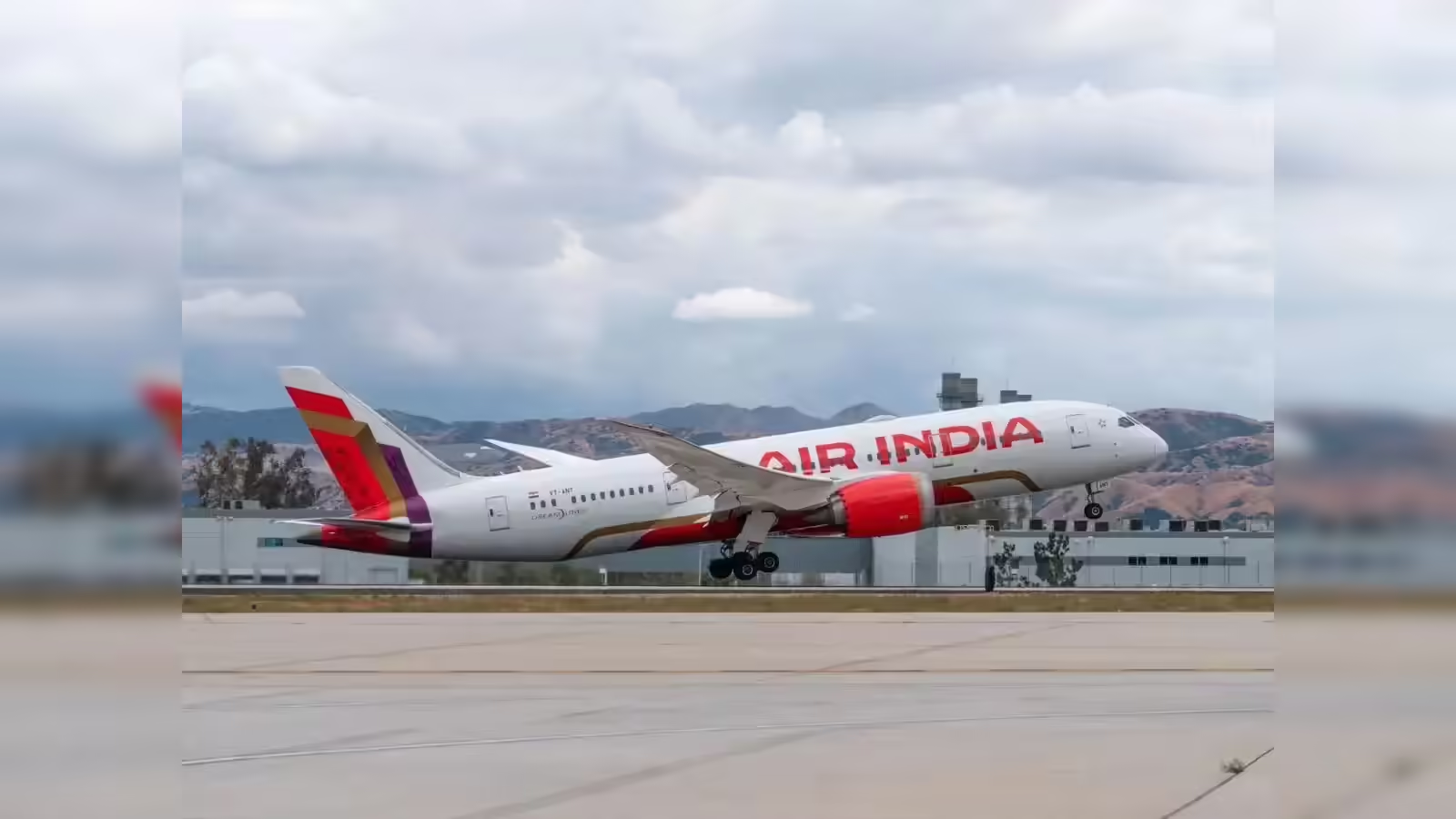
Following an international aviation disaster, there are intricate legal and financial issues to consider, as highlighted in the June 2025 crash of Air India Flight 171, a Boeing 787 Dreamliner that crashed shortly after takeoff from Ahmedabad.In the aftermath of an international aviation disaster, there are complex legal and financial questions to consider, as illustrated by the June 2025 Air India Flight 171 crash of a Boeing 787 Dreamliner shortly after takeoff from Ahmedabad (Sharma, n.d.). If an international air flight is involved in a catastrophic accident, there are a very clearly defined set of international treaties that will govern the process of liability, investigation, and compensation of the families of the victims
The Warsaw system: Historical Foundation.
The Warsaw Convention of 1929 was the first International Law for global control of civil aviation. It was the first comprehensive set of rules relating to international air carriage, and it required airlines to provide passenger tickets and to have a consistent procedure for complying with claims against carriers (Whalen, 2000). The main reason was to avoid the lawsuits driving the fledgling aviation industry bankrupt and to provide a minimum level of compensation for air passengers.
But the Warsaw Convention had set strict limits on what an airline could be held liable for in case of personal injury or death. For decades these arbitrary limits were bitterly attacked for lack of correlation with actual economic losses and contemporary standards of living, and led to a series of patchwork amendments, supplementary conventions and independent protocols, each of which was developed by a single country. (Jacobs, n.d.)
A summary of the Montreal Convention of 1999.Summary of the Montreal Convention of 1999.
In 1999, the Montreal Convention was adopted by the International Civil Aviation Organization (ICAO) to remedy a system of laws that is outdated and disjointed in Warsaw. This treaty literally revolutionised airline liability—it was replaced by an impartial, consumer-friendly approach to damage (Whalen, 2000).
The Montreal Convention provides for an updated two-stage liability regime in case of damage or loss of life to passengers on an international flight, including the passengers on Air India Flight 171.
Tier One (Strict Liability): In this category, the airline will be held liable for any actual damages it causes, up to a certain limit (around 151,880 Special Drawing Rights, or roughly ₹1.9 to ₹2 crore per passenger). The carrier has no right to challenge this obligation, or argue that it was completely at fault.
Tier Two (Unlimited Liability): When a victim’s family chooses to pursue damages over the amount allowed in Tier One, there is no limit on damages that can be awarded. The airline, however, can counter this argument by showing that the accident was not as a result of the airline’s negligence or that the accident was entirely caused by a third party, like an aircraft manufacturer or regulatory body.
Extended Jurisdictions and Broader Liability
The Montreal Convention also increased the number of jurisdictions in which a victim’s family may file a claim, provided that the airline has an office in that jurisdiction, and their claim is filed in their “permanent place of residence” as well as elsewhere. This means that during a disaster with multiple-country passengers, families won’t have to litigate in the country where the crisis took place.
The loss of life is the area of international aviation liability that is most obvious, but in law this also governs other aspects of the carriage contract and provides uniform rules for the delay, destruction, or loss of baggage or commercial cargo (Franks, 2006).
References
Franks, M. R. (2006). The responsibility of the airline in the case of loss or damage to an airline’s passenger bags or for airline delay. SSRN Electronic Journal. https://doi.org/10.2139/ssrn.937936
Cited by: 17
Jacobs, P. (n.d.). The economic analysis of liability rules for airline passengers’ accident insurance: The Warsaw Convention.
Cited by: 14
Sharma, S. (n.d.). Case Study of Air India Flight -171 crash.
Cited by: 1
Whalen, T. J. (2000). The new Warsaw Convention: The Montreal Convention. Air and Space Law, 25(1), 12–26. https://doi.org/10.54648/260365
Cited by: 52