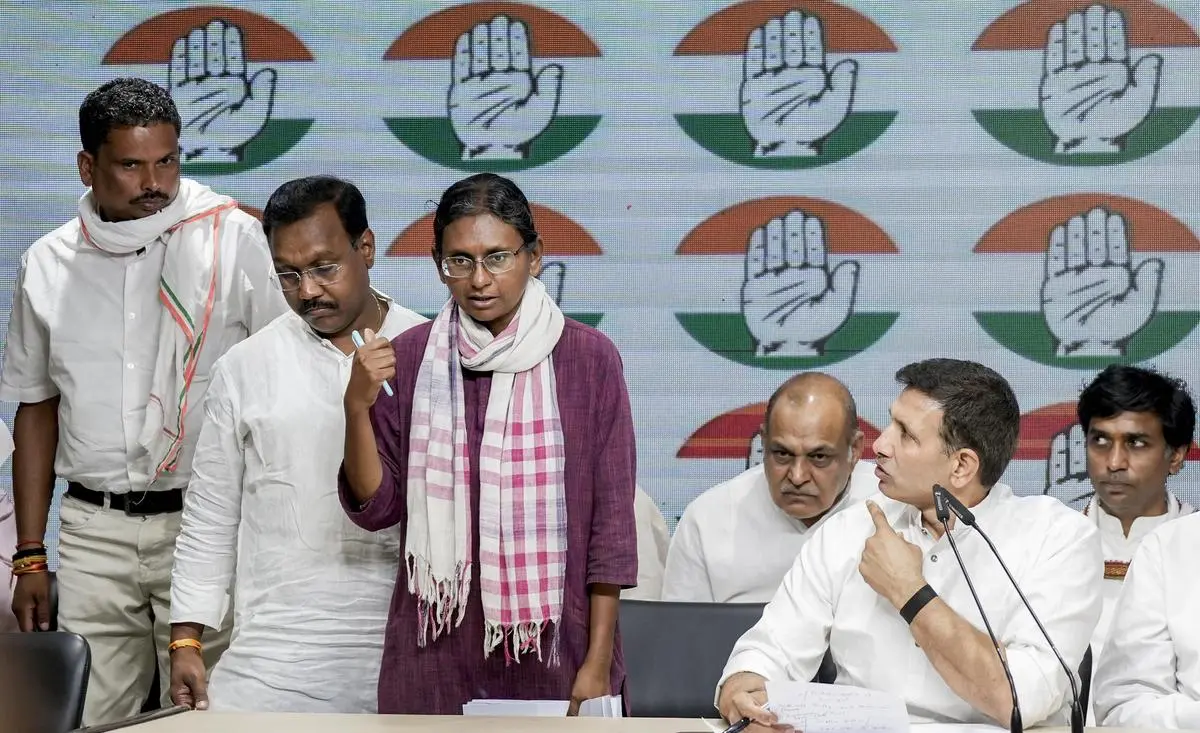
Congress’s Meenakshi Natarajan probably assumed her Rajya Sabha ticket from Madhya Pradesh would be mechanically sorted. It’s an unwritten rule of Indian politics that things will be chaotic, a given. But the paperwork-that is usually supposed to be the simple part of it. This time, it wasn’t.
A week ago, the Returning Officer firmly dismissed her nomination papers on a technicality that seemed minor to anyone not intimately involved in the system. She apparently hadn’t disclosed a pending criminal case in her Form 26 affidavit. Just like that, a powerful candidacy had been knocked out before any votes were cast.
What the undeclared case was all about would further highlight the almost absurdly technical nature of election proceedings. This was not some huge corruption case or even a crime involving physical violence. It was a private complaint filed in the lower courts of Hyderabad alleging sexual harassment and intimidation. But the crux of the allegations were focused on a completely different political figure and Natarajan’s role in it was ancillary; it was simply that she was the All India Congress Committee in-charge for Telangana at the time the complainant made certain representations.
The complainant only named her for being in charge, specifically because she was not taking swift enough action on the representations made by him to the party. That was her so-called offense; there was no criminal charge sheet filed by police nor charges framed by a court of law, simply an order of a private complaint taking cognisance and she was not the principal accused. And all of it culminated in her nomination being rejected.
The Section 33A tussle
So Abhishek Manu Singhvi, senior advocate, took the matter all the way to the Supreme Court and he placed his case mainly on Section 33A of the Representation of the People Act which states that every candidate shall disclose every case where the offense is punishable with imprisonment of two years or more; but this section contains a very specific condition, it further specifies that in this situation, a competent court shall have framed the charge.
Singhvi pressed this point repeatedly in front of the judges of the Supreme Court who looked very skeptical about it. The Hyderabad complaint had just about barely entered the criminal courts and how a candidate could be held accountable for non-disclosure of a charge that had not yet reached this specific stage is a thing he had argued is absolutely unacceptable.
The election authorities however, interpreted it very differently. They had argued that if the magistrate of Hyderabad had taken cognisance of the case and the summons had already been issued and Natarajan herself has appeared and filed a written statement for that case, there can be no argument in that count whatsoever, because if the candidate herself had received notice and responded to the notice. And the election authorities had argued the law demands that you disclose each and every case. There was no need to play judge and argue whether they should disclose it or not.
The Article 329(b) blockage
This is where Natarajan actually hit a constitutional wall as she was asked about the provisions of Article 329(b) of the Indian Constitution, which prevent constitutional courts from interfering in election proceedings; by Justice P.K. Mishra and Justice A.S. Chandurkar bench.
And that is how the whole saga should play out, you don’t go and halt elections under a writ petition when an election petition needs to be filed only after the entire process is complete; and this constitutional blockade for courts is intended to prevent every single election from being derailed, right from nominations through to polling results.
The law has always upheld that decision starting from the case of Ponnuswami and since then the law remains the same: there is no point approaching constitutional courts, after the entire election schedule begins under Article 32 or Article 226 for matters which are to be contested through an election petition later.
The “Glaring Error” Fallacy
Natarajan had actually tried to bypass this constitutional hurdle by claiming that the current rejection by the Returning Officer is a “glaring error”, since this rejection would make her nomination invalid, that her case was ex-facie illegal, and that interfering here would actually protect democracy, by not allowing for a sham election to proceed. The Supreme Court rejected that argument outright as it would require them to create two distinct classes of disputes-those with “glaring errors” that could be entertained during an election process, and regular disputes that had to wait. And if an order was plainly erroneous, it needed to have legal backing and precedence from the Supreme Court. Justice Mishra had specifically asked them for a precedence when the Supreme Court has interfered at any stage by way of ordering a re-instatement or for the review of a denied nomination during elections and there were none.
The arduous route of an election petition
Natarajan had one option at the end of it, and that was to file an election petition; this can only be done once the entire election process has concluded and the final result declared. The evidence will be presented, witnesses examined and in this entire process months of hearing in High Court will transpire with judges analyzing every aspect and decision made by the Returning Officer, and often there would be an order in favor of the politician years after the election term has ended anyway. Natarajan herself complained about the compromised officials involved and the unfair manner in which state lawyers appeared to contest her writ petition. At the end of the day, it is the Returning Officer or the ballot box that decides a candidate’s fate and every political hopeful learns the hard way.
Supreme Court rejects Natarajan’s Rajya Sabha nomination bid
This broadcast covers the politics, opposition stance and Election Commission’s stand on this nomination issue.


![JOB POST: Junior Associate at ASM Law Chambers, Jaipur [Freshers]](https://legalmaestros.com/wp-content/uploads/2025/11/Gemini_Generated_Image_8wrxer8wrxer8wrx.png)