Karnataka politics has been a hectic week so far. Three years after returning the Congress to power in a huge avalanche, it is Siddaramaiah who stepped down from the race. On Thursday, he made his way to Raj Bhavan, presented his resignation to Governor Thaawarchand Gehlot and put an end to his ongoing term as Chief Minister. Chairman of the party had given a very well planned cue to the move from Delhi. This was inevitable. In 2023, they did have a backroom power-sharing arrangement that was signed. Now the bill has come due
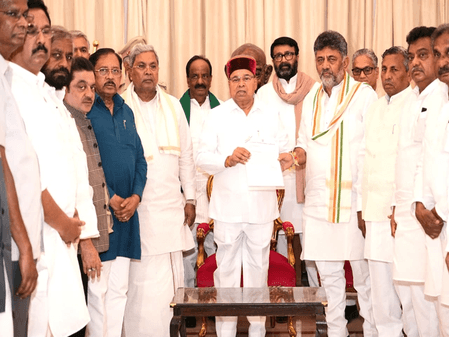
D.K. Shivakumar has finally got the top chair. He has been in the wings for some time as Deputy Chief Minister, handling state’s political crises and holding the flock together. It was official on Saturday. The Congress Legislature Party had reached Vidhana Soudha and without any dissentations, Shivakumar was elected as the new leader of the party. Shivakumar’s name was forwarded by Siddaramaiah himself. It was an elegant political transition cloaked in thick constitutional formality. Following that meeting, Shivakumar immediately went to the Governor to make his case. Gehlot verified the figures, and formally invited him to form the next government. The oath ceremony has been booked for the afternoon of June 3 at Lok Bhavan.
The story of Article 164 with your legalese removed!
But let’s take a look at what rulebook is propelling all this speed? This whole transformation is based on Article 164 of the Indian Constitution. The phrase is used by lawyers and politicians frequently in times of change. It may sound very complicated but it is actually very simple
The essence of article 164 is that it determines the mode of acquisition of a government in a state. The Governor shall appoint the Chief Minister, it says. Also, it provides for the appointment of the other ministers by the Governor subject to the recommendation of the Chief Minister. This implies that the Governor is not allowed to select any politicians at all to run departments. The list is submitted to the Governor for his official sanction by the selected Chief Minister.
Need Help With Your PhD or LLM Thesis?
Explore our thesis and dissertation writing support services for PhD and LLM students. Get subject-specific academic assistance for your research project.
Explore Our Services →On Friday Gehlot accepted Siddaramaiah’s resignation without issuing a blanket statement citing Article 164(1). The Governor accepted resignation of the Council of Ministers, which led to the automatic cancellation of the entire Council of Ministers with effect from the date of the resigned effective. The resignation of a government leader means the cabinet, which acts as a group, automatically loses its job. But a government without a head cannot function, however, even for a single day. So, to abide by the constitutional norms, Gehlot invited Siddaramaiah to remain and work as a caretaker Chief Minister till the new one takes the oath. It is a step that must be taken to avoid an administrative void.
The Governor’s Playbook in Action
Governors are a target of criticism a lot in Indian politics. They’re appointed by the central government and are in the states controlled by the opposition, leading to friction. However, in a clear majority government the role of the Governor is largely limited to ceremonial and procedural duties. In 2023, the Congress got a huge majority of 135. Even a couple of independent MLAs are supporting them.
The numbers are indisputable, so Gehlot didn’t have to apply any of his discretionary powers to determine who should govern. Shivakumar entered the meeting with a letter that he had that majority had signed. Gehlot read out the letter and confirmed the election of the new Congress Legislature Party leader, and gave the official invitation. It was the textbook doing of the constitutional tasks
Collective Responsibility and the New Cabinet
There’s another very significant nugget in Article 164. Requires the Council of Ministers to be collectively responsible to the Legislative Assembly. The government lives only so long as it has the support of the house. They lose a trust vote, the whole cabinet goes.
It’s a collective responsibility for which the backroom talks in Delhi are so intense right now. Shivakumar and Siddaramaiah immediately dashed to meet Mallikarjun Kharge, Rahul Gandhi and Sonia Gandhi at 10 Janpath. They aren’t only selecting who can become a minister. They need to create a cabinet that is able to satisfy all the diverse groups, castes, and factions. It’s a nightmare to please 135 MLAs. There are reports that a number of the outgoing ministers will be dumped. The party is even mulling on appointing up to four new Deputy Chief Ministers in order to even up the social balance across the state. Each and every one of those names on that final list that the Governor was given under Article 164 has to be considered carefully so that no one decides to throw in the towel and threaten the majority.
A Power Sharing Formula Comes Full Circle
This is a very unusual turnaround. It is where massive scams, lost elections or brutal rebellions within the MLAs, who are locked up in luxury resorts, are the usual reasons for the government to lose leaders like Chief Ministers. The changeover was actually peaceful. From the beginning it was a part of the party’s plan. Siddaramaiah received first 3 years. But now Shivakumar is getting the other two years to wait for the next big electoral cycle.
Even though Siddaramaiah’s hands are strong on administration and enjoys huge popularity, he has acted according to Kharge and the Gandhis’ directions without raising a hue and cry. He told the press that the constitution is his religion, and that he just thanked the people for entrusting him to a second term. In the meantime, Shivakumar wins the prize he has been yearning for for years. He led the charge to the win in 2023 and faced strong political pressure. Now, all he has to do is wait a bit longer until the 3rd of June, when he will take the constitutional oath of office before his presidency
Video of the Governor meeting DK Shivakumar, and him staking his claim to form the government in Karnataka has been made exclusive here.
The clip shows the actual constitutional process of the majority letters of D.K. Shivakumar being handed over to the Governor Gehlot at Raj Bhavan, before he is sworn in.