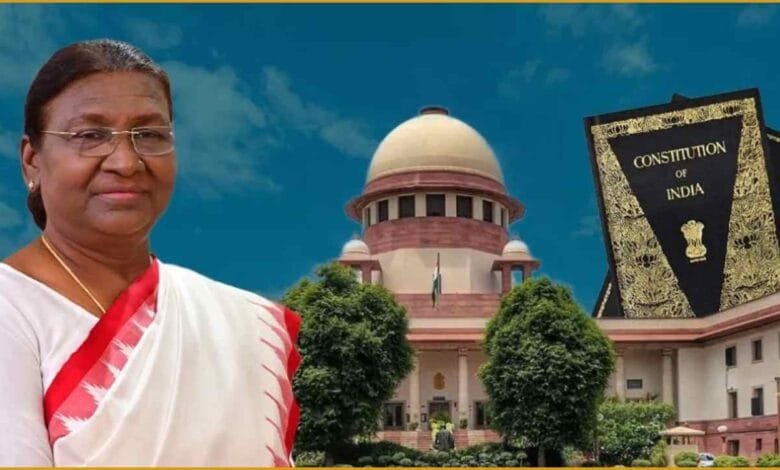
Hon’ble President Droupadi Murmu framed a constitutional reference directed towards Supreme
court under through the power given to her by Article 143, this reference came after the uncertainty
created by the Supreme Court’s Judgment dated April 8, 2025 State of Tamil Nadu v. Governor of
Tamil Nadu. This reference was called as a “Functional reference” by the Apex court because it
strikes at the root of Constitution’s federal character.
II. The 14 questions framed and the legal background of the reference
The April 2025 State of Tamil Nadu v. Governor of Tamil Nadu case (2-judge bench) had created
Need Help With Your PhD or LLM Thesis?
Explore our thesis and dissertation writing support services for PhD and LLM students. Get subject-specific academic assistance for your research project.
Explore Our Services →several questions regarding the Governor’s assent to state bills; both states and intervenors felt
confusion in its wake. In May 2025 the President noted (via Art.143) conflicting precedents on Article
201 justiciability, widespread use of Art.32 in federal disputes, lack of timelines, and the alien notion
of “deemed assent”. These vacuums in the constitutional procedures and no clear precedent of the
Apex Court on the same prompted the reference.
The President posed fourteen questions about Art.200/201 and related powers, Including:
The Governor’s options under Art.200 (assent, withhold, reserve, return) and whether he is
bound by ministers’ advice;
Whether governor’s (Art.200) or presidential (Art.201) discretion is justiciable;
Whether Art.361 immunity bars review;
If courts can impose timelines for assent in absence of constitutional limits;
If judicial review of a Bill’s content is allowed before it becomes law;
If Art.142 can be used to substitute executive action or create “deemed assent”;
Whether a state law can operate without Governor’s assent (deemed assent);
And lastly procedural queries on bench-composition (Art.145(3)) and SC jurisdiction (beyond
Art.131).
III. Arguments on Maintainability
Against Maintainability: Various Counsel for the States argued that the Court should decline
or invalidate the reference entirely because the reference was impermissible: since the
issues which are raised in the reference are conclusively determined in the State of Tamil
Nadu v. Governor of Tamil Nadu ruling, moreover States argued that this reference was a
review or appeal in disguise to nullify and alter the precedent established in the
abovementioned case.
For Maintainability: The Solicitor General Countered these arguments by the Counsel for
the States and argued that the questions framed by the president seeks clarification on
Constitutional principles and is not nullify or alter any precedent of this court. Court
accepted this view and also stated that to think that this reference is a appeal or review in
disguise in a leap and that this court is bound to answer any question of law asked by the
President. Court also noted that the questions do not compel alteration of the TN
judgment’s relief but merely ask for wider clarification “beyond the parties”. It held that it
was permissible to examine and even refine earlier legal propositions without acting in
appellate or review jurisdiction.
IV. Supreme Court’s Interpretive Approach
The Court adopted a textual structed approach to approach this reference in approach that
is based on the ethos of the Indian Constitution. The Court also rejected the Foreign models
adopted in USA and other democracies and highlighted that they will base their view on
truly swadeshi model. The Judge’s examined the Constitution’s grammar and design: for
example, The substantive part of Article 200 which employs three verbs that indicate the
options of the Governor which are to assent, withhold, and reserve a bill and the proviso of
the same article were given weigh rather than implied reading of the Constitution. Where
two meaning were possible, the Court preferred the one which preserved inter branch
dialogue between the Assembly’s message and the Governor’s advice rather than expanding
unilateral executive power. Federalism as a basic structure of the Constitution guided these
interpretations; the Court emphasised on harmonious “cooperative federalism”, requiring
Union and State to work together avoiding Constitutional Discord between each other.
Overall, the analysis blended textual (words/structure of Articles) and purposive
(constitutional values of federal balance, democracy) methods.
V. Governor’s Powers under Article 200
Constitutional Options: The Court highlighted that the Governor has three options
(upon presentation of a bill): to assent, to reserve for President, or to withhold and
return it with comments. The first proviso does not create a fourth separate option
but merely establishes a limit on the power of Governor to withhold-return to a non-
Money Bill (Money Bills must be either assented or reserved).
Discretion vs. Advice: The Governor enjoys real discretion in choosing among these
options. He is not bound to act on the Council of Ministers’ advice under Article 200
because binding the Governor to ministerial advice could render the reserve/return
options moot.
Justiciability: The Court highlighted that they cannot review whether the
Governor’s action under Article 200 are non-justiciable on merits that whether it was
a correct choice or not in good faith. However, in cases of prolonged inaction (a
Governor simply failing to decide indefinitely), the Court may issue a limited
mandamus directing Governor to exercise his duty within a reasonable time. This is
limited form of supervision: the Court may take action to ensure that Governor takes
some kind of action.
Personal Immunity: The Court reiterated that the immunity granted to the Governor
under Article 361 gives him personal immunity that he can’t be sued or bound in a
court for his decision. This however doesn’t bar the Court to take compel action on
the inaction of the Governor in cases of prolonged delays in bills presented to him. In
total, while the Governor is answerable to no one on the substance of his
assent/withholding of bills, his office remains subject to constitutional checks if he
abdicates responsibility.
VI. President’s Powers under Article 201
Discretion and Timelines: By analogy with the Governor, the President’s exercise of
discretionary assent (Art.201) is likewise not a subject of Judicial review on the merits
of it. The Court held the President cannot be ordered to grant or withhold assent by
deadline; no judicially prescribed timeline can bind him in the absence of a
constitutional one.
Reference Under Art.143: Importantly, the Court clarified that the President is not
obliged to seek the Supreme Court’s opinion whenever a Governor reserves a bill. His
subjective satisfaction suffices for assent. The President may seek advice by reference
only if he deems it necessary. In practice, advice has been sought on some reserved
bills, but this is discretionary, not mandatory practise which President is bound to do.
VII. Justiciability, Deemed Assent, and Judicial Review
No Pre-enactment Review: The Court conclusively held that the court cannot
entertain challenges which pertains to what a bill has in it before it becomes a law.
The decisions of the Governor or President are not justiciable in the precursor stage
and the judicial review of the decision is limited to the form and the timing of the
assent by the Governor, not the policy substance of it. In opposition to this the post-
assent laws can be challenged on the ground that they’re unconstitutional, but only
on its face not on procedural discretion.
Deemed Assent Doctrine: Both the pleadings in reference and the judgment rejects
any notion of deemed assent. A state law cannot be made operative unless it has been
assented by the Governor. Moreover, there is no scenario in which a bill becomes a
law automatically due to silence or lapse, regardless of assembly dissolution. The
Court barred the use of Article 142 to create a notion of deemed assent remedy.
Article 361 Immunity and consequences: Article 361’s immunity bars subjecting
the Governor or President to legal process, but it does not insulate them from the
Court’s limited power to enforce timely action. The judgment relied on Rameshwar
Prasad (1981) to note that Article 361 does not preclude courts from examining
executive action or inaction.
VIII. Opinion and Commentary
There are concerns about the institutional consequences of this Judgment. There are
argument regarding the Apex Court while preserving the constitutional balance, has
clearly expanded its discretionary power. With vague standards on what constitutes
undue delay, the Court now will potentially act as a constant arbitrator between the
States and the Governors. This may transform the Court into quasi-political
adjudicator in the state-centre legislative standoffs. The practical effect of this review
judgment will be that the states will increasingly approach the Court for relief in
stalled legislation, granting judiciary an informal gatekeeping role over federal
process of legislation.
IX. Conclusion
Presidential Reference No.1 of 2025 is a landmark advisory opinion that clarifies the
contours of governor’s and presidential assent within India’s constitutional order. By
reaffirming the textual limits of Articles 200 and 201, the Court has sought to
harmonize executive discretion with legislative intent and federal principles. The
judgment’s guidance will resonate in state legislatures, executive offices, and courts,
shaping the law of assent and the practice of cooperative federalism for years to come.