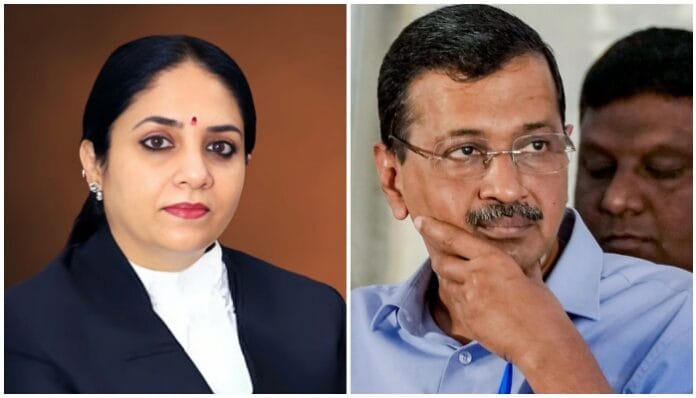
Delhi High Court Justice Swarana Kanta Sharma made a colossal ruling yesterday. She categorically denied that she would recuse herself in listening to the high profile liquor policy case against former Delhi Chief Minister, Arvind Kejriwal. To people who were following the drama, Kejriwal and a number of other Aam Aadmi Party leaders had submitted pleas requesting the judge to recuse herself.
They argued that they had a good fear of discrimination. Justice Sharma was having none of it. She shot down the applications during a pronouncement which lasted more than an hour on Monday, April 20. She made it quite clear that a litigant cannot easily make judgment on a judge without material evidence
A withdrawal in her part would really be to submit to pressure. And justice, herself, is not pressed into service. The root of this problem lies in the fact that the Central Bureau of Investigation appealed to the court against the ruling of the trial court to release Kejriwal and 22 other individuals in the alleged conspiracy in the excise policy. This fell on the desk of Justice Sharma. The AAP camp sought to have her removed almost immediately, in the hearings.
The Catch-22 Dilemma
The decision was an easy read. Justice Sharma could not hear the plea. She made the time to break down the story constructed around it. She termed the whole situation as a typical Catch-22 on the side of the court, but an otherwise convenient win-win on the side of Kejriwal. Her reasoning was simple. In case she chose to resign, the camp of Kejriwal would then argue that they were correct in their accusations of prejudice. In case she had remained on the case and later ruled against him, they could just claim that they had guessed it was going to happen so early since the court was biased
This was the strategy that the judge could see through. She noted that a court embarking on writing recusal judgments simply because a formidable litigant has developed a media story is a dangerous precedent
. The citizens may even begin to think that judges are partisan to this or that political ideology simply because that is what a politician claims. When she clearly stated that this should not be permitted because it would be like opening the floodgates to anyone to criticize judges and their families whenever they fail to win a case. It would be absolute failure of duty to her yielding to unfounded suspicions.
The Source of the Dispute and Family Relations.
And what was it that caused Kejriwal to demand a new judge? He essentially raised two key points in his marathon arguments earlier this month. First, he was pointing a finger to the children of Justice Sharma. He pointed out that her son and daughter are both now empanelled as Central Government Counsel. Because the CBI is a central agency, Kejriwal claimed that this gave an outright and grave impression of a conflict of interest. The second concern was on her attendance to some events
Kejriwal observed that during the years 2022-2025 Justice Sharma had participated in functions held by the Akhil Bharatiya Adhivakta Parishad. He claimed that this organization adheres to an ideology that was completely the opposite of what his own party believes in and her involvement was a possible indication of a hidden ideological prejudice. He further told that she had issued negative notices against AAP leaders in the past, such as Manish Sisodia and K Kavitha, without any relief being given to them ever. The deck seemed stacked to him.
Fighting Back When Attacked Personally.
Justice Sharma tackled both of these accusations head-on, and she did not mince her words. She dismissed the implication as completely baseless when dealing with the problem of her children becoming government lawyers. She argued that just because a judge takes an oath of office, it doesn’t mean their family members have to give up their fundamental rights to practice law and succeed in their chosen profession. She even made a political analogy
She would say why it is so agreeable that the spouses and children of politicians should join politics but at the same time it is not agreeable that the children of a judge join the legal profession and find it hard to assert and prove themselves just like others. In the case of the Adhivakta Parishad, she explained that she was present there on zero political grounds. She described how judges are often called upon to address legal programs, meet with students or come to Women Day events. There are numerous judges in the country who are involved in their functions. She emphasized that attending a legal seminar can not turn into a weapon to suggest the ideological bias at once. She reminded them all that the competence of a judge is determined by the courts that are above him and not by a politician who is in the courtroom attempting to overstep.
The Battle is brought to the Supreme Court.
The legal battle is not over yet, as the High Court door to the recusal request was closed. The Aam Aadmi Party has already indicated that they are not giving up the issue. They are even getting ready to go directly to the Supreme Court. The law firm acting on behalf of Kejriwal will most likely petition the court over the action of Justice Sharma to refuse stepping down
. They will carry with them the same arguments about the perceived conflict of interest and the semblance of bias to the supreme court in the nation. Meanwhile, the CBI is also straining to go forward with their appeal of the discharge order of the trial court. The agency had seriously contended against the petition of recusal by Kejriwal at the inception itself terming it frivolous and vexatious and an attempt to tarnish the dignities of the High Court. They contended that in the event that the line of reasoning was extended to Kejriwal, all the judges who had ever made adverse decisions against an AAP leader would have to recuse themselves.
Whether the personal fear of prejudice by a litigant is sufficient to disqualify a judge in a case or whether the Supreme Court was justified in resisting what it called a media-cataract narrative, is an issue that the Supreme Court is soon to resolve. It will be up to the next few weeks to see who will hear the merits of the case on the excise policy.