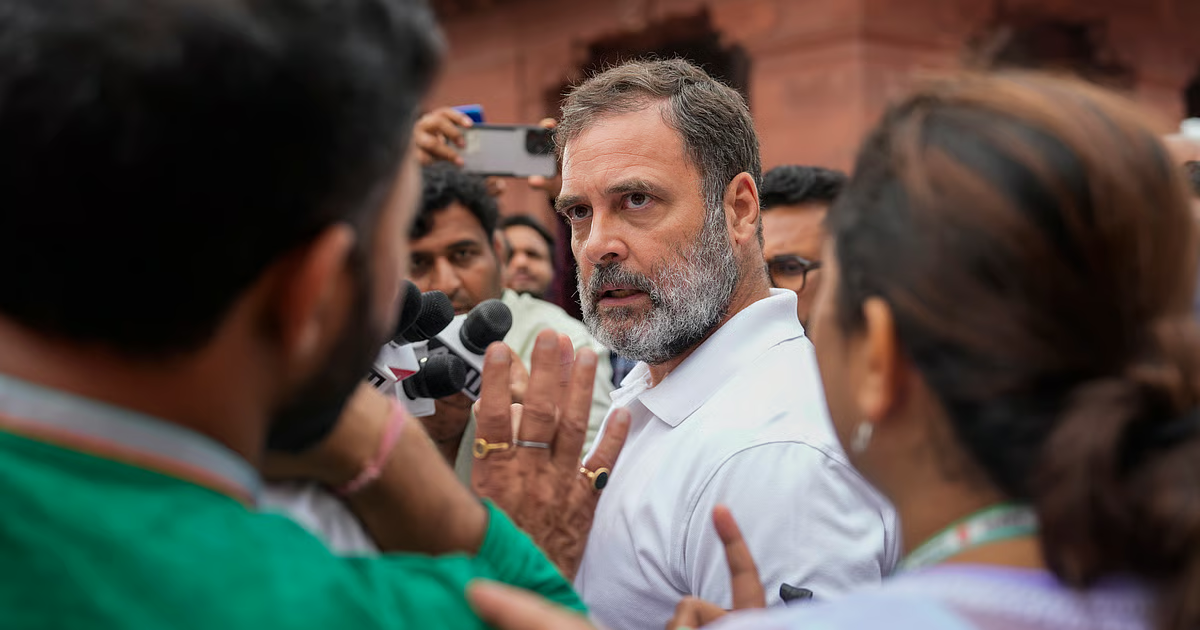
The court battle against Congress leader Rahul Gandhi due to his alleged dual citizenship has taken a gigantic setback. It was a scene of drama in the Lucknow Bench of the Allahabad High Court on Monday, April 20, 2026. The judge who was dealing with the high-profile case, Justice Subhas Vidyarthi, stepped out of the case wholesomely. He did not just recuse himself. He openly expressed regret for ever taking up the matter in the first place
This abrupt departure was not in any way connected to the true charges on Gandhi. The thing was that it was all what occurred outside the courtroom. The petitioner, a BJP worker of Karnataka, was a man called S. Vignesh Shishir, with whom the judge took a very tough stand on a row of controversial posts, which he had posted on social media. This twist of fate will see the whole legal procedure in a big delay as a new bench will have to be appointed to put the pieces together.
The Open Court Drama and the Unsigned Order.
You must go back to what occurred three days ago, to see why the judge was so angry. Friday, April 17.–Justice Vidyarthi gave an order on open bench. He ordered the Uttar Pradesh Police to file a First Information Report against the Leader of the Opposition. It appeared to be a great legal triumph on the side of the petitioner.
And there was a proviso. That order did not even get signed by the judge.
Justice Vidyarthi, before the formal document could be typed and completed by the court staff, came to the realization that there was a significant procedural mistake that had been made. The court was bound by a legal precedent of a prior Full Bench judgment that it had to give a notice to the intended accused before an FIR could be ordered under such revision proceedings
. In simple terms, Gandhi was within the law to have an opportunity to be heard by the police before they could give an order to prosecute him. The judge realized this legal hitch and stopped the order. On April 18, the court posted a two-page document clarifying what had happened and postponed the final decision to Monday, April 20, in order to have the question of sending a notice debated properly.
The Online Posts by Social Media Overstep.
The petitioner was not pleased with this procedural delay. Shishir also engaged in other social media and interviewed digital media outlets over the weekend. He claimed there was “foul play” involved in the court’s decision to hold back the FIR order. He even began to seek the opinion of the people on whether he should proceed to fight the case before this particular judge. He even tried to involve Chief Justice of India in the controversy by tagging his office online
Justice Vidyarthi was enraged when the court resumed on Monday. He was responding to the social media action on the spot. The judge observed that the messages raised serious doubts about the integrity of the court. He slammed the BJP worker for trying to use the judiciary for political mileage.
The courtroom had some very direct questions asked by the judge. He inquired how it was right to pour mud behind the court. He raised doubts about what was being said in the media asserting that the petitioner was attempting to use the court as his political platform. He clarified that a court does not require popular approval or Twitter surveys to operate. Observing that Shishir had made a public statement of a loss of confidence in the bench, Justice Vidyarthi said that it was extremely inappropriate that the case should be heard any more.
Attorneys Under Fire.
The petitioner was not the only one to undergo the wrath of the bench. The lawyers in the courtroom were also dragged in their way because of how they dealt with the situation. Justice Vidyarthi was highly disappointed over the government advocates and the Deputy Solicitor General of India.
This was a glaring failure on their part, pointed out by the judge. In the protracted hearings that culminated in the order of dictation on April 17 none of the attorneys had ever told the court the proper legal stance on the issue of the obligatory notice. They were spectators as the court nearly flouted one of the most basic legal stipulations.
Justice Vidyarthi did not mince words. He noted in his oral statements that the lawyers appearing in the case completely failed to perform their basic duty. They were also expected to offer just and correct legal services to the bench and they merely failed to do so. The state government counsel as well as the lawyers of the central government later had to admit in the court that the social media posts made by Shishir were beyond defense. Shishir attempted to claim that his posts to the internet were targeted at those individuals that were putting pressure on him to dismiss the case, not the court. The judge did not believe the explanation.
The Next Step in the Citizenship Row.
The case itself can be characterized by some grave accusations going back more than twenty years. Shishir had initially addressed a special MP/MLA court in Lucknow in January 2026, which refused to hear the plea. Thereafter, he transferred the High Court. His petition seeks an FIR on various weighty laws which include Bharatiya Nyaya Sanhita, the Official secrets act, the foreigners act and the passport act.
The accusations are that Gandhi was a British citizen and a company called Backops Ltd registered in the UK in August 2003 was associated with him. The petitioner claims that Gandhi voluntarily declared his nationality as British, having a Director Identification ID and addresses in London and Hampshire. This nationality was supposedly listed in annual returns in October 2005 and 2006, prior to the company dissolving in February 2009. In previous hearings, the bench had questioned the Centre regarding any action on these grievances and even ordered the production of records by the Union Ministry of Home Affairs, but the court decided not to look at these records at present.
Everything is now on a hard pause. Justice Vidyarthi has forwarded the file to the Chief Justice of the Uttar Pradesh High Court by recusing himself. To examine the case afresh, the Chief Justice will need to appoint an entirely new judge. Government advocates believe that such a procedural change will probably introduce a ten to twenty-day delay. There will be a need to consider the matter of the issuance of a notice to Gandhi to the new bench first before the discussion of an FIR can continue. The legal process is completely frozen until the time the new judge comes into office.