It is a long time to live out of a suitcase, three years. However, the nightmare which began in May 2023 did not stop in Manipur at all, in the eyes of tens of thousands of people. A high court order of controversial tribal status at the time triggered a series of ethnic conflicts between the Meitei and Kuki-Zo people. It is April 2026 and the northeastern state is not extinguished. The number of dead was estimated to be more than 260. Approximately 60,000 people are left displaced, and are left with no place to go by being stuck in relief camps.
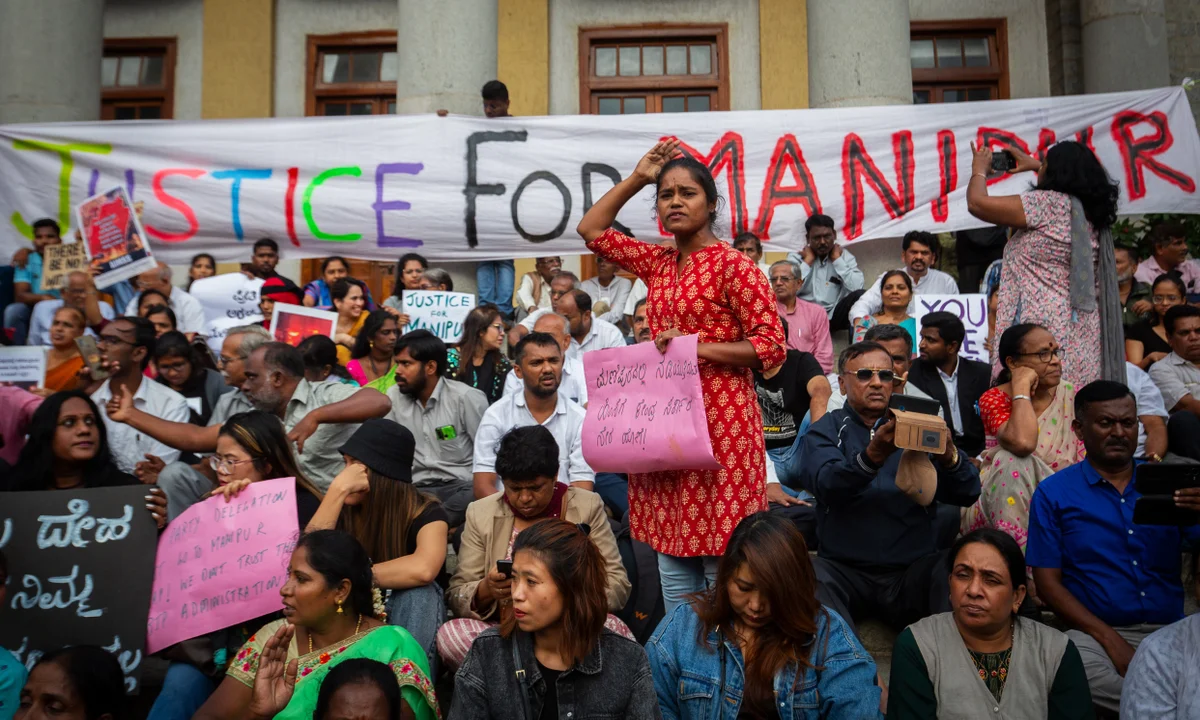
The violence has evolved, but it hasn’t stopped. On April 7, a boy aged five and a six-month-old sister died in a bomb attack in Bishnupor district when they were asleep. Protests erupted immediately. The demonstrators flocked a local paramilitary camp where security forces fired and killed three protestors. Curfews returned. The internet blackouts were imposed again in various districts
The cycle of death, protests, and state clampdowns was repeated, which bore a disturbingly similar resemblance to the initial outbreaks of 2023. This is a timeless mess which brings up a serious legal issue. In case, a local war has dragged on for 36 months, and lives and property are ruined on a large scale, whom is the legal liability on? The state apparatus is indicated by legal experts, civil rights movements and independent tribunals.
A Failure to perform basic constitutional responsibilities.
Article 21 of the Constitution provides every citizen in India the right to life and personal liberty. This right is non-negotiable as a responsibility of the state. In Manipur, the state was a failure. It has not succeeded in the initial stages of the war and it is not succeeding even now. In August 2025, an Independent People Tribunal published a report which described the systemic nature of the unrest. The evidence and witness testimony were examined by the jury, and in the end, it was declared that the violence was not an outburst. State failures facilitated it directly, were planned and targeted
Inaction is the fundamental reason why there is a responsibility of the state. Government officials were greatly condemned to underestimate the initial violence and failure to take any tangible steps to implement the rule of law. Radical groups were working with virtually impunity. A state government should be objective in defusing tensions of ethnicity. Rather, the political and administrative apparatus in Manipur was charged with standing idle, letting a local conflict to escalate into a humanitarian emergency. When houses are burnt down and the whole area is ethnically cleansed in the presence of the law enforcement, the government is legally accountable of the loss of life and property that will occur.
With Law Enforcement Becoming Part of the Problem.
The state of affairs is even more gloomy when considering the role of the police. The responsibility of states does not lie only in the failure of the state to do something. It also entails the actual actions of government agents. In the first riots, crowds invaded police armories and stole thousands of guns. Records indicate that more than 6,000 advanced guns and lakhs of rounds of ammunition were stolen. By the beginning of 2026, the state has been able to restore only a portion of them
Nothing can function as a society when the police are letting their weapons fall into the hands of the civilian militias. Some of the high profile cases that the Central Bureau of Investigation took over included gruesome cases of sexual violence in women. In a few of these prototypical instances, probe agencies discovered the full cooperation of the local police, either as direct participants or as people who left victims to violent crowds.
The state is bound by the UN declaration on the rights of indigenous people which India has signed, which requires the state to effectively put in place mechanisms to prevent ethnic discrimination and violence. Looting of state armories and partisanism of law enforcement officers are a direct violation of these international and domestic legal requirements.
The Unfulfilled Mandate of the Central Government.
The local administration in Imphal was not the only one which failed. The central government at New Delhi also has a big constitutional responsibility. When the situation got worse and worse, the federal government finally established President Rule in February 2025. This immediately followed the resignation of the then Chief Minister N. Biren Singh whose rule was characterized by claims of partisan politics and divisive rhetoric. When the President Rule was withdrawn early in 2026, a new state government under the leadership of Yumnam Khemchand Singh assumed power.
The problem was not solved by direct central control though. The Constitution under Articles 355 and 356 provides extraordinary powers to the Union government in cases where constitutional machinery of a state fails. This intervention aims at restoring order. However, in the year of direct federal control, national highways were blocked. The basic necessities were limited. Extortion rackets run by armed groups flourished. The citizens were not able to move between the valley and the hills safely. Legal observers observe that the failure by the Union to bring back basic public order in the course of President rule is a failure on its part in its own constitutional mandate.
Courts and Unresolved Problems.
When the executive arm fails, citizens turn to the judiciary. Since the beginning of 2023, the Supreme Court of India has been significantly engaged in dealing with the repercussions of the Manipur crisis. The highest court formed a commission headed by the former judge Gita Mittal to manage humanitarian aid, rehabilitation, and make compensation to victims.
Towards the end of 2024, a bench headed by the Chief Justice instructed the Manipur government to provide exhaustive lists of premises that had been burned, looted or encroached upon. The court was forced to intervene and hold anyone responsible over the way the state was intending to deal with criminal activities and compensations on the homes destroyed. This judicial micromanagement can occur only when the state machinery has completely neglected its responsibilities. The Supreme Court too kept urging the government to provide information on the weapons recovered, because they knew that the only means to trace the perpetrators would be through matching the guns with the bullets. Even with the high-level interventions, justice is agonizingly slow.
The Interminable Wait to Be Held Accountable.
The situation in Manipur is as unstable as ever as of April 2026. The recent murders of the two young children in Bishnupur, and the ensuing shooting of the civilian protesters, instigated further shutdowns in the region. Markets remain closed. Public transport is off the roads. Members of minority groups such as the large Nepali speaking community stay in a constant fear of extortion and harassment.
The arrests of the large killings are still absent. The highway blockades have stalled the investigation of the April 7 bomb attack and the National Investigation Agency is unable to conduct its work. Civilians are still using unexploded improvised weapons, rocket tips that are factory-made, and automatic rifles. The state government discusses the peace operations and requests calmness. In the meantime, the displaced citizens in the relief camps are in their fourth year out of home. According to the law, a government has to pay the price of its failures and to punish violators of the law. The wait to see that legal reality take form is still in progress in Manipur.