Introduction
In a landmark decision, the Supreme Court of India looked into the question of whether the bail awarded to the accused may be maintained when the terms of the same are not observed. The case of Satinder Singh Bhasin v. Government of NCT of Delhi & Ors. On (2026 INSC 310), there is a case of fraud in a massive real estate project and the repercussions of not meeting the bail terms.
Justice Sanjay Karol made the ruling.
Background of the Case
The case is based on the Grand Venice project that Bhasin Infotech and Infrastructure Private Limited are the developers of. Some of the buyers had made FIRs claiming that they had not been provided with possession of their units, their money had been misused and land allotment was irregular.
To address several FIRs registered in various states, Satinder Singh Bhasin went to Supreme Court under Article 32 requesting to consolidate cases and grant bail.
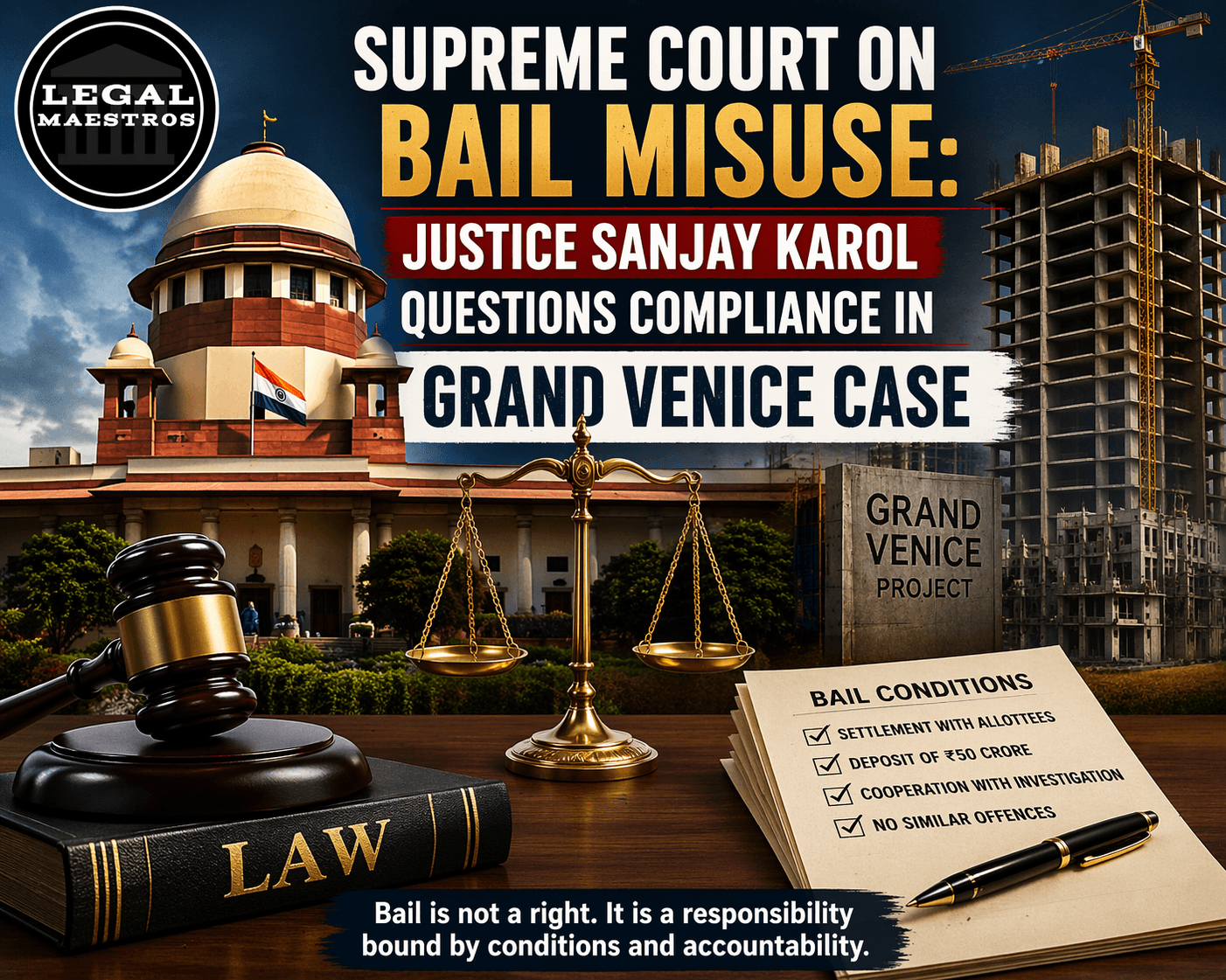
The Court set him on bail with stringent conditions in the year 2019. Among the most significant conditions was that he should attempt to pay off the claims of the buyers within a given time frame. There was a second huge condition that he placed 50 crore as pre-condition of bail.
Terms which were declared by the Supreme Court.
The Court clarified the fact that bail was not at all unconditional. It was approved primarily to make sure that the accused will sort out disagreements with the investors.
The main conditions were to deposit 50 crore, cooperate with investigation, avoid committing similar crimes, and earnest attempts to resolve disagreements with buyers within six to eight months.
The Court clarified the non-compliance very clearly to the effect that failure to comply would lead to the cancellation of the bail and forfeiture of the deposited amount.
The Incidents after Bail Granted.
The Court monitored the settlement developments in a couple of years following granting of bail. Mediation process was launched and the accused kept on giving promises to the Court that he would settle disputes.
However, lots of buyers were not compensated or their possession was not made regardless of numerous opportunities and extensions. Six years later, more than four years later, settlements were not complete.
The other problem that Court decided was to amalgamate various FIRs into a single big FIR to avoid overlapping of proceedings and proper investigations.
Failure to settle up Investors.
The major question that the Court had to consider was whether the accused had made a good-faith attempt to resolve the claims of the investors.
The Court concluded that many investors were yet to be resolved. Some of the settlements that the accused was supposed to have applied were not applied. Several consumers were not delivered or refunded even after agreements.
The Court observed that the main purpose of the granting of bail was to settle but this was not the case.
Bail Deposit through Abuse of Company Funds.
The other critical concern was connected with the 50 crore deposit.
The Court ruled that this amount was not deposited with the personal funds of the accused. Instead, he embezzled money that was in the possession of his company and other associations.
This was considered as an issue because the bail condition assumed that individuals would perform them individually. The Court, also noted that such kind of transactions were against the provisions of the Companies Act as no due approvals were taken.
This raised questions of lapse of transparency and misappropriation of business finances.
Unfinished Construction and Project Problems.
Reports that were submitted to the Court revealed that the project was not accomplished.
The lack of some of the basic facilities like water, electricity and safety system or even the absence of some units. Even the places where possession was alleged to have been granted were not habitable in the units.
This was an indication that the accused was not keeping his oaths to purchasers.
Bankruptcy Cases and Economic Abnormalities.
The Insolvency and Bankruptcy Code was used in the proceedings to commence insolvency proceedings against the company.
This was succeeded by the appointment of Interim Resolution Professional (IRP) who informed the Court that the accused had not fully relinquished the control of the company.
Even after the insolvency procedure had commenced, it was said that massive amounts of money were being diverted to affiliated companies.
These changes also undermined the honesty of the accused.
Observations of Court on the Accused Conduct.
The Supreme Court made very acute remarks on the conduct of the accused.
It indicated that the bail was awarded more than six years ago but the requirements were not fulfilled. The accused was seen to be avoiding the responsibility and shifting the responsibility to other parties such as authorities and purchasers.
The Court further noted that customers were also continuing to get victimized and had to run to one authority to another to get help.
The behavior that was being accused was alleged to be undesirable and not done with bona fide intent.
Cancellation of Bail Show Cause Notice.
In view of all these, the Court gave a show cause notice requesting why the bail should not be cancelled.
It also considered losing half the 50 crore on bails on default in regard to non-compliance.
The Court made it clear that the right to bail was not permanent and that it might be cancelled because of the breach of the conditions.
Formation of Standalone Committee.
The Court went further to protect the interest of buyers.
It was an independent committee that was led by retired judges to confirm the list of buyers, enquired about the construction status and whether possession or money back were possible.
The purpose of such a step was to ensure that the disagreements are eventually resolved and the situation explained.
Legal Rules of Cancellation of Bail.
The Court reiterated once again that cancellation of bail is not equivalent to refusal of bail.
Bail may be revoked when the accused violates the conditions, abuses the liberty or behaves in a manner that hinders the process of justice.
The Court in this case did conclude, there was material in order to contemplate cancellation because of non-compliance and misconduct.
Conclusion
This decision raises a very important issue that bail on conditions ought to be followed.
The Supreme Court made it clear that in the situation when bail is determined with the consideration of achieving a particular end, e.g. settlement with victims, inability to achieve the end can be disastrous.
The case also demonstrates that the Court relieved the homebuyers who were not relieved in the course of years. By passing a show cause notice and forming an independent committee, the Court tried to balance what is right to the accused and what is right to the victims.
Keywords
justice sanjay karol, Supreme Court of India, cancellation of bail, Grand Venice project, real estate fraud, home buyers, insolvency proceedings, misuse of funds, Companies Act violation, IRP, Article 32, criminal law, protection of investors.