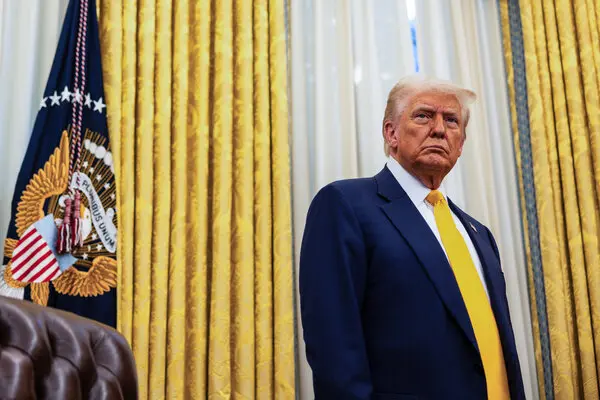
The President of the United States has just made a rather controversial statement even stronger. It did on Truth Social. A transcript of an original broadcast by conservative radio host Michael Savage was shared by Donald Trump. The post was full of rhetoric bombs about birthright citizenship, immigration, and foreign countries. When talking about the influx of immigrants, Savage specifically mentioned such countries as India and China as the hellholes.
He asserted that foreign nationals come to the United States when their pregnancies are late so as to have their children born to acquire citizenship and then they would bring with them their whole extended family back to these parts of the world.
Trump, a long-time critic of the Fourteenth Amendment and its provisions on birthright citizenship, aired this transcript to his huge following. The post did much more than criticize laws about citizenship. It included stinging invectives against the American Civil Liberties Union and the legal community that dealt with immigration issues.
The common text was that the contemporary immigrants are using the services of the country and do not become a part of the cultural life of the country. It was also aimed at the technology sector in California. In the post, it was claimed that the system of hiring is systematically biased to favour Indian and Chinese professionals at the cost of white American workers.
The First Amendment and Safeguarding Political Speech.
Users of social media immediately required the law to be held to account. They were interested in knowing whether a sitting president may undergo the real legal repercussions of domestic law against making a statement that attacks an ally state and its diaspora. Even the short answer has to be within the confines of the American constitutional law.
The First Amendment offers near blanket coverage to political commentary. It is irrelevant how offensive, crass or geopolitically insensitive that commentary is. The constitution of the United States prohibits the government to censor expression on the ground that the ideas that are being expressed are not pleasant or distasteful to the society. The courts have taken decades to make it clear that when it comes to regulating political speech, it is subjected to the greatest judicial scrutiny. There is nothing like a radio host ranting about immigration policy that falls outside the core of political speech.
The Imminent Lawless Action Standard.
In America, there are exceptions to free speech. They are merely so thin. The best applicable legal test would be a historic case in the 1969 Supreme Court case called Brandenburg vs Ohio. To deprive the speech of constitutional protection and cross over into criminal waters, it must be inciting or producing imminent lawless action. It should also have a likelihood to actually provoke or cause such an action.
No one would consider Trump posting a post that employs derogatory language to refer to foreign countries would pass this tough legal criterion. The rhetoric conveys a bitter political opinion about demographic changes and employment policies. It is not the direct command to be violent against a certain group of people and right now. Devoid of such a direct connection with the imminent lawless act, domestic criminal responsibility is a non-starter.
In American Courts there is no such thing as Sovereign Defamation.
When a criminal case is legally nonviable, the question that will then arise is the issue of civil liability. Is the Indian government, or an organization of Indian professional, suable on the ground of defamation? The law of defamation in the United States stipulates that the plaintiff must demonstrate that the false statement of fact actually harmed their reputation in a particular manner.
American jurisprudence is extremely specific. To survive a motion to dismiss in a defamation claims, the plaintiff has to be easily recognizable. When a radio host or one of the political figures complains that the technology industry in California is stacked to only employ Indian or Chinese engineers, they are assaulting a demographic notion. They are not targeting a particular engineer or a particular hiring manager. No one has a legal standing that he or she was destroyed by the post as regards his/her personal reputation. Moreover, political rhetoric cannot be the subject of a defamation suit in an American court by a sovereign nation state. The legal system considers states to be a political entity that should address their grievances by diplomacy, but not by civil litigation. The extensive scope of the shared post guarantees that it is not subject to civil liability in any way.
International treaties come in a variety of forms and are known as the Framework of International Treaties.
Going outside the borders of the country, the question turns to international law. The question that is always raised by the observers is whether such inflammatory language is in breach of the United Nations Charter or any other international treaty which is binding. The international law mostly regulates the behavior of states, wars, territorial issues and trade pacts.
No international law has been created to criminalize a political leader within the nation that expresses an offensive opinion of another nation. The international court of justice has been set up to settle complicated treaty disagreements among sovereign nations. It lacks the authority or the mandate to determine offensive speech posted on social media. The use of words to rub shoulders between states is a natural side effect of international politics, and not necessarily a crime that can be addressed by international law.
ICCPR and American Reservations.
One international law is regularly raised in the context of the discussion of extreme rhetoric. The International Covenant on Civil and Political Rights also includes certain wording on the matter of hate speech. Article 20 of this treaty clearly explains that the law shall outlaw any advocacy of national, racial or religious hatred that amounts to incitement to discrimination, hostility or violence.
This can be directly applied to derogatory statements about foreign countries on paper. The truth of treaty enforcement tells another tale altogether. The United States made a tremendous, very narrow reservation to this particular covenant. The American government came out clearly to add that it was not adopting any international obligation which curtailed the basic freedom of speech under the First Amendment. Due to this formal reservation, the standards of international hate speech cannot be applied to provide any means of override to domestic constitutional protections and impose penalties on American citizens in the courts of the United States.
The Boundary Between Statecraft and Jurisprudence
The distinction between a diplomatic incident and a formal legal violation remains absolute. Words carry immense geopolitical weight. Derogatory remarks from a head of state can undoubtedly trigger severe diplomatic repercussions. Embassies can issue formal demarches. Ambassadors can be summoned by foreign ministries for harsh reprimands. Bilateral trade negotiations can suddenly stall. Intelligence sharing agreements can face unexpected hurdles.
These are the traditional political responses utilized in the international arena. They operate entirely outside the realm of formal legal ramifications. The mechanisms of international relations rely heavily on leverage, economic pressure, and bilateral negotiation to address grievances. They do not rely on criminal codes or civil litigation when dealing with presidential rhetoric. The consequences of such statements are measured in political capital and diplomatic friction rather than courtroom verdicts.