A huge legal battle on religious freedom and access to temples is currently being witnessed in the highest court in the country. A nine-judge Constitution bench has been listening to a complicated set of reference petitions arising out of the Sabarimala temple dispute. The mood in the courtroom became heated this week as the judges had to address the fine line between the right of a particular religious group to run its own and the larger constitutional imperative of social change.
In these highly charged sessions, the bench asked stinging questions to the legal teams that were defending the exclusionary temple practices. The essence of the controversy is whether a given group of people has the right to legally prohibit outsiders to enter their shrines. The justices put it clear that excluding people because of their particular sect or community might be irreparably harmful to the entire religion.
Justice BV Nagarathna Warns against exclusivity.
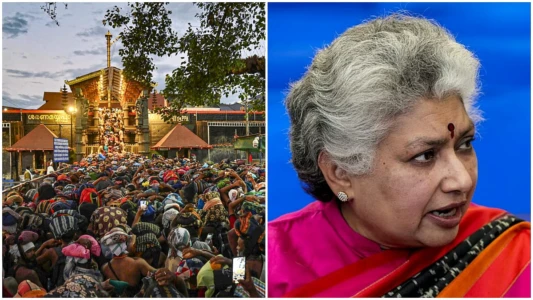
Some of the most striking of the week were made by Justice B.V. Nagarathna. She vehemently resisted the notion that religious groups could act as closed silos. Her message was straight. Hindu society needs to be united and unified.
She created a portrait of how a disjointed landscape of religion would appear. She asserted that individuals are simply unable to declare that they are of a particular denomination and then make those of another sect keep off. The judge said there is something wrong with telling people that they cannot go to a particular temple and at the same time refusing to go to other shrines. She gave a clear threat to the movements that sought complete independence. She said that any religious denomination will eventually go down the drain in the event that they deny anyone the right to open her temple door.
Her remarks were to the point of the arguments raised by various advocates of senior citizens. The attorneys had attempted to prove that a denomination was a closed, disciplined group of followers guarded by Article 26 of the Constitution. Nagarathna, the justice, could not swallow that. She demanded that all should be allowed access to all the temples as well as mutts.
The Practical Effects of Segregating Worshippers.
Justice Nagarathna went beyond the controversy of the Ayyappa shrine in Kerala in order to make her point clear. She used hypothetical cases of other mainstream religious institutions to demonstrate how harmful the use of exclusionary logic can be.
She requested the courtroom to consider a situation where members of Gowda Saraswath Brahmin community confine their temples to their own. She continued that thought experiment to the Kanchi mutt and Sringeri mutt followers. When all the followers of Kanchi visit Kanchi and decline to go to Sringeri and vice versa, the religion splits. She said that the real power of these institutions lies in more people visiting them and going to various places of worship. It is not in good taste to restrict that movement, which is not good to Hinduism.
Her concerns were echoed by other members of the nine-judge bench. Justice Aravind Kumar chipped in with a scathing evaluation. He cautioned the attorneys against the idea of raising up the absolute denominational frontiers because it would serve to segregate the whole society. One time the bench even declared the extreme danger such strict divisions might hypothetically result in a civil war situation were pushed to their extremes.
Article vs. Article.
The courtroom over which this conflict is fought is based on two elements of the Indian Constitution. The attorneys that represent the temples bank on Article 26(b). In this section, the religious denominations are accorded the right to control their own in religious affairs. The proponents claim that this right is supreme and it safeguards ancient customs against state intrusions.
Article 25(2)(b) appears on the other side of the ring. This is a direct grant to the state to enact legislation to support social welfare and reform. More to the point it enables the government to open Hindu religious institutions of a public nature to all classes and sections of Hindus.
Senior Advocate C.S. Vaidyanathan, was defending various religious organizations in Kerala. He attempted to make a demarcation of the state temples and the denominational shrines. According to him, when a private family shrine or an ancient shrine does not demand any money by the state or the general population, it should be allowed to keep out the outsiders. He asserted that these particular locations do not rely on the number of steps by the masses to prosper.
The Social Reform of Chief Justice, Surya Kant.
The bench, headed by Chief Justice of India Surya Kant had much to tell about the role of the state in this dynamic. He resisted the notion that the courts could establish a lasting boundary that safeguarding all the denominational practices.
The Chief Justice observed that the term, social welfare and reform, is unbelievably broad. He reminded the courtroom that the state is not a stranger or alien to citizens. It is the will of the people. In the event that the populace concludes that a particular social vice must be reformed, then the state certainly has the right to intervene and act within its mandate.
Nevertheless, the Chief Justice also admitted the tremendous challenge the judiciary has to endure in such cases. He explained that it is very hard, and maybe impossible, to have a judicial court establish permanent future direction as to what amounts to an essential religious practice or a non-essential one. The court understood that emotions are so intense in matters related to faith. Senior Advocate Rakesh Dwivedi had urged the judges to use soft, light-stroke method of judicial review since religion is actually an aspect that evokes strong human feelings.
The 2018 Lingering Questions.
This is a colossal legal project, which is closely connected to the historic Supreme Court ruling of 2018. The five-judge bench ruling overturned the centuries-old ban that could not allow women of menstruating age to enter the Sabarimala shrine. Most of them decided that the practice was unconstitutional and that it was against personal dignity.
The ongoing hearings have experienced the Union government challenging part of the reasoning behind that initial verdict. The retired Justice D.Y. Chandrachud, when likening the restrictions on Sabarimala to the heinous act of untouchability, was objected to by Solicitor General Tushar Mehta. Mehta claimed that India is not a victim of patriarchal stereotyping that is present in the west and that the practices of denominations need to receive at least a minimum of respect on the part of the secular state.
The nine-judge court still listens to all the arguments. The court will have to ultimately determine just how far religious freedom in India can go and how the right of a community to administer its own faith limits and the right of the state to promote equality.
NewsX story on the position of Justice Nagarathna on temple inclusiveness.
This radio report gives a comprehensive overview of the recent courtroom proceedings and pictures the bigger picture, the push by the Supreme Court of exclusionary religious practices.
Justice Nagarathna: Temples Need to Be Nonsectarian, Denominations Can not separate Hindus | NewsX – YouTube.
NewsX Live · 9.3K views.