c
Introduction
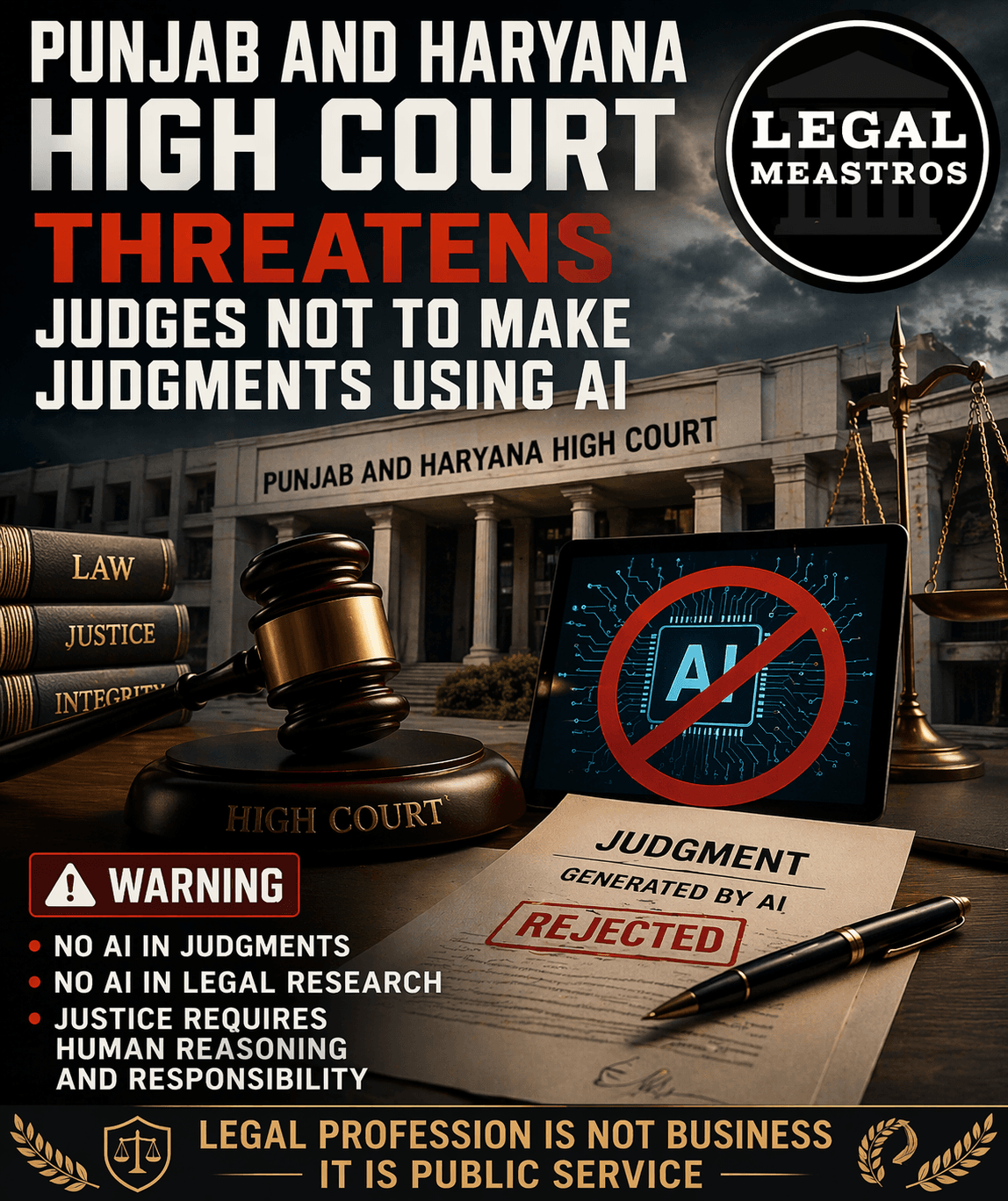
The High Court of Punjab and Haryana has recently made a significant order to the judges in the district courts. The High Court has made it very clear to them that they should not use Artificial Intelligence (AI) tools when writing judgments or conducting legal research. This ruling raises grave issues on the issue of technology in the justice system.
The Reason the High Court made this Direction.
The High Court observed that a number of judges began to rely on AI tools to form judgments and conduct legal research. As much as AI may be quick and effective, it is not always precise. It may provide incorrect information, inadequate analysis and even misleading legal inferences.
The court was of the opinion that the use of such tools may have an impact on the quality of justice. Judgments do not involve only information, they involve human knowledge, reasoning, and wise use of law. AI does not have this judgment of humans.
Significance of Human Reasoning in Law.
The legal profession is founded on critical thought, interpretation and experience. Judges are supposed to interpret facts, comprehend the law and administer it justly. Machines cannot take the place of this process.
Artificial intelligence tools operate on information and trends, yet they do not really comprehend justice. They are not able to take into account emotions, social realities, and specifics of each case. That is why the High Court stressed that judges had to make use of their personal knowledge and arguments.
Dangers of AI use in Judgments.
The High Court also made the risks of applying AI tools to legal work. Reliability is one of the major problems. The content produced by AI can be made to appear right, yet have severe mistakes.
Another problem is accountability. When something goes wrong and AI affects the judgment, it will be hard to correct the responsibility. Judges are supposed to be fully responsible of their verdict and this can not be transferred to a machine.
Confidentiality issues are also of concern. The cases that are related to the law can be delicate and the application of AI can jeopardize the privacy of information.
Legal Profession as a Service to the Community.
This lineage leads to a bigger point, which is the legal profession is not only a business, but a service to the community. It is the duty of judges and lawyers to safeguard rights and administer justice.
The responsibility can be undermined with the help of such shortcuts as AI tools. Justice involves hard work, honesty and individual participation. The message of the High Court is to remind the judges that they are serving society, rather than convenience.
What This Implicates on the Future.
The order does not completely reject technology. It merely establishes boundaries. Administrative work can be helped by the use of technology, but this should not be at the expense of judicial reasoning.
The court can also give other Indian courts guidance on this ruling. It demonstrates that the technological trend is increasing; however, the essence of the legal system should be human.
The high court of Punjab and Haryana has been of a firm stand to defend the integrity of the judiciary. Limiting AI use in decision-making and research of the law has strengthened the role of human reasoning in the law.
This move serves as a reminder that justice is not just about speed or efficiency. It is concerned with fairness, responsibility and thoughtful decision-making; something that can only be offered by humans.