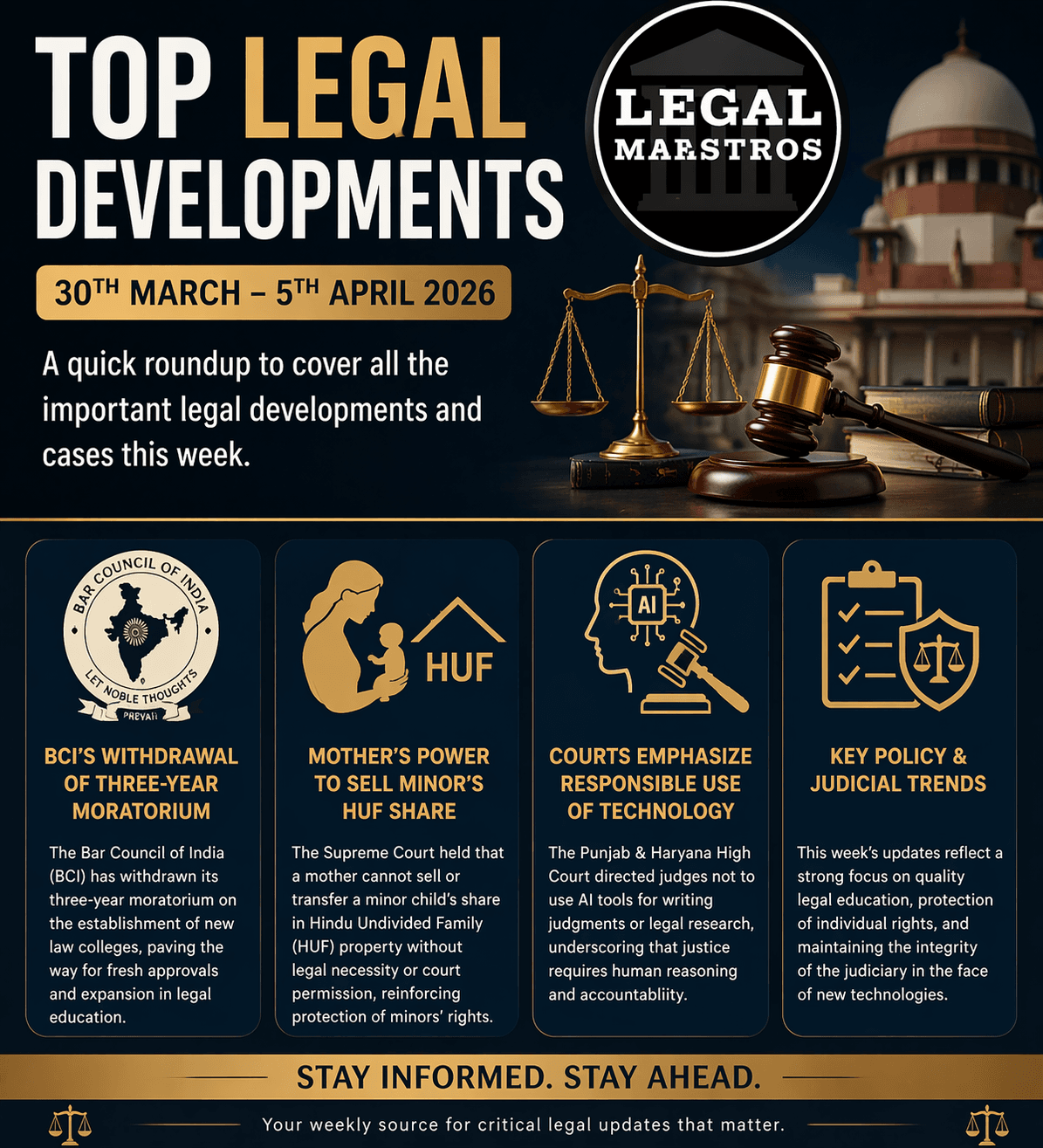
Top Legal Developments (30 th March -5 th April 2026)
Introduction
Several noteworthy legal developments, both policy-related and court-related, took place in India over the last week. These updates are indicative of how the legal system is still developing as the Bar Council has taken a giant leap in educating the lawyers and some significant decisions concerning family and property law. The following are a few brief and cursory highlights.
BCI Lifts Three-Year Moratorium.
The Bar Council of India reneged on its previous ruling of placing a three-year moratorium on the opening of new law colleges. The significance of this move lies in the fact that it allows new institutions to join the legal education sector.
The previous moratorium was made to uphold quality and regulate the mushrooming of law colleges. Nevertheless, its exit indicates that the BCI now feels that expansion is possible, perhaps with more regulation.
This ruling will expand access to students but it also brings in question the quality of legal education.
Mother Power to Sell HUF Share of Minor Supreme Court.
The Supreme Court of India in a major judgment made it clear what a mother could do on the property of her child in a Hindu Undivided Family (HUF).
The Court maintained that a mother is not in a position to sell the share of a minor in HUF property by default unless with an appropriate legal authorization or court authorization. This ruling enhances the safeguarding of the property rights of the minors and that such judgments are made in a deliberate and legal manner.
It also provides a significant legal issue that frequently comes up in family property cases.
Courts Stress on the responsible use of technology.
Also during the week, the use of Artificial Intelligence in legal work was questioned in the courts. The Punjab and Haryana High Court made it very clear that judges should not use AI tools to write judgments or to conduct a legal research.
The court emphasized that justice must have human reasoning and responsibility. This is indicative of a more general issue regarding the utilization of technology versus accountability in law practice.
Important Policy and Court Trends.
There are certain trends in the legal system that are evident in the events of this week. Improvement of legal training, safeguarding the rights of individuals, and judicial integrity is emphasized.
Courts are also getting more cautious of the use of new technologies in the legal processes. Innovation is desirable, but it must not affect fair
The 30 th March to 5 th April 2026 legal developments bring to the fore significant shifts in the policy and judicial thought. The resolution of the Bar Council of India, the guidance of the Supreme Court of India and the guidance of the Punjab and Haryana High Court all indicate a system that is evolving without abandoning original values of justice.
Such updates are significant to the students, lawyers, and anyone who would be interested in knowing how the law is evolving in India.