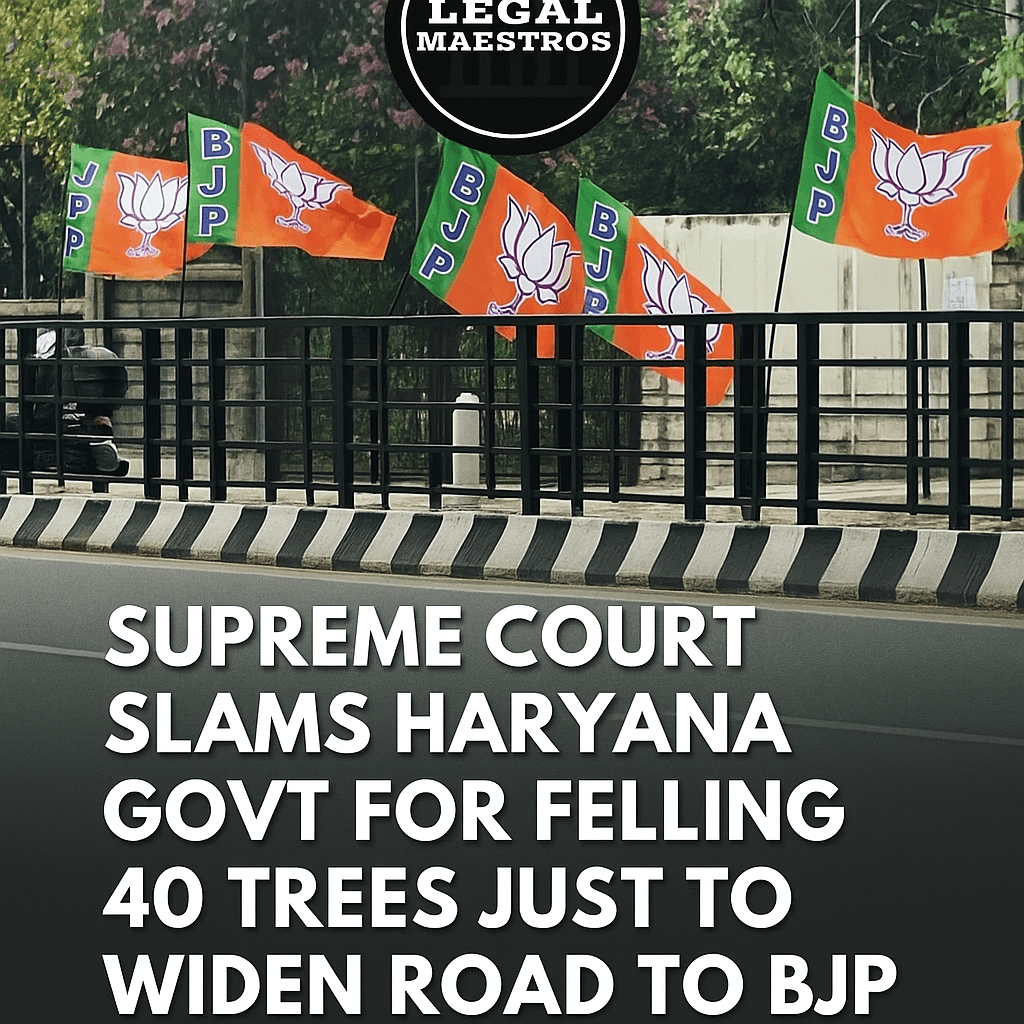
High Court Slams Destruction of the pathetic Act.
The Supreme Court of India has made a scathing attack on the administrative priorities by reprimanding the government of Haryana harshly over its approval of cutting down of 40 fully grown trees. The accident, that happened in Karnal, was allegedly to make a road wider to serve a newly built office of the Bharatiya Janata Party (BJP). The apex court bench including Justices J.B. Pardiwala and K.V. Viswanathan did not hold back and referred to the act as pathetic and inquired the rationale of the act to sacrifice the environmental assets at the comfort of a political body.
The observation made by the court happened in a hearing of a plea made by a concerned citizen who petitioned against the decision of the local authorities. The justification given by the state was very evident, as the judges looked frustrated at it, inquiring why the place occupied by a political office could not be moved instead of demolishing a century-old green cover. This stern criticism reflects the increasingly impatient attitude of the judiciary with so-called development projects, which completely ignore the ecological price, in particular, when these projects seem to aim at serving the relatively small political interest of the population, as a whole.
The bench gave a strong admonition to the Haryana Shehri Vikas Pradhikaran (HSVP) and other state agencies concerned. They indicated that they would have the officials to account over this environmental violation. The proactive attitude of the court will be an indicator of a possible change in that any bureaucratic consent regarding the cutting down of trees will not be received at face value anymore, in particular the instances of the cuts that violate the common sense and the principles of environmental conservation.
The judges also required an elaborate explanation on the lapse. They especially took offense at the fact that the trees belonged to an already existing green belt which is an important lung to the city. When such an important ecological resource was destroyed to provide a simple approach road, it was perceived as a disproportionate and unreasonable measure, and the court required a remedial plan to be given as soon as possible.
The Battle of Green Belt by a War Veteran.
This was highlighted in a legal battle that was initiated by a 79 year old war veteran, Colonel (Retd.) Davinder Singh Rajput. Col. Rajput, who was awarded in 1971 with Vir Chakra to honor his courage in the war, created it his personal mission to defend the trees around the locality of his house in Sector 9, Karnal. His petition was not only on the trees but also on the so-called unlawful appropriation of a residential area land to institutional use.
. He claimed that the concerned plot initially belonged to a specific green belt, a green buffer area that was to offer the locals an environmental relief. In his petition, the authorities changed the land use arbitrarily to allow the BJP office to be constituted. He argued that this conversion was against the current town planning standards and the right of the residents to have a healthy environment.
The petitioner noted his paying of preferential location charges several decades before directly because of a piece of land that was located facing this green belt. His perception of the 10-meter wide road constructed suddenly to demolish this area in order to build a road to serve one political party was in his opinion, a betrayal of trust placed on the authorities doing urban planning. The Supreme Court found his arguments meaningful and saw value in the fact that it felt like the public interest was being pushed to the periphery to suit political interests.
This tenacity of the veteran is striking as he had already petitioned the Punjab and Haryana High Court. But his petition had been thrown out by the High Court in May on the ground that all the desired permission had been obtained by the state. To this end, Col. Rajput took the case to the Supreme Court, which was sufficient to demonstrate that despite the challenges, individual activism is also an effective weapon in keeping the state on the wrong side of the road in the context of environmental violations.
Defense by the State and Rejection by the Court.
The Haryana government attorney tried to justify the activity of the urban development body in the case. The case was brought before the court by the Additional Solicitor General who claimed that the ruling to cut the trees was not a capricious move to pass but rather a legal procedure. He argued that appropriate permissions to cut had been secured by the appropriate forest and environment departments prior to any cutting.
The state attempted to defend the road widening process as well, by referring to the traffic jams. They claimed that the new road was needed to control the traffic of vehicles in the region which would to be higher with the operation of the new office. Moreover, the state counsel provided the typical defense of such a case, which is compensatory afforestation. He promised the court that the government would plant new saplings as replacements of the 40 mature trees that were lost.
But the Supreme Court court was absolutely unconvinced by such arguments. The judges put into doubts even the foundation of the state-stated “permissions.” They questioned who would be blamed of the direct loss of the fully grown trees, they said that saplings do not bear the same benefits to the environment as full grown trees do, it takes decades before the saplings can reach the same every-level benefit. The offer of future planting was rejected as a weak solution to the local ecology that has been permanently damaged.
The doubt expressed by the bench is a fatal weakness in the application of environmental laws in India. Compensatory afforestation is often used as an authorization to demolish forests or green belts present. The response of the Supreme Court to this case brings about the notion that the judiciary is now reacting more to the realization that planting a sapling in a different area does not in any mathematical sense equate to removing a full grown tree in a particular place of the city.