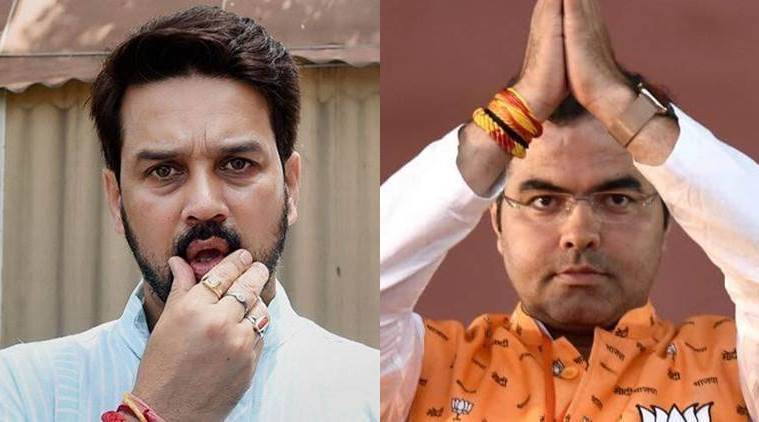
India’s Supreme Court has declined to direct the filing of a First Information Report (FIR) against two prominent politicians. The court on Wednesday was headed by Justices Vikram Nath and Sandeep Mehta. They said there was no offence under the Indian Penal Code (IPC) made out against the Bharatiya Janata Party (BJP) leaders Anurag Thakur and Parvesh Verma.
The duo are being sued for speeches they delivered in January 2020. The period was just prior to the Delhi Assembly elections. The plea was filed by Communist Party of India (Marxist) leader Brinda Karat. She had appealed against an earlier order of the Delhi High Court too, which did not order the police to register an FIR.
The Supreme Court scrutinised the material submitted. This included the alleged speeches and a status report filed by the police in February 2020. The Supreme Court found the lower court’s view correct. The judges concluded that the speeches didn’t cause violence or public nuisance.
The Core Allegations by Brinda Karat
Brinda Karat had taken the court with the allegation of hate speeches by Thakur and Verma. There were massive protests against Citizenship Amendment Act at that time. Delhi’s Shaheen Bagh was the site of these protests. The activists blocked some main roads for months.
The petition claims that, on January 27, 2020, Anurag Thakur was delivering a speech at a political rally. At the rally, he reportedly chanted a derogatory slogan. The audience replied to his chants of “desh ke gaddaron ko” by chanting “goli maaro saalon ko”. This translates to “goli maaro saalon ko” or “shoot the traitors of the country”
Karat said this was an open threat to the protesters at Shaheen Bagh. The petition also pointed to the comments of Parvesh Verma at around the same time. Verma was on an active campaign for his party and appeared in the local media. He said the thousands of protesters at the Shaheen Bagh protest would soon enter people’s homes.
According to the complaint, Verma told people they would rape their sisters and daughters and kill them. Karat said these statements demonised Muslims as dangerous aliens. She said the speeches caused extreme hatred and hostility between groups. She called for a police probe into the charges against the leaders.
The speeches were made on the eve of the national capital’s assembly elections. In February 2020, just after the election campaigns, riots erupted in North East Delhi. The clashes led to 53 people dead and hundreds wounded. The petitioners attempted to draw a connection between the tense political environment.
The Long Legal Journey
The case began in late January 2020. The complainants first issued a complaint to the Delhi Commissioner of Police. A week later, they requested the same of the Parliament Street Police Station. The petitioners demanded an FIR registered under several stringent sections of the Indian Penal Code (IPC). These sections related to the promotion of hatred among groups and insulting the religious sentiments of people.
The politicians did not get an FIR registered and then approached the court. They lodged a complaint to a magistrate under Section 156(3) of the Code of Criminal Procedure. The section allows a magistrate to direct the police to investigate a cognizable offence
In August 2020, the trial court rejected their request. The magistrate found the complaint wasn’t maintainable at that stage. This was primarily due to the absence of sanction. In India, there are cases where public servants can only be prosecuted with the sanction of a competent government authority.
Karat then appealed the trial court’s ruling in the Delhi High Court. In June 2022, the High Court too dismissed her appeal. The High Court went through the transcripts of the speeches and concurred with the trial court’s decision. It noted the statements were not made against a particular group.
What the Supreme Court Decided
Karat eventually took the case to the Supreme Court to appeal the lower courts’ decisions. Her lawyers told the court that the lower courts misinterpreted the hate speech laws. They argued the speeches obviously presented a great threat to public order. But the Supreme Court did not agree with the arguments
Justices Nath and Mehta examined the status report prepared by police and the lower court decisions. The bench upheld the independent analysis of the political speeches by the Delhi High Court. The judges stressed that the statements did not contain elements that would allow a criminal case to be filed for hate speech.
The court document contained the bench’s exact position. It said that on a consideration of the evidence, no offence was ever disclosed. The judges did not feel it was necessary to interfere with the Delhi High Court’s decision on the merits of the case. They agreed that there was no specific intent to cause communal disturbances in the statements.
One Small Procedural Change
Despite rejecting the plea, the Supreme Court did make an important legal amendment. The court took issue with the interpretation of a particular rule of procedure by the Delhi High Court. The High Court had previously ruled that a magistrate requires prior sanction to order an FIR under Section 156(3) of the Code of Criminal Procedure (CrPC).
The Supreme Court has explained that this interpretation of the law is wrong. The court said that sanction isn’t needed before the court takes cognizance. So it’s absolutely fine for a magistrate to direct the police to investigate without getting prior sanction from the government. The sanction requirement comes much later, at the time of taking cognizance of the charges.
The Court set aside the High Court ruling in relation to this procedural aspect alone. But this clarification didn’t affect the outcome for Thakur and Verma