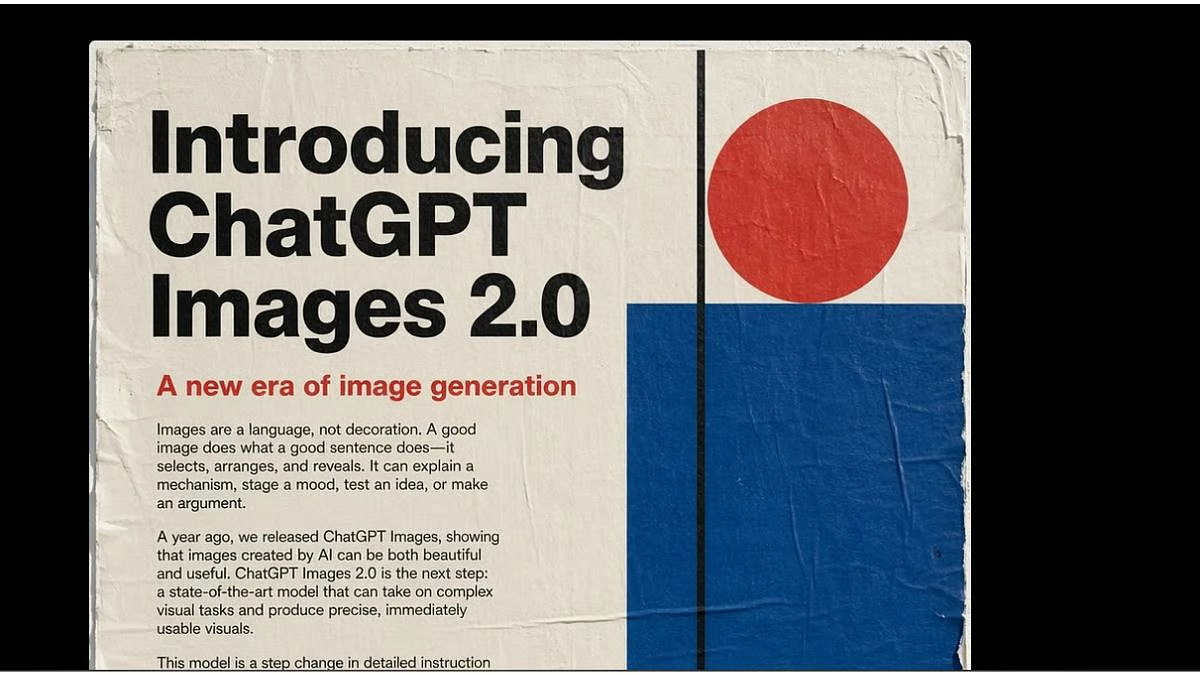
Now, we can discuss the latest update of OpenAI. Recently the company introduced ChatGPT Images 2.0. It is not any ordinary software patch. It is an enormous leap in the direction of artificial intelligence that deals with pictures. The big news here is that the image generator now can actually think prior to drawing.
A long time it was a slot machine to ask a computer to make a picture. You added a prompt, pressed a button and crossed your fingers. Every now and then you received a masterpiece. Other occasions you would find individuals with seven fingers or letters that were untidy and illegible.
Most of those old problems are fixed by the new update. It introduces logic into the creative working process. The system has become somewhat of a human designer. It waits a fraction of a second to think over just what you want, designs the layout, and checks its work, before presenting you with the finished product.
Pictures What Thinking Means
The most interesting one is the dual-mode system. You have a Quick Mode of requests and a Reflecting Mode of challenging projects.
When you turn on the thinking mode, the system does not immediately begin to create pixels. Deliberating is a time-consuming endeavor. When you request a very specific infographic or a complex storyboard, the model will break. It determines how to organize the information the most.
It is even able to search the web. Suppose you require the image of a new model of a smartphone or some recent news. This generator has the ability to draw real time information over the internet to ensure that the information is absolutely accurate. The cut-off date is December 2025, although the web access option has been included to facilitate access to anything more recent.
At this point, only paid users can use the thinking capabilities. This advanced reasoning is available to you in the case you have a Plus, Pro, Business or Enterprise plan. Free users even have an opportunity to use the new Images 2.0 model, only without the deep deliberation mode.
The fixes that can be made to correct the text problem are as follows:
Everyone who has ever used an image generator is familiar with the text struggle. You request a store front sign reading Fresh Coffee and the computer provides you with what appears as a foreign language.
ChatGPT Images 2.0 is a solution to the text problem. OpenAI names this text rendering as almost perfect. The model is now able to incorporate written language into a scene. You need a handwritten note, a clean user interface label or a huge billboard, the spelling is right and the spacing is logical.
It is also far above English. Multilingual support has been added to the system. You may request it to create posters or instruction manuals in Japanese, Korean, Chinese, Hindi or Bengali. Initial experiments demonstrate that grammar and wording in these non-Latin scripts are surprisingly sound.
Making Multiple Images at Once
The other giant change is the relationship of the system with volume. You requested an image earlier and received a single image. The model can now be asked to produce an entire batch of pictures with a single prompt.
You are able to draw up to eight different pictures simultaneously. This is a huge plus to individuals who are attempting to create storyboards or comic books. You are able to provide the model with a character description and request a comic spread of eight pages. The system will keep the character on the look, the color scheme, and the atmosphere in each frame.
This particular feature will be a favorite of social media managers. You may request a promotional asset and have the system automatically spit out the various versions that will be customized to various platforms. It can create a banner to a site, a square post to the feed and a tall video cover all at the same time. The aspect ratio support is expanded to 3:1 to 1:3 to provide users with enormously more flexibility without having to crop later in Photoshop.
Another Dimension of Reality.
The quality of the pictures has been taken seriously upgraded. OpenAI refers to it as world-aware photorealism. The computer has now the knowledge of simple physics, the way light bounces back off surfaces and the texture of various materials.
The older models used to have problems with intricate scenes. When you have too many objects in the same picture, then things would begin to melt together. Backgrounds would be bizarre. The new model maintains things apart and clean. It also abandoned the irritating warm-color tint that was afflicting the earlier models. The colors are now neutral, and very true to the prompt.
Also, you can drive the resolution to a lot higher level. The system will be able to support full 4K output. It implies that professional designers and developers can come up with rich and incredibly detailed images that are presentable on large screens.
Surgical Editing Tools
It is marvelous to make a brand new picture, but it may be more important to repair an old one. The update has mighty image editing capabilities and support of masks.
You can attach a picture and instruct the system on which parts you want to alter. You apply a mask to emphasize a certain part. The model will overwrite that position but leave all the other pixels totally unchanged.
This is ideal in product photography. A person who owns a business can capture an image of a coffee mug on a kitchen counter. They can then request the system to replace the kitchen background with a dramatic overcast sky. The coffee mug remains the same, but the setting is totally different. You can moreover change clothes on a model or introduce new props to a scene, without needing to arrange an entire new photoshoot.
Current Limitations and Safety Filters.
There are guardrails to every new technology. To ensure that this generator is checked, OpenAI developed several layers of safety. The system implements prompt level filters that prevent unsafe requests to the drawing process before it even begins. After creating the image, output-level checks scan the picture to ensure that nothing dangerous has gotten through the cracks. They even go to the extent of having a specific safety reasoning model that is used to follow up on the inputs as well as the end results.
All these upgrades notwithstanding, the company acknowledges that the system is still not perfect at this time. The model continues to have problems with very complicated physical logic. Ask it to provide you with a picture of a step-by-step build of a complex mechanical engine and the system may become confused and join the misplaced gears. The model is also subject to high-density or repetition in visual patterns that may lead to stumbling. Occasionally, it continues to commit tiny errors on technical labels or arrows in structured graphics.An API called gpt-image-2 is offering developers direct access to this new technology. This will enable technology firms to develop these logic and editing systems within their applications. The API has real-time streaming. This implies that a user does not need to watch a loading bar as a 4K image with huge size is being rendered. The image is displayed in bits as the computer constructs it on the screen. This makes interactive editing tools look far more responsive and fast.