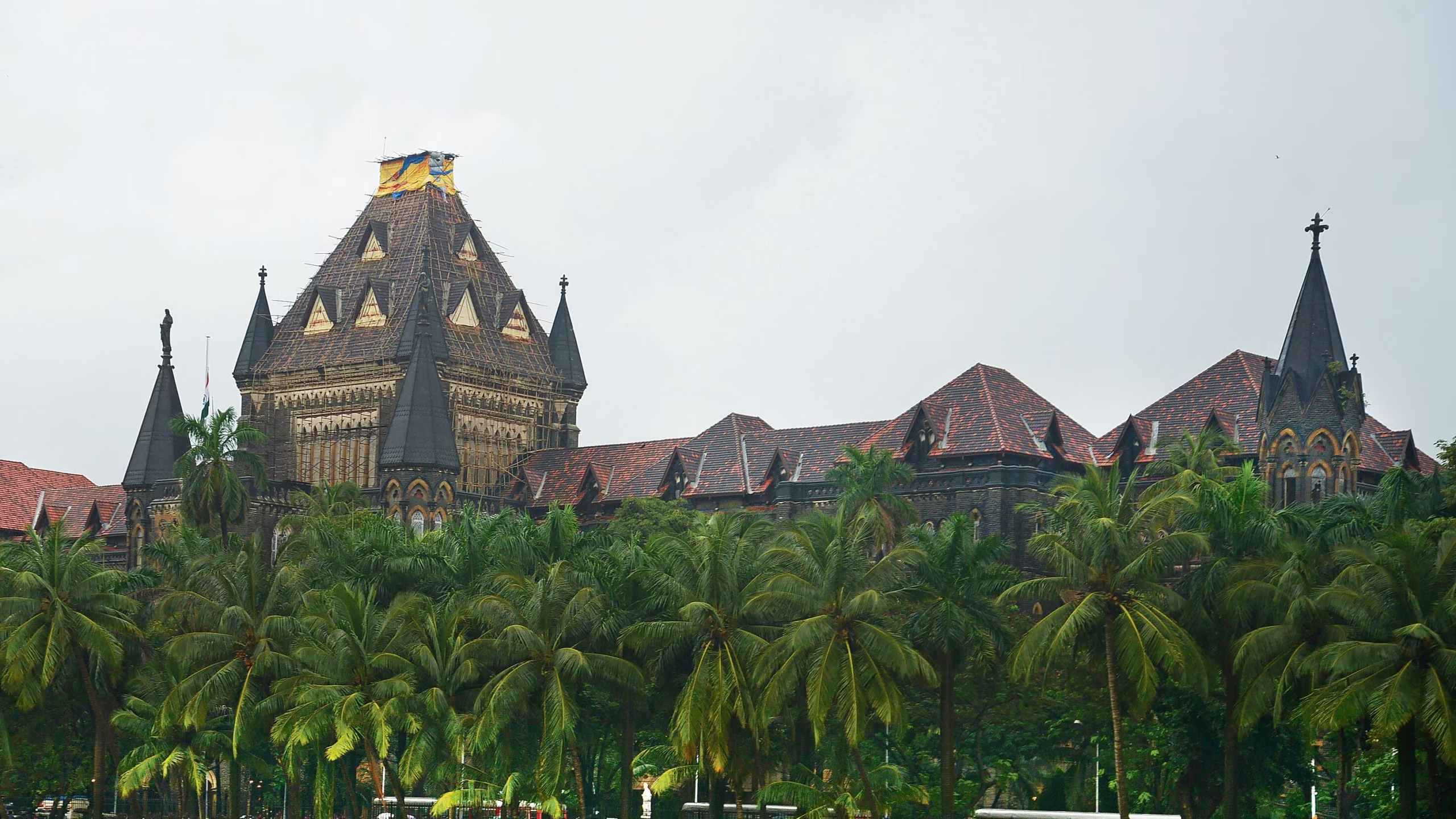
One doesn’t just walk into the Bombay High Court and get a good noise making from the Judges. However, that is what occurred this past Wednesday. A desperate appeal to put off a huge board meeting of Sir Ratan Tata Trust failed to take off. It turned out the petitioner was 61-year-old resident of Thane, Suresh Patilkhede who withdrew his case. There was really no choice for him. The logic behind the filing was virtually ripped apart by the vacation bench of Justices Advait Sethna and Sandesh Patil
It’s an interesting scenario to watch unfold. The legal ploy was meant to block a high-stakes meeting of the Tata Trusts scheduled for May 16. It didn’t work. Instead, it revealed an odd, somewhat amateurish, style of high-level corporate litigation. Patilkhede called for the court to put a hold on all the proceedings. He said the trust’s board was an illegitimate board. However, the bench weren’t panicking. They were very suspicious of the real movers and shakers, in fact.
The number of the students who are unable to solve the Math Problem on the Board
Let’s examine why Patilkhede had to take all to court in the first place. It’s about a relatively new law. The Maharashtra government had implemented a Public Trusts Act amendment last year. It will come into force on 1st September 2025. The new rule was intended to make these huge charitable organisations democratic in their functioning. This, in particular, limited the number of “perpetual” or life trustees. They are not allowed to make up more than 25 percent of the board of a trust unless otherwise provided by the original trust deed.
Suddenly, math at the Sir Ratan Tata Trust seemed out of sync. There are six members on the board now. Three of them are permanently appointed lifetime members. The Chairman would be Noel Tata, Jimmy Tata and Jehangir HC Jehangir. This represents half of the room. Double the legal limit of THC.Double the legal amount of THC.
This mismatch was exploited by Patilkhede’s attorney, former Madras HC judge T Raja. He informed the court that any board that has such a ratio is legally incompetent. He said he believed that, if an illegal Board meets, that is a bad Board, and consequently its decisions are bad. He wished the meeting on May 16 cancelled completely. He even wanted the board’s decision since it went into effect last September erased from the books. It was a pretty hardball offer.
The Ghost Complainant
That’s where everything just went down the drain. You will normally need to establish that you are having any type of detriment or are directly involved in order to seek a court order. In legalese, it’s known as locus standi. A leg is required to stand on. In Patilkhede, they were zero
During the hearing, it came to light that Patilkhede wasn’t a trustee. He wasn’t a beneficiary. He was nothing but a Thane guy who ran as an independent against deputy chief minister of the state couple of years ago. To complicate matters even further his entire petition was based on claims made to the Charity Commissioner. However, the judges enquired and it was found that Patilkhede did not even file those complaints. It was done by some third party, unknown. The petitioner was riding piggy-back on a ghost.
The response of the bench was frozen. It was an astounding situation. They noted that it was ridiculous for someone to seek an urgent stop, and file a complaint with a charity regulator that hadn’t yet acted. Raja made an effort to make things go smoothly. He said that it was a “simple mistake. It didn’t fly with the judges. So they didn’t say it was no accident, they said it was not.“It wasn’t a mistake,” they said, “and there was a reason behind it.” It was no surprise that they were skeptical. It was more a preemptive measure than a real complaint, and it was meant to send a chilling message to the boardroom.
The Ripple Effects of a Retrospective Rule
There was severe opposition from the defense side. Heavy hitters Abhishek Manu Singhvi and Janak Dwarkadas were from Tata. Their case was easy to understand and compelling. They said that retroactively introducing the 2025 amendment would wreak havoc. It is not just going to rock the Tata Trusts. It would lead to thousands of trusts in Maharashtra axing their board members overnight.
This was clarified by the state government. The purpose of the law was to be prospective. It’s for the future, not the past
Timing is also a factor. Why now? The Sir Ratan Tata Trust had convened at least four times since the amendment was passed in September 2025. No one appealed at that time. It would be a huge stretch to believe that the new urgency to prevent the May 16 meeting has much to do with the abstract requirements to comply with the law. The meeting’s agenda for that meeting is quite extensive. That they are reportedly talking about continuing to keep Venu Srinivasan in the Tata Sons Board. The trusts hold a massive stake in Tata Sons, with nearly 66 per cent of the stake. The one who controls the trusts also controls the direction of India’s biggest conglomerate company. The odds are immense. It’s not credible that a random citizen happened to become the big investor in that 50.5 percent of lifetime trustees just weeks before a pivotal vote.
A Temporary Ceasefire
The petition was withdrawn at the end of the day. The court turned a blind eye but left a clear message. Throwing bombs in the corporate board room isn’t something you can do without doing your research first.
Does this imply that the legal battle on the Tata Trusts system is ended? Not a chance. This is only a withdrawal, it was a bad attack. The issue of the 2025 amendment and the trust deed of 1916 has not really been settled on that issue. The Charity Commissioner is still considering the original, albeit enigmatic, complaints. It is already expected that someone else will attempt the same ploy in the future, according to legal experts. Next time, however, they’ll be sure to have the paperwork in the name of the suit itself.