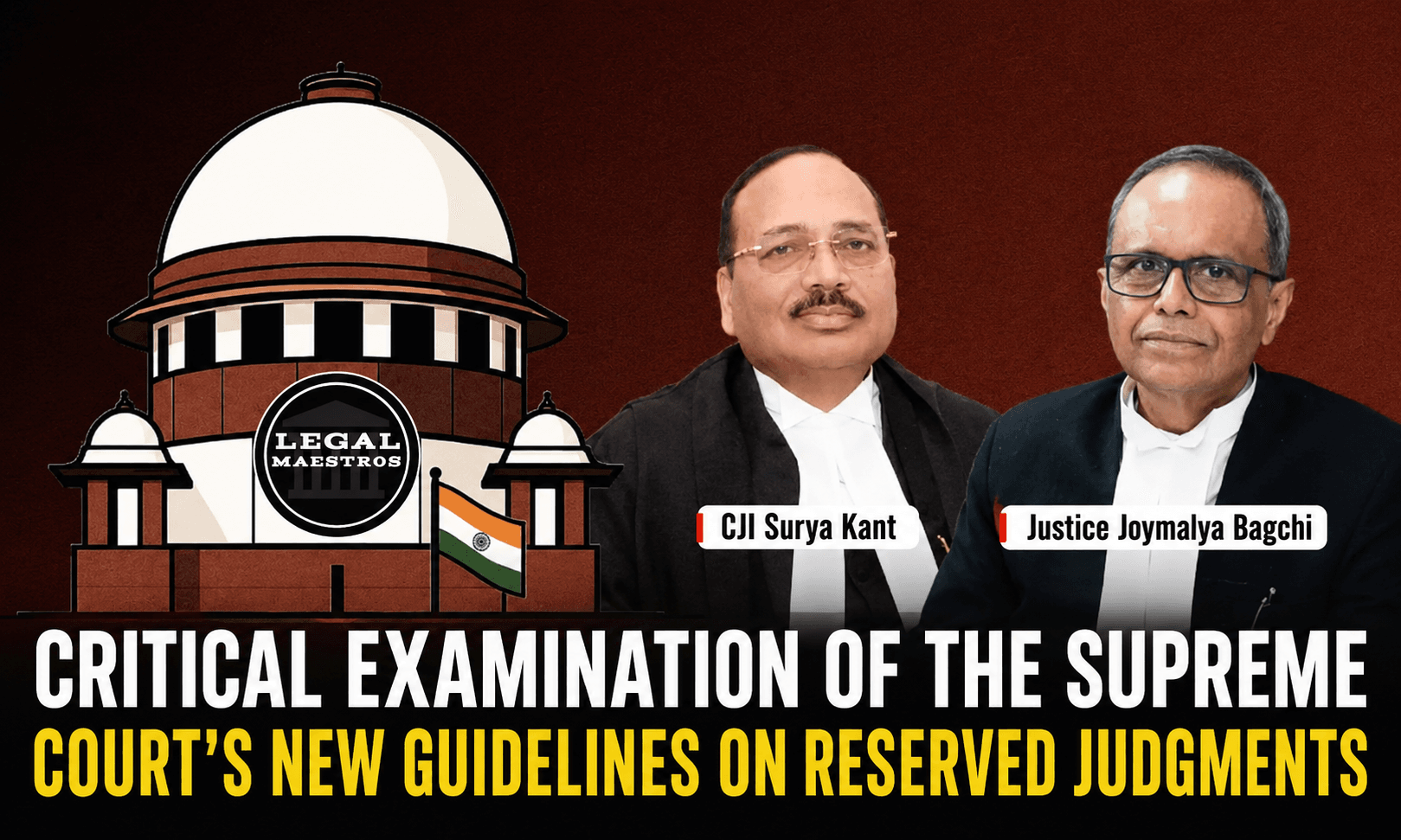
In 2024, In State through CBI vs Naresh Prasad Agarwal[1], the Supreme Court had to set aside a reasoned order of Madras High Court, for the reason that it was pronounced months after the Hon’ble Justice had retired. The recent decision by the Supreme Court of India in Pila Pahan @ Peela Pahan v. State of Jharkhand[2] attempts to deal with this long-standing problem within the judicial system in India, i.e., the problem of delays in pronouncing orders on matters reserved. The Court has issued detailed binding guidelines to High Courts concerning the pronouncement of reserved judgments within the stipulated period of time.
The concern that prompted these directions is undoubtedly legitimate. A combined reading of several cases including Smt.Akhtari Bi vs State Of M.P[3], Anil Rai vs State Of Bihar[4], and Asian Resurfacing Of Road Agency P. Ltd. vs Central Bureau Of Investigation[5] (Now overruled), shows a menace of pendency in judiciary, either due to perpetual stay orders, pending arguments, or due to judgements being reserved but not pronounced. Delay leads to a loss of public faith in the justice delivery system, and the implications are more serious in criminal cases where the persons concerned may be fearing for their liberty, safety, or may even have been sentenced to death. It should be kept in mind that when we talk about Speedy Justice, we are not just concerned with speedy trial, but also with speedy disposal of cases[6], which necessarily includes pronouncement of the reserved judgements.
However, these recent directions passed in Pila Pahan have several issues, which mostly lie on the point of feasibility, and lack of enforceability.
THE REASSIGNMENT MECHANISM AND THE MASTER OF THE ROSTER DOCTRINE
One of the most troublesome aspects of the guidelines is the provision of withdrawing a matter from the bench responsible for hearing the matter after failing to deliver judgment and then allocating it to another bench. According to the guidelines, where judgment fails to be delivered within the given time frame, “the Registrar General shall placed the matter before the Chief Justice for orders, and the Chief Justice shall bring it to the notice of the bench within 2 weeks thereafter. If it is still not delivered within 2 weeks thereafter, the Chief Justice may assign the case to another bench with notification to the advocates and parties. The new bench may rehear the case and pronounce the judgment promptly.”[7]
In the first place, this scheme comes up against a fundamental problem from the scheme of the Constitution of India. The Chief Justice of a High Court is deemed the “master of the roster,” with sole powers for allocation of matters and bench constitution.[8] The Supreme Court orders seem to assume that re-allocation will be possible in every situation. What if the Chief Justice believes reassignment of the matter is unnecessary? What if the Chief Justice concludes that the original bench remains best suited to decide the matter? The guidelines do not provide any concrete answer to this issue. Therefore, either the guidelines can be construed to mean that the Chief Justice has no other choice but to appoint a new bench and in doing so encroach upon the sphere of master of the roster, or they have to be completely dependent on the decision of the Chief Justice and consequently be toothless. Since the High Courts are not subordinate to the Supreme Court[9], and the direction of the Supreme Court uses the word ‘May’, the latter option seems more in line with the constitutional relation between the Constitutional Courts.
Secondly, The reassignment mechanism is premised on the assumption that in every matter, there are alternative benches competent enough to hear the matter. This may not necessarily be the case in many high courts. There exist certain categories of cases that are specialised which tend to be heard by specially designated benches, owing to their expertise in the subject concerned.
In this scenario, let us assume that there is a tax matter before a particular high court, which is being heard by a bench including judges who have experience and expertise in tax, competent enough to hear the matter, and this bench hasn’t pronounced the judgement in the time specified. In such circumstances, can the directives issued by the Supreme Court direct the Chief Justice of the high court to constitute another specialised bench? It should also be considered that in smaller high courts such as the Sikkim High Court (with three judges), the Meghalaya High Court (four judges), and Manipur and Tripura High Court (five judges), constituting a new bench means taking burden off one bench, and adding it to another set of judge who already are part of a completely different roster.
REHEARING MAY INCREASE RATHER THAN REDUCE DELAY
The directions passed by the Honble Supreme Court seem to presuppose that reassignment would result in quicker disposal of the matter. However, in a practical sense, the outcome will be just the reverse.
When a case is assigned to an altogether new bench, the newly appointed judges need to acquaint themselves with the background of the case, go through the pleadings, consider the evidence submitted by the parties, take note of the written submissions made in the matter, and listen to the arguments raised orally on behalf of both sides. For cases concerning difficult constitutional, commercial, tax, or criminal issues, such a procedure can entail a considerable amount of work from the bench. As a result, a case which took weeks or even months for a certain bench to hear might need the same amount of judicial effort to be expended again.
ENCOURAGING PROCEDURAL LITIGATION
The guidelines give parties an avenue to file an application and have their cases reassigned. Unintended, This might end up creating an altogether new type of interlocutory litigation. Applications for orders to pronounce judgment, applications for reassigning the cases, and even representations made to the Chief Justice would be possible under these guidelines. If a party has anticipated some favorable order being issued by one bench, then the party will definitely oppose the case getting re-assigned. The Indian courts currently carry heavy load due to procedural applications.
AN ASYMMETRICAL REFORM
A second distinctive aspect of the guidelines is that they exclusively concern High Courts. The problem of delays in issuing reserved judgments is one that has not been experienced in High Courts alone. Instances exist where the same problems have also been experienced in the case of reserved decisions of the Supreme Court. An analysis done by N.V. Geetha clearly illustrates that the Honorable Supreme Court itself is not so prompt in delivering its judgments.[10] Given that delay in pronouncing a reserved judgment is a violation of constitutional rights, it would follow from this that such accountability needs to be exercised in relation to all courts. A reform to improve judicial accountability should, therefore, be consistently applied to High Courts as well as the Supreme Court, else its risk of looking like a showdown of authority, while simultaneously evading accountability.
ADDRESSING SYMPTOMS RATHER THAN CAUSES
The main limitation that can be spotted in the directives is the fact that they are centered primarily around monitoring and not causation.
The guidelines call for automatic monitoring systems, monthly reporting procedures, email alerts and supervision by Registrars General and Chief Justices. Such initiatives certainly contribute to greater transparency and help identify problems. It is, however, essential to note that increased transparency does not automatically mean improved efficiency. Delayed judgments result not so much from only a lack of transparency as they do from serious issues such as judicial vacancies, growing workloads, complicated procedures, lack of research support, and unnecessary documentation. Indeed, judges have to consider numerous cases at once while producing elaborate reasoned judgments. Administrative monitoring alone cannot solve all these problems.
THE ABSENCE OF EFFECTIVE CONSEQUENCES
The efficiency of any regulatory mechanism will depend on what the consequences are for failing to comply with the requirements. The guidelines provided by the Supreme Court have deadlines set out, but they fall short of putting in place an effective mechanism for ensuring accountability (Which in all fairness, They cannot do that). In the end, the so called guidelines can only be used to send reminders and re-assign the matter, which is also not always possible. As a result, compliance continues to rely substantially upon judicial self-regulation and discipline. The directions passed recently, strengthen monitoring mechanisms without fundamentally remedying the factors that contribute to delayed pronouncement of judgments.
TOWARDS TECHNOLOGICAL AND STRUCTURAL REFORM
A long term solution to the problem of delayed pronouncement of judgments may not lie in administrative escalation but rather modernisation of the judiciary itself. It is high time for the judiciary to seriously look into the possibility of incorporating technological advancements within the judicial system. It is rightly argued that AI cannot substitute the human judicial reasoning[11] which has to interpret provisions, weight different aspects of legal principles, and calculate the real life consequences of their orders, However, AI can definitely save a lot of time otherwise spent on other ancillary activities. For instance, an AI-powered citation checker, precedents mapping, case notes, AI generated drafting for common paragraphs and also AI-assisted speech to text can be highly beneficial.
Combined with increased judicial appointments, improved research support, and better case management systems, technological integration can offer a more sustainable solution than a fixed timeline with no accountability.
CONCLUSION
The Supreme Court’s concern regarding delayed judgments is entirely justified. Justice delayed, particularly in matters affecting personal liberty, is justice denied. The Court’s attempt to introduce transparency and institutional monitoring therefore deserves appreciation. Nevertheless, the newly issued guidelines for all practical purposes, is marred with lack of effective enforceability. The re-assignment mechanism needs to be reconclied with the “master of the roster” doctrine, and it may prove unworkable in many cases, and could actually lead to increase in pendency and delay. Meaningful reform requires not merely monitoring judicial delay but confronting the structural and technological deficiencies that continue to burden the administration of justice.
[1] CRIMINAL APPEAL NOS.829-830 OF 2024
[2] (Writ Petition (Crl.) No. 169 of 2025)
[3] Smt.Akhtari Bi vs State Of M.P 2001 (4) SCC 355
[4] Anil Rai vs State Of Bihar 2001 (7) SCC 318
[5] Asian Resurfacing Of Road Agency P. Ltd. vs Central Bureau Of Investigation 2018 (16) SCC 299
[6] Krishankant Tamrakar v. The State of Madhya Pradesh, 2018 (5) SCALE 248
[7] Pila Pahan @ Peela Pahan v. State of Jharkhand (Writ Petition (Crl.) No. 169 of 2025)
[8] Shivani Srivastava & Ashit Srivastava, Working of Master of Roster, SCC Times (Aug. 8, 2024), https://www.scconline.com/blog/post/2024/08/08/working-of-master-of-roster/.
[9] Shankar Kumar Jha Vs The State Of Bihar, Special Leave Petition (Civil) Diary No(S). 40774/2022
[10] N.V. Geetha, How Long Does the Supreme Court Take to Deliver a Judgement?, Supreme Court Observer (Apr. 30, 2026), https://www.scobserver.in/journal/how-long-does-the-supreme-court-take-to-deliver-a-judgement/
[11] Shidarta & Abu Bakar Munir, Can Artificial Intelligence Technology Replace Judges in Deciding Legal Matters?, 43 Hamdard Islamicus (Special Issue 1) 617 (2020).