Introduction
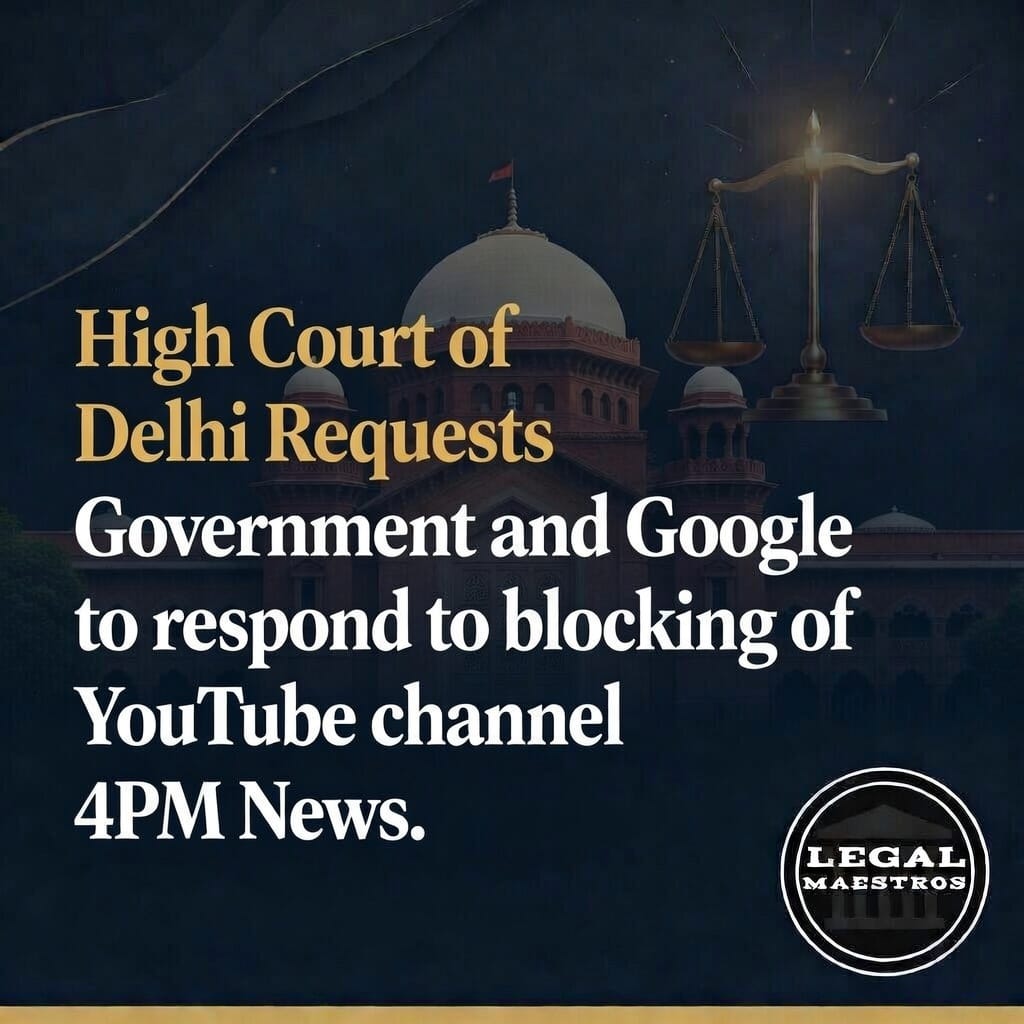
The Delhi High Court recently took up a case related to the blocking of a YouTube channel named “4PM News.” The Court has requested the Central Government and Google to answer the accusations, which have been raised against the blocking of the channel.
Case History.
It was a lawsuit filed by an individual related to the YouTube channel, 4PM News. The petitioner argued that the channel was blocked or restricted without due notice or without any clear reasons.
The petitioner claimed that such action violated their right to freedom of speech and expression which can be guaranteed by the Constitution of India.
Issue Before the Court.
The main issue before the Court is whether the blocking of the YouTube channel was done in a lawful and fair manner, and whether proper procedure was followed before taking such action.
Court’s Action
The Delhi High Court gave notices to the Ministry of Electronics and Information Technology (MeitY) and Google to submit their responses.
Need Help With Your PhD or LLM Thesis?
Explore our thesis and dissertation writing support services for PhD and LLM students. Get subject-specific academic assistance for your research project.
Explore Our Services →The Court would also wish to know why the channel was blocked and the legality of the action that was taken.
Petitioner arguments.
The petitioner said that no due process was heard prior to blocking the channel. It was argued that this should be done in due process and transparency.
The petitioner further claimed that, by blocking a media platform you do not only end up hindering the creator, but also the people who use it to get information.
Importance of the Case
It is a significant case as it concerns online rights and censorship on the internet. It poses questions on how, and when the government or sites such as YouTube can censor content.
This case can be used to shed light on the online content blocking regulations and procedures in India.
The fact that the Delhi High Court has decided to seek answers means that the issue is going to be reviewed. It emphasizes the importance of fairness, transparency, and adherence to basic rights in the online realm.
Keywords
Delhi high court, You Tube channel block, 4PM News, MeitY, Google, freedom of speech, digital rights, control of online content, constitutional rights, Indian law.