Introduction
In the case of Dr. S. Balagipal vs State of Tamil Nadu and Another, the Supreme Court of India made an important ruling concerning the criminal prosecution of physicians and patient consent.
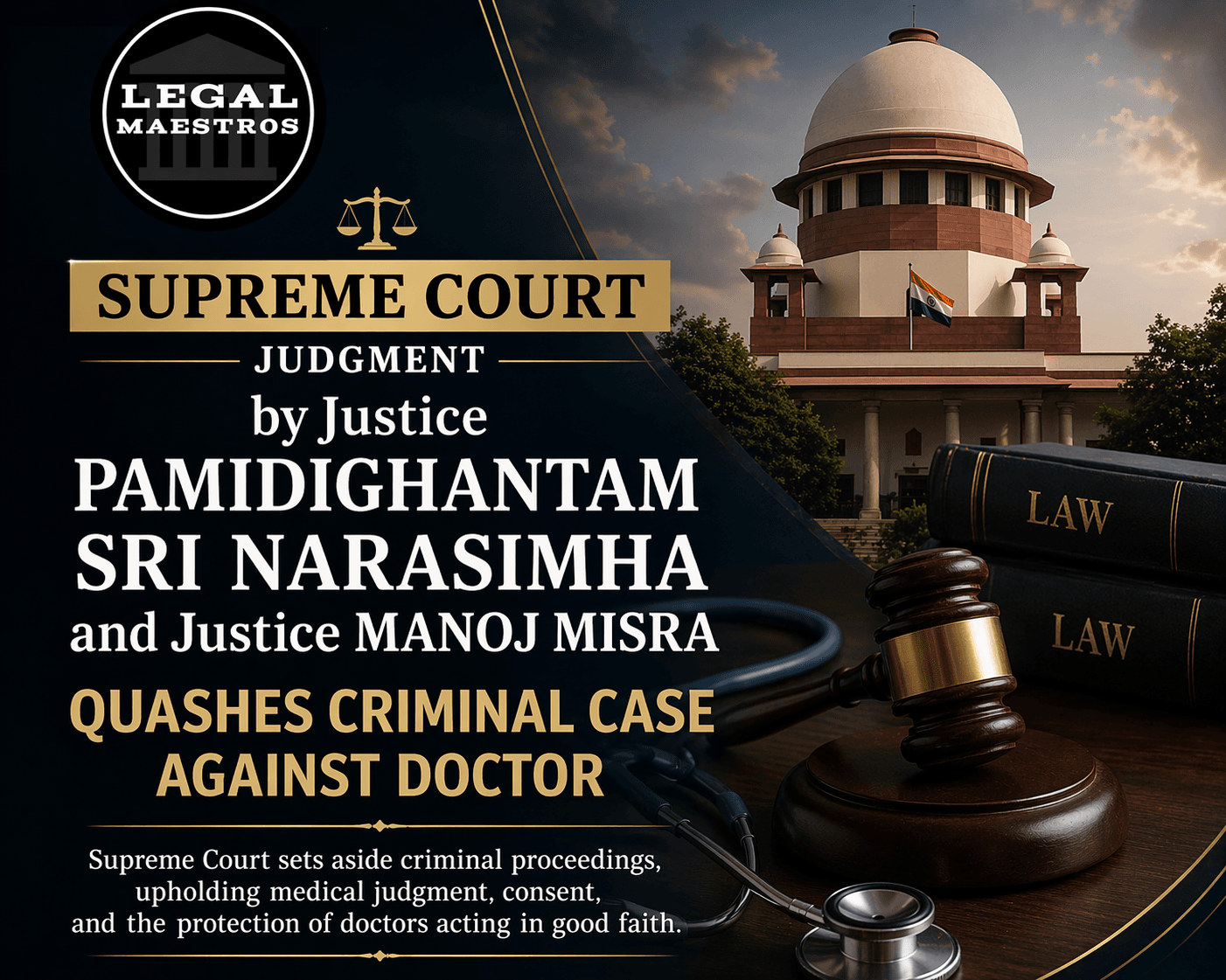
Justice Pamidighantam Sri Narasimha and Justice Manoj Misra ruled on the case on 6 April 2026.
The case indicates that courts should be very cautious when analyzing medical decisions that can result in criminal charges.
Background of the Case
The case was connected with a complaint made by the father of a young child.
The boy had an undescended testicle and was taken to a hospital to be operated. The father asserted that he had only agreed to a procedure known as Orchidopexy which involves the location of the testicle to its correct position.
Need Help With Your PhD or LLM Thesis?
Explore our thesis and dissertation writing support services for PhD and LLM students. Get subject-specific academic assistance for your research project.
Explore Our Services →Nevertheless, the surgeon carried out Orchidectomy during surgery, which consists of removing the testicle. The father claimed that this was done without his permission and that permission form was modified afterwards.
On the basis of these allegations FIR was filed and criminal charges against the doctor were filed on different provisions of Indian Penal Code.
Pre-trial Before the High Court.
The physician went to the High Court to have the criminal proceedings quashed as under Section 482 of the Code of Criminal Procedure.
The High Court however did not quash the case and ordered the trial to proceed.
This led to the appeal before the Supreme Court.
Medical Board Findings
In the line of the investigation, a Medical Board was established to investigate the case.
The Medical Board decided that:
The excised testicle was small, deformed and of no useful use.
The future disease, with potential malignancy, was a risk.
In this scenario, castration of the testicle is a medically reasonable and correct intervention.
The Board ruled that the doctor acted within the medical standards and the surgery that was conducted by the doctor was appropriate.
Case Before the Supreme Court.
The major question before the Court was whether the criminal proceedings ought to proceed against the doctor particularly when the medical experts had endorsed his decision.
The Court also looked at whether the consent form was actually manipulated.
Supreme Court’s Analysis
The Court carefully analysed the law relating to criminal liability of doctors.
It was referring to the case of Jacob Mathew v. State of Punjab which had ruled that no doctor should be prosecuted without clear evidence of gross negligence.
The Court noted that medical practitioners need to be shielded since their judgment is informed by experience and emergency.
In this case, the Court found that:
No negligence was claimed on doing the surgery.
The Medical Board made it very clear that the procedure was right.
Both procedures were mentioned in the consent form meaning that the doctor could select the right one.
No proof existed as to the alteration or tampering of consent form.
On the Question of Consent.
The Court observed that:
The operation was preceded by consent being taken in a printed form.
Both of the possible procedures were mentioned in the form.
No forensic evidence supported the allegation that there was manipulation.
The Court ruled out that doctors should be left free to make decisions in the best interest of the patient during medical emergencies.
In this case, therefore, the question of consent did not warrant criminal prosecution.
Court’s Findings
The Supreme Court concluded that:
The doctor did not have material to demonstrate criminal intent or wrongdoing.
The medical intervention was reasonable and expertly opinionated.
To further prosecute the criminal would be tantamount to an abuse of the law.
The Court noted that criminal law was not to be applied to harass medical professionals who are acting in good faith.
Final Judgment
The appeal was permitted by the Supreme Court.
It overturned the High Court order and dismissed the criminal charges that were awaiting before the Magistrate.
The Court found that the case ought to be dismissed as it would amount to an abuse of the process of law and contrary to the interests of justice.
Significance of the Judgment
This is a critical judgment as far as the medical profession is concerned.
It shields physicians against criminal cases they are not supposed to be involved in.
It also explains that the courts need to act on the basis of expert medical opinions prior to granting prosecution.
The ruling is a compromise between the rights of patients and the necessity to preserve the lives of medical workers.
The Supreme Court restated that medical determinations must not be lightly considered in the criminal law.
The Court granted the case through its dismissal to make sure that physicians are not penalized because they made reasonable judgments that benefited the patients.
This verdict builds trust in the healthcare system and the law that regulates it.
Keywords
S Balagopal v Supreme Court, Dr S Balagopal, Justice Pamidighantam Sri Narasimha, Justice Manoj Misra, medical negligence, consent, Orchidectomy, Orchidopexy, Jacob Mathew case, criminal law, quashing of proceedings.