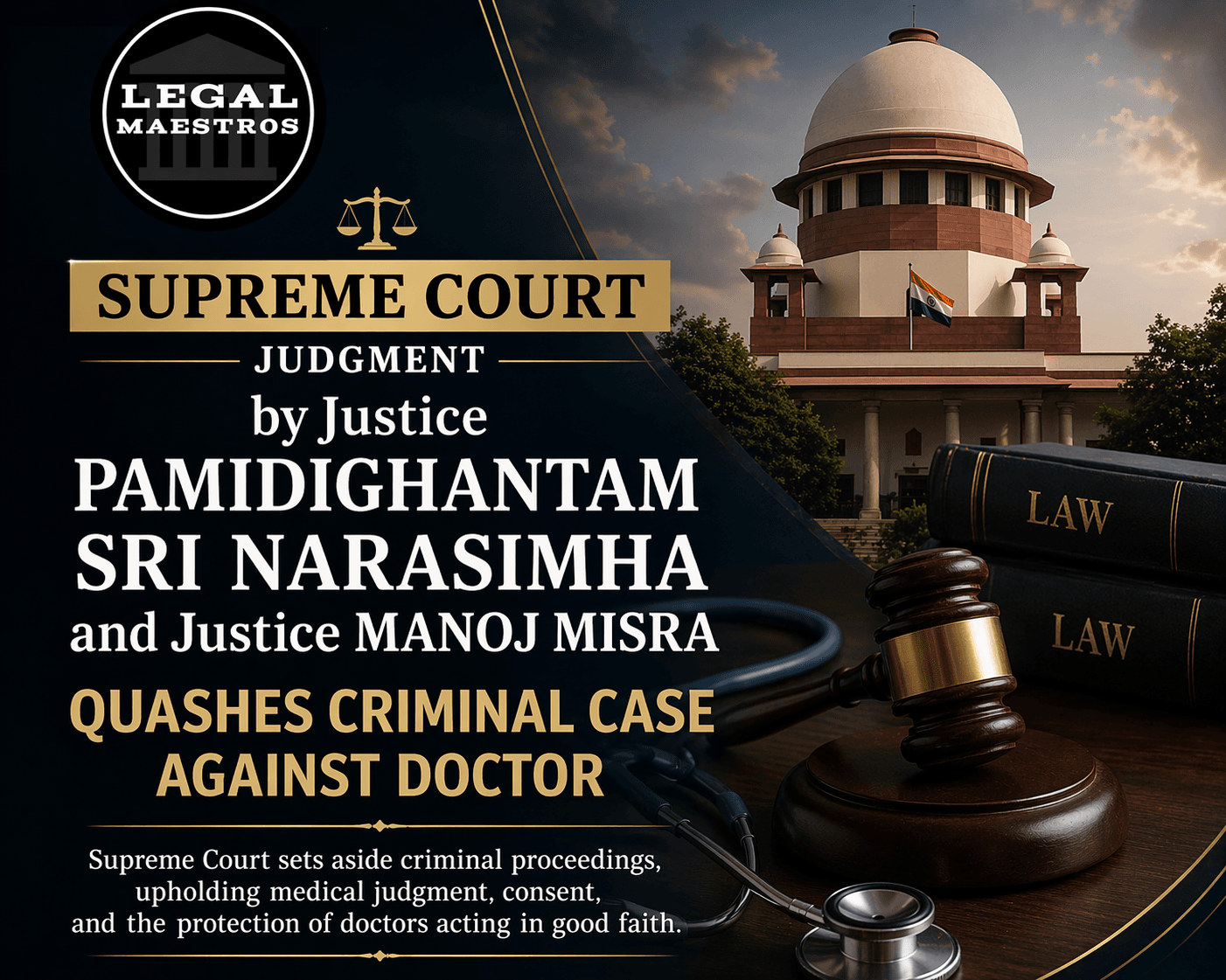
Supreme Court Judgment by Justice Pamidighantam Sri Narasimha and Justice Manoj Misra Quashes Criminal Case Against Doctor
Introduction In the case of Dr. S. Balagipal vs State of Tamil Nadu and Another, the Supreme Court of India…
Keeping Pace with Legal Change
Introduction In the case of Dr. S. Balagipal vs State of Tamil Nadu and Another, the Supreme Court of India…
Recently the supreme court of India made a landmark ruling on the interpretation and the existence of arbitration agreements especially…
Portion of a July 16, 2025 Supreme Court of India decision in an appeal examined by Birka Shiva versus The…
Section 69 of the Bharatiya Nyaya Sanhita, 2023, criminalizes sexual intercourse obtained through deceit, prescribing imprisonment up to seven years and a fine. It targets fraudulent inducement, ensuring accountability for deceptive practices in sexual interactions and protecting individuals from exploitation and breach of consent.
Section 67 of the Bharatiya Nyaya Sanhita, 2023, clarifies that consent remains critical in sexual relations during marital separation, prescribing punishment for non-consensual acts. It reinforces individual autonomy, ensuring legal protection against sexual violence within strained marital contexts, aligning with modern criminal justice principles.
Section 63 of the Bharatiya Nyaya Sanhita, 2023, redefines rape in India, expanding its scope to include non-consensual sexual intercourse by men against women, with stricter penalties. It emphasizes consent, addresses coercion, and ensures severe punishment, aligning with modern gender justice principles under criminal law.
This article provides an explanation of the process by which the Supreme Court determined whether or not sexual consent derived from a promise of marriage is valid. This paper investigates Section 376 of the Indian Penal Code and the legal framework that governs partnerships that involve adult consent and subsequent charges of rape.
Section 30 of the Bharatiya Nyaya Sanhita, 2023, exempts acts done in good faith for a person’s benefit without consent, when consent is impossible or the person is incapable, and no guardian is available. Exceptions exclude intentional death, grievous harm, or abetment.
Section 29 of the Bharatiya Nyaya Sanhita, 2023, clarifies that consent does not absolve liability for acts independently defined as offences, like causing miscarriage, ensuring legal accountability regardless of consent, protecting public safety and justice.
In a key ruling, Justice Satish Chandra Sharma of the Supreme Court held that failed romantic relationships between consenting adults cannot be treated as rape under Section 376 IPC without clear evidence of coercion, fraud, or false initial intent.