Introduction
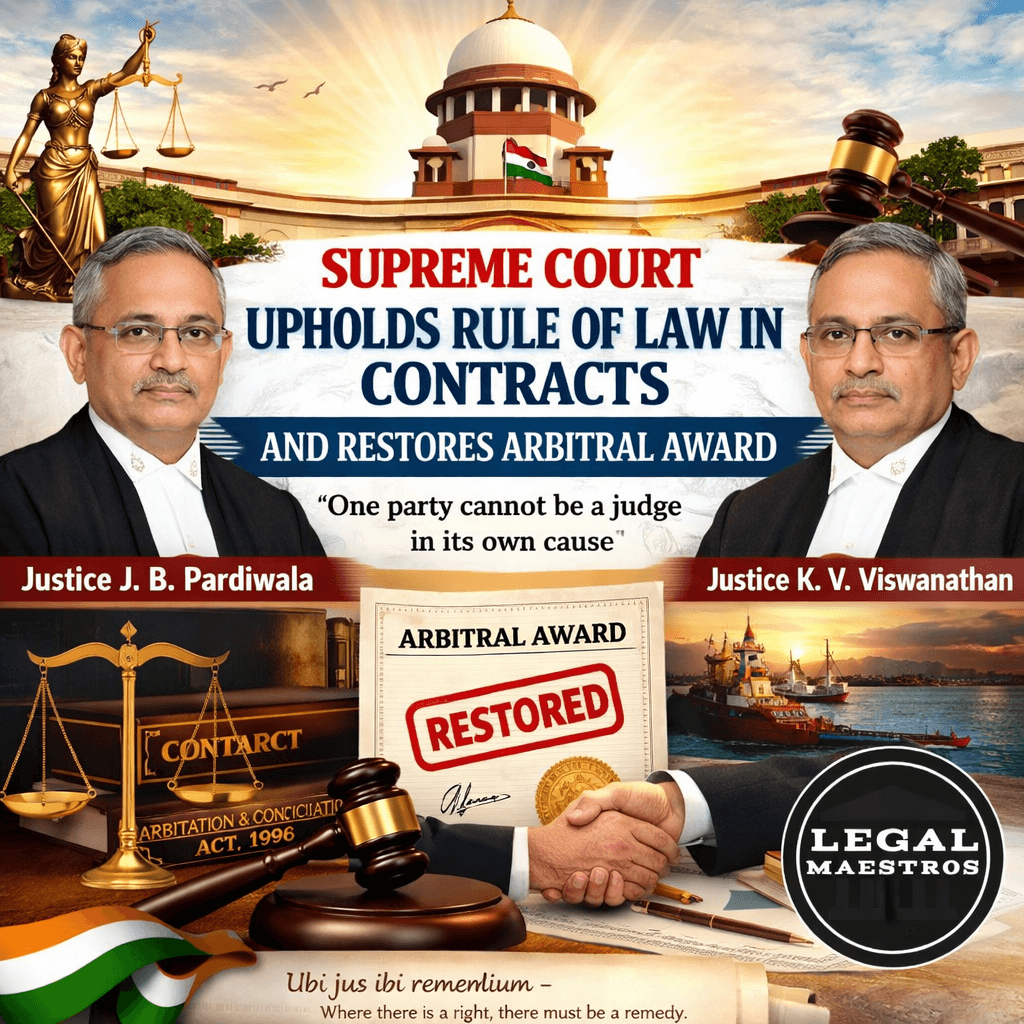
The Supreme Court of India, in an important judgment delivered on 23 March 2026, reaffirmed that contracts involving the government must follow the basic principles of fairness and rule of law. The Court made it clear that one party to a contract cannot act as a judge in its own case and cannot deny the other party access to legal remedies.
Facts of the Case
The dispute arose between a private company, M/s ABS Marine Services, and the Andaman and Nicobar Administration. The parties had entered into a contract for providing manpower services for ships. Under this agreement, the company was responsible for supplying officers for the vessels and was paid a fixed monthly fee.
During the contract period, one of the ships suffered damage after hitting a submerged rock due to rough sea conditions. The Administration blamed the company and imposed a heavy financial penalty. This amount was directly recovered from the company’s pending payments.
The company denied liability and challenged the recovery. The dispute was then referred to arbitration.
Decision of the Arbitrator
The arbitrator examined the contract and held that the clause used by the Administration to impose the penalty was invalid. The clause stated that the Administration’s decision would be final and could not be challenged in any court or through arbitration.
The arbitrator found that such a clause was against the law because it completely restricted legal remedies. The arbitrator ordered the Administration to return the recovered amount along with interest.
Need Help With Your PhD or LLM Thesis?
Explore our thesis and dissertation writing support services for PhD and LLM students. Get subject-specific academic assistance for your research project.
Explore Our Services →Proceedings Before Courts
The Administration challenged the arbitral award before the District Court, but the challenge was rejected. However, the High Court later set aside the award. The High Court held that the arbitrator did not have jurisdiction because the contract clause prevented arbitration in such matters.
The company then approached the Supreme Court.
Issue Before the Supreme Court
The main issue before the Court was whether a contractual clause can completely bar a party from approaching courts or arbitration, and whether one party can decide disputes on its own without any independent review.
Supreme Court’s Analysis
The Supreme Court carefully analysed the contract clauses. It observed that the arbitration clause in the agreement was very wide and covered all disputes between the parties.
The Court strongly criticised the clause that allowed the Administration to make a final decision without any challenge. It held that such a clause goes against basic legal principles.
The Court explained that no person or authority can be a judge in its own cause. If one party is allowed to decide whether the other party is at fault, it would be unfair and against justice.
The Court also relied on the principle “Ubi jus ibi remedium,” meaning that where there is a right, there must be a remedy. It stated that contracts cannot create a situation where a person has no legal remedy at all.
Interpretation of the Contract
The Supreme Court interpreted the disputed clause in a reasonable way. It held that the Administration could only decide the amount of loss in cases where the company admitted its fault. But when the company disputed liability, the matter had to be decided by an independent authority like an arbitrator or a court.
The Court emphasized that contract clauses must be read in a way that avoids injustice and does not eliminate legal remedies.
Final Judgment
The Supreme Court set aside the High Court’s decision and restored the arbitral award. It held that the arbitrator had acted within his jurisdiction and had correctly interpreted the contract.
The Court also warned against including unfair clauses in contracts, especially when the government is involved. It stated that such clauses undermine the rule of law and should not be encouraged.
Name of the Judges
The judgment was delivered by Justice J. B. Pardiwala and Justice K. V. Viswanathan.
Conclusion
This judgment is an important reminder that contracts must respect fairness and legal rights. Even in agreements with the government, no party can be given unlimited power to decide disputes without accountability. The decision strengthens the role of arbitration and courts in ensuring justice and protects parties from unfair contractual terms.
Keywords
Supreme Court judgment, arbitration law, contract law India, rule of law, arbitral award, unfair contract clause, government contracts, legal remedies, Ubi jus ibi remedium, judicial interpretation