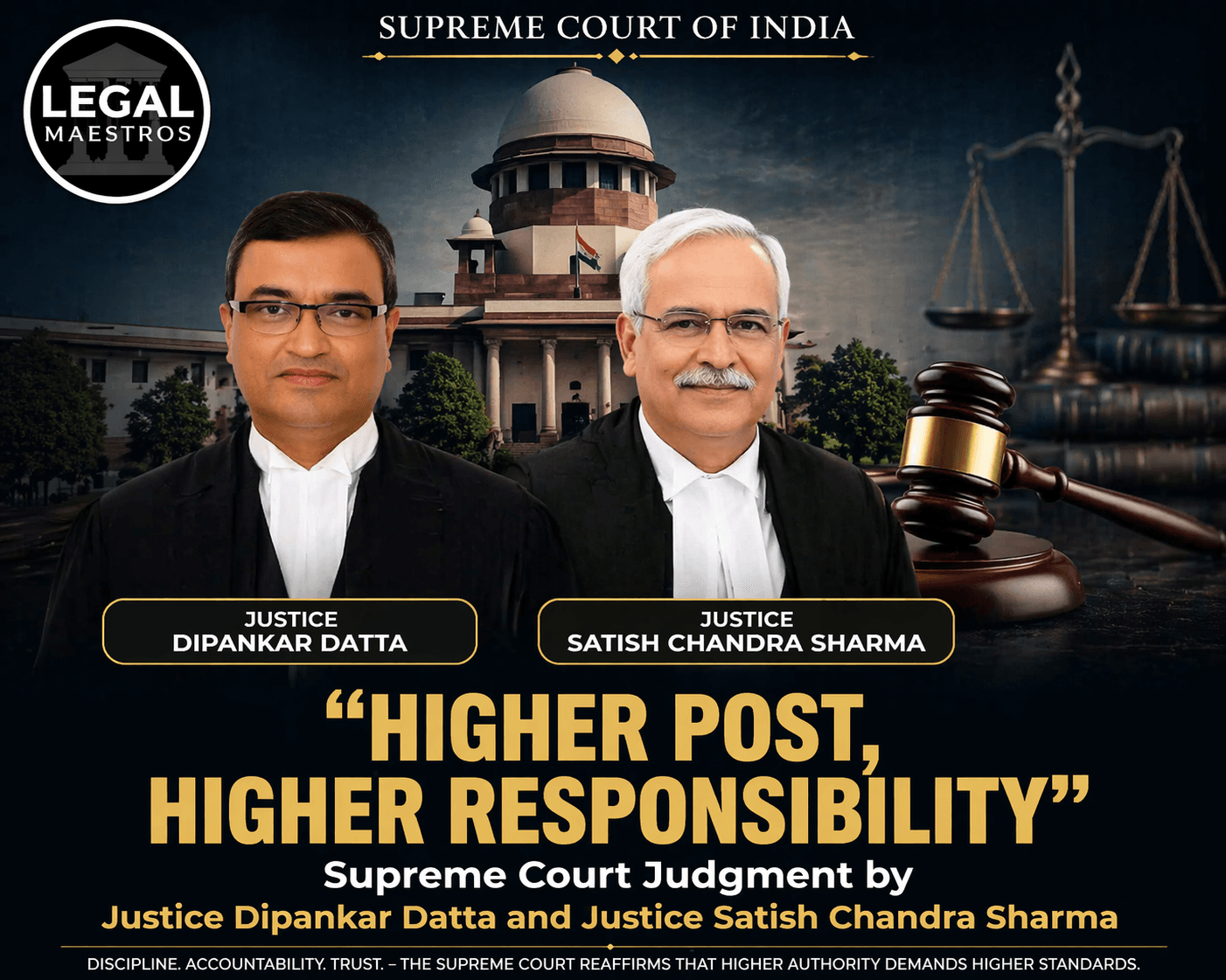
Higher Post, Higher Responsibility”: Supreme Court Judgment by Justice Dipankar Datta and Justice Satish Chandra Sharma
Here is a simple English article with headings, based on the Supreme Court judgment you provi The Supreme Court of…
Keeping Pace with Legal Change
Here is a simple English article with headings, based on the Supreme Court judgment you provi The Supreme Court of…
Introduction The Supreme Court of India made a judgment in Chinthada Anand vs State of Andhra Pradesh & Others. The…
Introduction The Supreme Court of India made a decision in the case of M/s Rashtriya Chemicals and Fertilizers Ltd. Vs…
Introduction The Supreme Court of India, in a significant judgment delivered on 23 March 2026, dealt with a dispute relating…
Introduction The Supreme Court of India, in an important judgment delivered on 23 March 2026, reaffirmed that contracts involving the…
Recently, the Supreme Court of India answered a crucial question of whether an entry made in the balance sheet of…
Asian paints limited v. Ram Babu & Another on July 14, 2025 is an important legal case of addressing the…
In the case of Adavya Projects v. Vishal Structurals, the Supreme Court made it clear that the failure to serve Section 21 notice does not impede impleadment in arbitration provided the parties accepted to the arbitration agreement. This decision highlights the fact that the jurisdiction of the tribunal is derived from consent rather than from compliance with the procedures.
The defamation charges against homeowners who were demonstrating against a builder were dismissed by the Supreme Court of India, which affirmed the homebuyers’ fundamental right to peaceful dissent in accordance with Article 19(1)(a). The verdict sheds light on important problems in defamation law, particularly the Ninth Exception to Section 499 of the Indian Penal Code.
This article provides an analysis of the decision that was handed down by the Supreme Court on April 17, 2025, which upheld the conviction of a father for the murder of his kid. This report analyzes the facts, looks at Sections 302 of the Indian Penal Code and Section 25/27 of the Arms Act, and investigates how the verdict of the court was influenced by circumstantial evidence, motivation, and forensic results.