Introduction
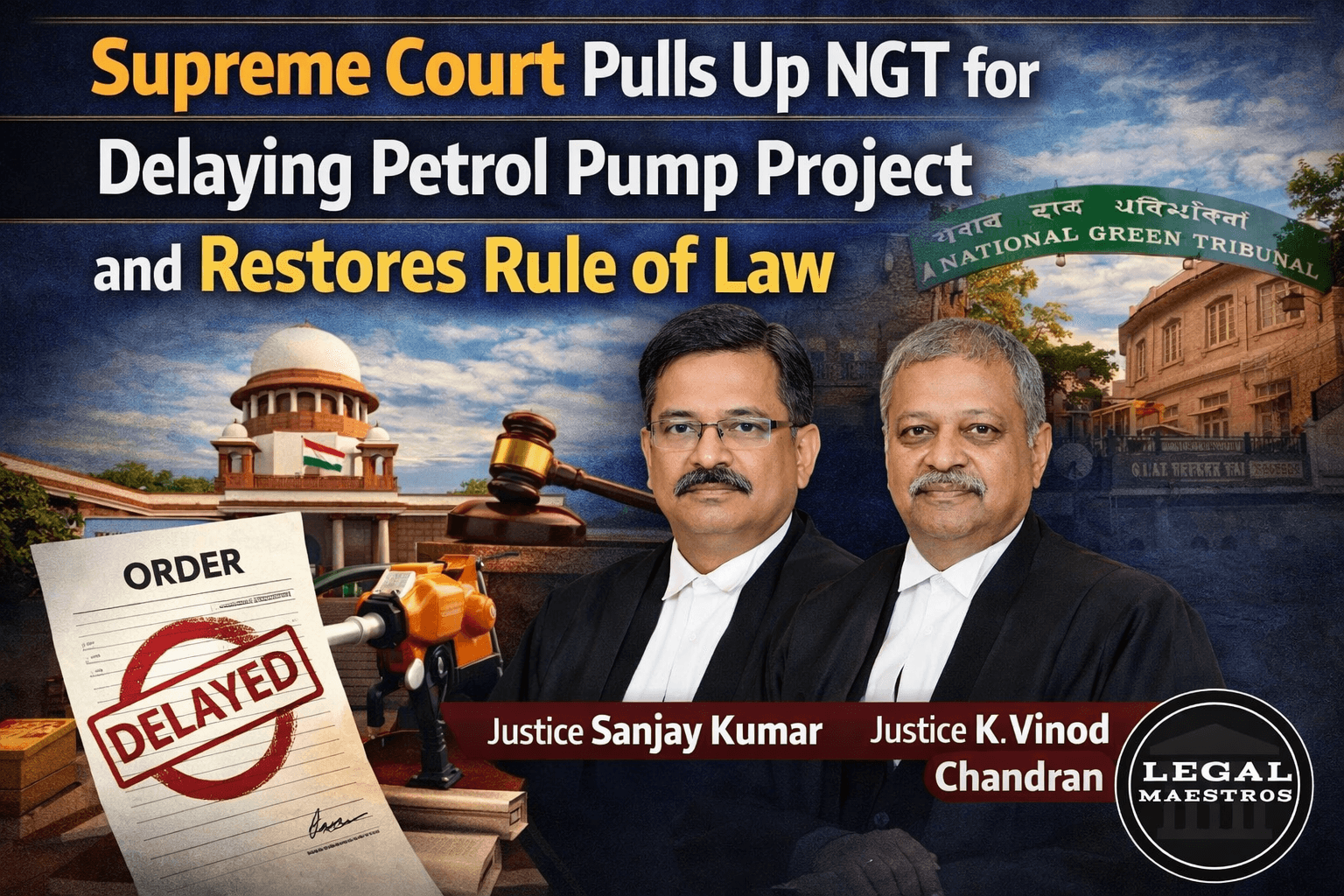
The Supreme Court of India, in a significant judgment delivered on 23 March 2026, dealt with a dispute relating to the setting up of a petrol pump. The Court strongly criticised the functioning of the National Green Tribunal (NGT) and emphasised that judicial bodies must decide cases themselves instead of passing responsibility to committees.
Facts of the Case
The case involved Indian Oil Corporation Ltd. and others who were granted permission to set up a petrol pump. A person approached the NGT claiming that the petrol pump was being set up in violation of environmental guidelines, particularly those issued by the Central Pollution Control Board regarding distance from schools, hospitals, and residential areas.
The NGT, instead of deciding the issue, asked a committee to examine the matter. Even though the committee initially found that the petrol pump could be established, the NGT relied on general environmental concerns and kept the project in uncertainty.
Later, without proper notice to the parties, the NGT passed another order directing authorities to ensure compliance with its earlier directions. This further delayed the project.
Issue Before the Supreme Court
The main issue before the Supreme Court was whether the NGT had acted properly in handling the dispute and whether it could delegate its decision-making power to committees instead of deciding the matter itself.
Supreme Court’s Analysis
The Supreme Court examined the role of the NGT and made it clear that it is an adjudicatory body, which means it must decide disputes on its own. The Court held that committees can only assist the tribunal, but they cannot replace the tribunal’s role.
The Court found that the NGT had failed to properly examine the reports submitted by the committees. It also noted that the tribunal passed orders without giving proper opportunity to the affected parties, which is against the principles of natural justice.
Interpretation of Environmental Guidelines
The Court carefully looked at the guidelines regarding the location of petrol pumps. These guidelines require a certain distance from schools, hospitals, and residential areas. However, the Court found that the proposed site was located in a commercial area and did not violate the required distance rules.
It also observed that some of the concerns raised, such as the presence of a school, were not valid since the school was no longer operational. The reports showed that all necessary permissions and safety measures had been complied with.
Criticism of the NGT
The Supreme Court strongly criticised the NGT for not performing its duty properly. It stated that the tribunal had “abdicated” its responsibility by leaving the decision entirely to a committee.
The Court also pointed out that passing orders without hearing the parties is a serious violation of natural justice. It emphasised that judicial bodies must follow fair procedures and cannot act in a casual manner.
Final Judgment
The Supreme Court set aside both orders passed by the NGT. It allowed the appeals and directed that the matter be reconsidered by the District Magistrate based on current legal requirements.
The Court also made it clear that if all legal conditions are satisfied, the petrol pump should be allowed to be established without further delay.
Name of the Judges
The judgment was delivered by Justice Sanjay Kumar and Justice K. Vinod Chandran.
Conclusion
This judgment reinforces the importance of accountability in judicial bodies like the NGT. It makes it clear that tribunals must decide cases themselves and cannot shift responsibility to committees. The decision also protects business activities from unnecessary delays while ensuring that environmental laws are properly followed.
Keywords
Supreme Court judgment, NGT powers, petrol pump case, environmental law, natural justice, CPCB guidelines, Indian Oil Corporation, tribunal responsibility, judicial review, commercial activity