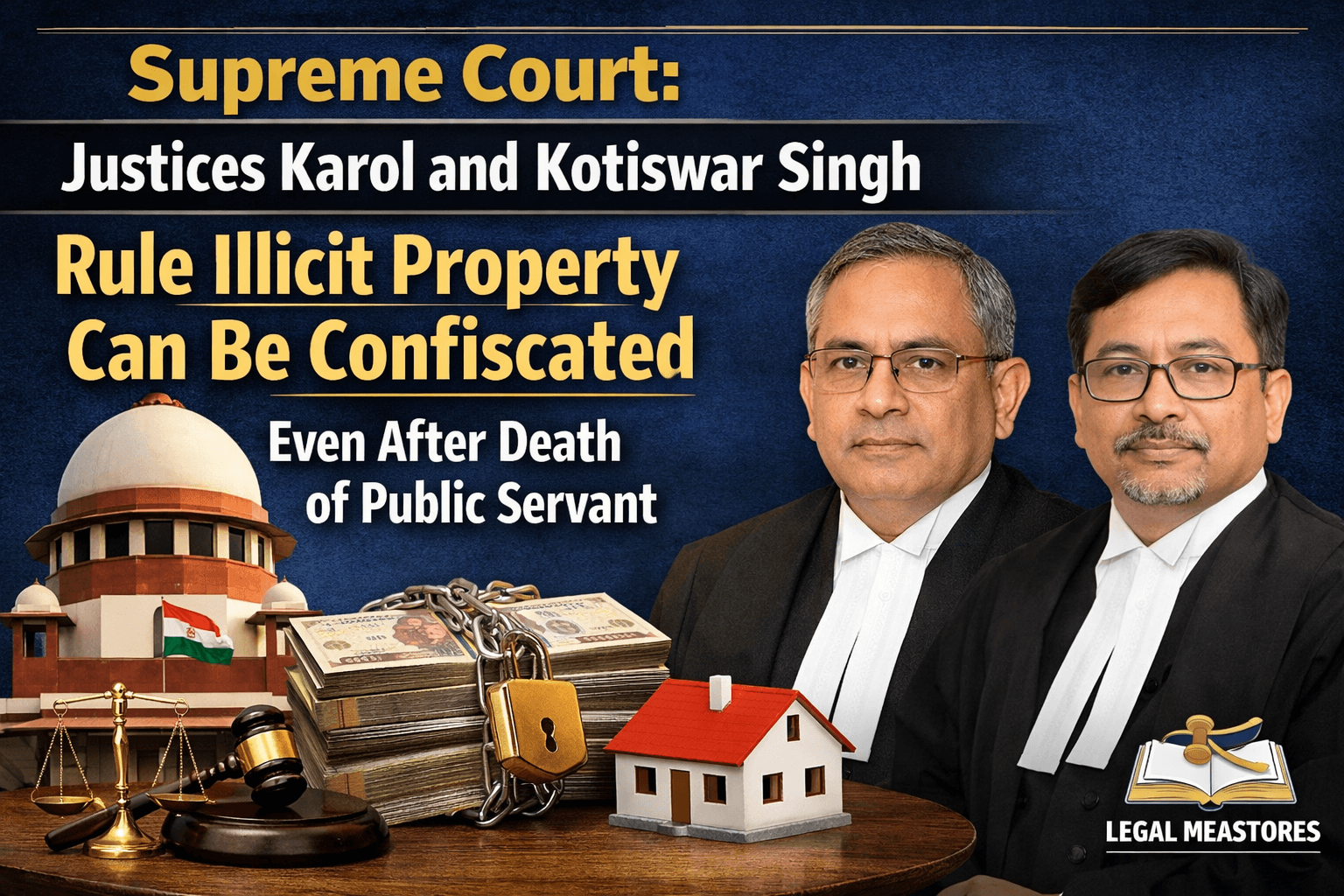
Death of Accused Does Not End Confiscation Proceedings: Supreme Court Clarifies Law
Introduction
The Supreme Court of India, in a significant judgment delivered on 20 March 2026, examined whether confiscation of property can continue after the death of a public servant accused of corruption. The case arose from appeals filed by the State of Bihar challenging High Court decisions that had set aside confiscation proceedings after the death of the main accused.
Facts of the Case
The case involved a government officer who was accused of possessing assets disproportionate to his known sources of income under the Prevention of Corruption Act. According to the allegations, he had accumulated wealth over several years, including properties and monetary assets.
During the investigation, authorities also identified properties held in the name of his wife. Confiscation proceedings were initiated under the Bihar Special Courts Act, 2009. The authorised officer, after examining the evidence, ordered confiscation of several assets, concluding that they were acquired through illegal means.
However, during the pendency of the appeal before the High Court, the accused public servant died. The High Court held that since the main accused had died, the proceedings could not continue and the confiscation order was set aside.
Issue Before the Supreme Court
The main question before the Supreme Court was whether confiscation proceedings against property, including property held in the name of family members, automatically come to an end upon the death of the accused public servant.
Arguments by the Parties
The State argued that confiscation proceedings are different from criminal trials and do not automatically end with the death of the accused. It was submitted that the law only allows return of confiscated property in specific situations, such as acquittal or modification of the order by a higher court.
On the other hand, the respondent argued that since the accused had died, the proceedings could not continue and there was no legal provision to proceed against family members.
Understanding the Law on Confiscation
The Court examined the provisions of the Bihar Special Courts Act, which allows confiscation of property believed to be acquired through illegal means. It clarified that confiscation proceedings are not purely criminal in nature. They are aimed at taking away unlawfully acquired property and can involve persons other than the public servant, such as family members who hold such property.
The Court also explained the concept of abatement. It held that criminal proceedings may end upon the death of the accused, but this does not mean that all related proceedings automatically stop. Confiscation proceedings, being distinct, can continue.
Court’s Reasoning
The Supreme Court observed that the law specifically provides only two situations where confiscated property can be returned: when the confiscation order is modified or annulled, or when the accused is acquitted. Death of the accused is not one of those situations.
The Court further noted that the respondent (wife) had been given notice and an opportunity to explain the source of the assets. Therefore, proceedings against her were valid and could not be dismissed simply because her husband had died.
It also emphasised that even non-public servants can be proceeded against if they are found to be holding illegally acquired property connected to a public servant.
Final Decision
The Supreme Court set aside the High Court’s judgment and restored the matter for fresh consideration on merits. It directed the High Court to decide the case properly instead of dismissing it merely due to the death of the accused.
Both appeals filed by the State were allowed.
Name of the Judges
The judgment was delivered by Justice Sanjay Karol and Justice Nongmeikapam Kotiswar Singh.
Conclusion
This judgment makes it clear that confiscation proceedings under special laws like the Bihar Special Courts Act do not automatically end with the death of the accused. The focus of such proceedings is on the property and its legality, not merely on the person accused. The decision strengthens the legal framework against corruption by ensuring that illegally acquired assets cannot escape confiscation simply due to the death of the offender.
Keywords
Supreme Court judgment, confiscation of property, Prevention of Corruption Act, Bihar Special Courts Act, death of accused, disproportionate assets, corruption law India, abatement of proceedings, illegal property, judicial interpretation