High Court Deems Tragedy in History as the most shocking.
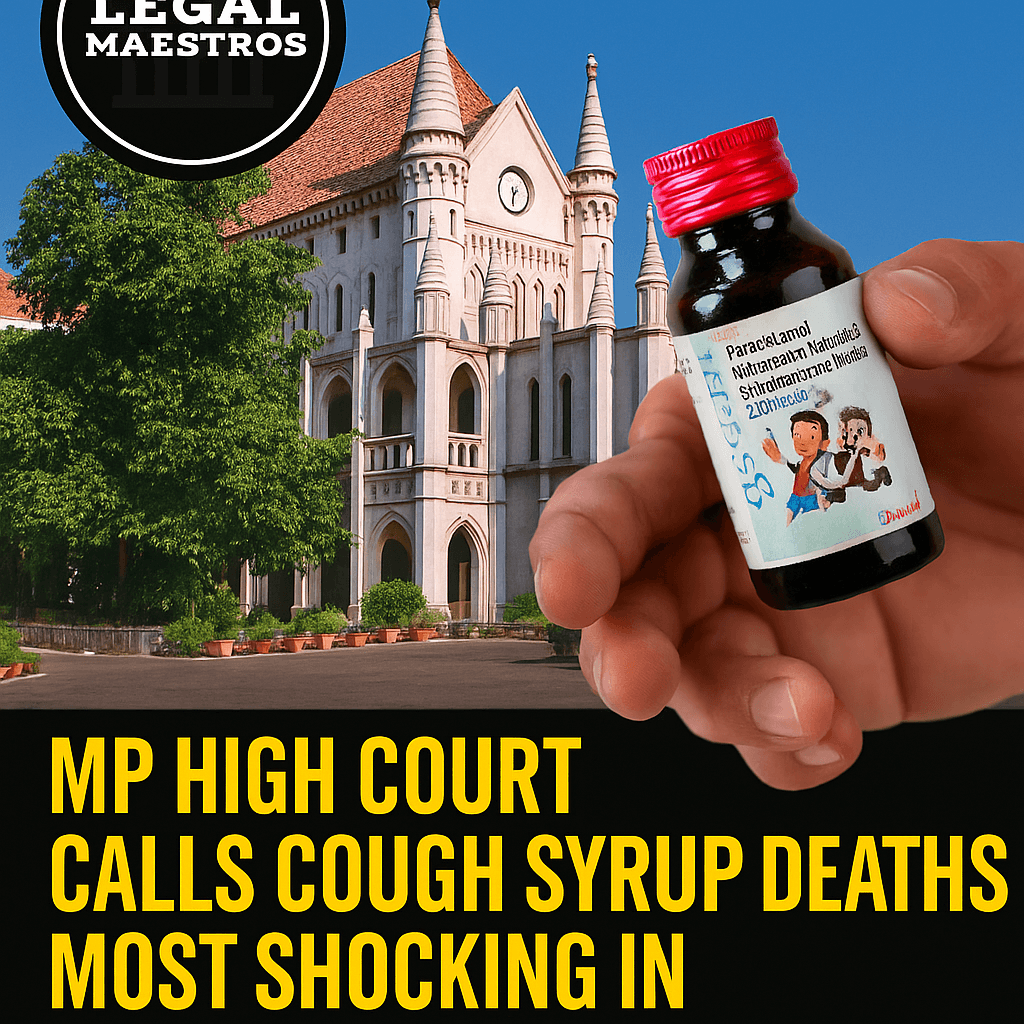
The Madhya Pradesh High Court has made a scathing remark about the recent cough syrup tragedy that had claimed the lives of many children in the state. During a recent hearing, the court called the incident one of the most shocking cases in the history of medicine. This powerful observation was made in the process of the bench hearing an appeal over an appeal having been filed by a local distributor of the pharmaceutical products in question. The distributor had appealed against the ruling of the administration to close his medical store and revoke his license to sell drugs after the catastrophe.
The fact that the court made this observation highlights the severity of the crisis that struck the Chhindwara and Shivpuri districts which has never been experienced before. The judges were amazed by such a loss size as they remarked that innocent human lives were just snuffed out out of negligence and greed. The judiciary has sent signals that the case transcends the ordinary medical negligence by classifying it as a historically shocking case. It points out a structural failure where a simple cure to a cold contaminated into a poison to small children.
The court rejected the appeal by the distributor to be relieved by the court as the administrative measures taken against him were reasonable considering the severity of the case. The bench stressed that where the public safety is jeopardized on such a disastrous level, there should be strong actions. The closure of the shop and cancelation of the license were considered to be the correct immediate measures that had to be taken to avoid further spread of the toxic substance. This decision can be viewed as a stern reminder by all the stakeholders of the pharmaceutical supply chain of their responsibility.
The position of the court indicates the social outrage and the great sorrow of people who lost their children. It recognizes that it is not only a violation of regulation that poor quality medicine is distributed but a violation of the right to life in itself. The judiciary positively put the rights to the victims ahead of the commercial interests of the business owners in question. This hearing has also put new emphasis on the case at the national level thus making it a priority to the investigative agencies.
The Unraveling of a Health Care Nightmare.
The tragedy took on a new face when children in the Chhindwara district started exhibiting signs of serious and strange symptoms after receiving treatment on common cough and colds. Their parents would take their small ones to the nearby physicians and believe that medicine prescribed by the doctor will help the poor kid. The conditions of the children worsened at a very rapid pace and many of them were found to have acute kidney failure. These victims were all found to have a common factor which was a certain brand of cough syrup called Coldrif.
As soon as the number of dead people had started increasing, panic set in among the population of the affected districts. The fact that the number of deaths in relation to kidneys in such a young population has suddenly risen puzzled the health officials initially. This required a thorough research to trace the cause to the bottles of syrup placed in the shelves of the local chemists. When the connection was finally traced, dozens of the children had already ingested the poisonous combination.
Need Help With Your PhD or LLM Thesis?
Explore our thesis and dissertation writing support services for PhD and LLM students. Get subject-specific academic assistance for your research project.
Explore Our Services →The tragic tales of parents scurrying to the hospitals in Nagpur and Bhopal painted a very bleak picture of the disaster that was going on. Most of the families sold their jewellery and land to get advanced medical treatment and lost their children in the process. The entire medical society was devastated because it had come to the realization that the same medicine that they used to treat was inflicting permanent damage on the organs. The outbreak of the disease and the fact that it was not a natural disaster, but man-made was a deeper source of rage to the grief.
The government response departments were later on mobilized to take stocks of the syrup, but to many it was already too late. The time taken to detect the poisonous substance enabled the syrup to stay in circulation long enough. This time lag was deadly to the victims who were injectioned with the syrup in the early days of the outbreak. The incident revealed the significant weaknesses in the diseases surveillance and monitoring of drugs used by the state.
The Poisonous Substance Under the Murders.
The chemical composition of the seized “Coldrif” syrup was analyzed forensically which showed a frightening truth about its composition. The laboratories that were conducting the tests discovered that the syrup had a high concentration of Diethylene Glycol (DEG) which was dangerous. DEG is a very toxic chemical that is normally employed in industries, including in brake fluids and antifreeze, and which should not under any circumstances be used in edible products. Its inclusion in a child medicine was a sign of a colossal collapse of measures of safety in the manufacturing.
Experts justified that Diethylene Glycol is usually a less expensive substitute in place of Propylene Glycol or Glycerin which are non-toxic solvents applied in syrups. Some unscrupulous manufacturers may replace the safe ingredients with the toxic industrial one to reduce the cost of production. Here, the concentration of the toxin was so large that was practically a poison. The chemical damages the kidneys and they become fully shut down hence multi-organ failure.
When the samples tested positive of DEG, parallel conclusions were immediately drawn with comparable tragedies that have been experienced in other regions across the globe. It was an indication of an intentional contamination or gross negligence at the production level. What was very questionable was that such a deadly substance could go through quality checks and still pass without raising any concerns on the integrity of the manufacturing company. It also created awareness on the fact that raw materials have not been strictly tested prior to their being sent to manufacture finished medicines.
Even the trace of the DEG is not acceptable in the pharmaceutical products as pointed out by the regulatory bodies. Its content in large amounts implied that the manufacturer had totally ignored normal safety standards. The chemical examination turned out to be the smoking gun that made the case change to a medical investigation to a criminal one. This gave the tangible facts to act on the legal action against the producers and suppliers.