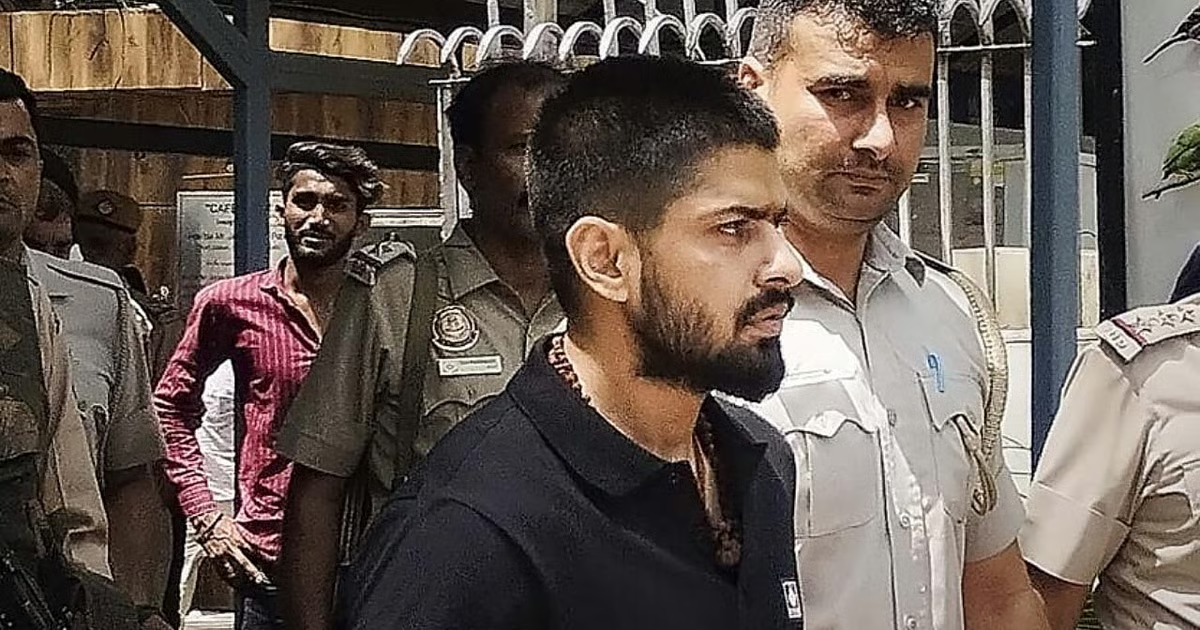
Lawrence Bishnoi is surrounded by the walls. On April 21, 2026, a Delhi court framed charges against him and 19 of his associates. It is not another flimsy cop complaint that could crumble in court. Further Sessions Judge Prashant Sharma released a huge 79-page order that described a very organized interstate crime syndicate. The prosecutors are unleashing the big guns. They referred to Maharashtra Control of Organised Crime Act commonly referred to as MCOCA. They heaped on with it grave infractions of the Arms Act and the Explosives Act.
Defense attorneys despise combating MCOCA. The law was constructed to shatter cartels and mafias which act with complicated chains of command. You couple this particular law, with hard bodily evidence of weaponry trafficking and it becomes almost impossible that a gang leader will beat the rap.
There are two approaches to decoding the MCOCA Trap.
Syndicate bosses are often out of reach of frequent criminal indictments. The boys at the very head seldom draw the trigger themselves. They simply take a phone call or send a message. According to the typical provisions of Indian Penal Code, it is necessary to involve the witnesses who could testify against dangerous individuals to establish the boss as the cause of a shooting in the street. The witnesses nearly always become hostile in fear.
MCOCA redefines the whole legal system. It is aimed at the enterprise. Organized crime is a continuing lawless activity that is defined by the law as being executed, either by an individual alone or together, as a part of a crime syndicate. Police only have to demonstrate that a gang has been charged with at least two of the most serious offenses over the past decade in order to invoke it. Bishnoi has that box checked in records. He has dozens of cases spread in Punjab, Rajasthan, Haryana and Delhi.
In this act, the acquisition of wealth by violence or intimidation is the main offense. Prosecutors need not demonstrate that Bishnoi was present at a crime scene. All they need to show is that he was at the centre of a web that was using money to make pecuniary gains. The act has section 3 that deals with the aspect of organized crime. Section 4 is aimed at anyone who is unaccountable on the wealth of the gang. Delhi Police Special Cell contended that Bishnoi was the main facilitator. He had his top lieutenants like Sandeep alias Kala Jatheri and Sampat Nehra who were in charge of the street-level logistics, execution, and communication.
After the Extortion Money to the Arsenal
Extortion is not a crime that will hold any water when the cops are unable to trace the cash. This is precisely where the Arms Act charges help to strangle. The new court ruling traced the path of the dirty money of the gang. They threatened local businessmen, constructionmen and liquor store owners. The syndicate systematically raised high charges on protection.
Whatever happened to that money? The prosecution provided solid documents that indicated that those funds were used directly to fund an illegal arsenal.
Law enforcers found a huge arsenal of weapons. We are discussing pistols, assault rifle, grenades, and thousands of live cartridges. The court observed that the flow of protection money was equal to the acquisition of such advanced weapons. The police created a paper trail by following the money trail of a frightened home construction professional directly to the illegal gun dealers. Paper trails are not threatened. They do not forget what has occurred on the stand. The state seals the disparity between the stolen money and the caused terror by charging key players under the Arms Act due to holding these particular weapons.
The Issue with Operating out of a Jail Cell.
You would imagine you were locked up since 2014 and that would be an alibi. It was a boomerang to the defense. Bishnoi is now imprisoned in the high-security Sabarmati Central Jail, Gujarat. The Home Ministry even gave a strict order in late 2025 confining his movements outside that prison on the basis of extreme law and order.
Although it was isolated, the 79-page judicial order pointed out that the gang still operated behind bars. Mobile phones were constantly being found smuggled into prisons. Voice over IP calls were used by the gang members to coordinate hits and extortion rackets. Prison account records were pulled by the police. They discovered that alleged members of the gangs were living a high lifestyle within the jail with large amounts of unexplained money being deposited in their prison accounts.
This documentation makes a direct back into MCOCA structure. It creates a chain of command and uninterrupted benefit of illegal financial gain. It meets the most stringent demands of the law. The state also indicated that the syndicate had a large network that extended to as far as Canada and Thailand whereby some of the members were working using fake passports so that nothing could be detected.
Why Previous Acquittals Will not come to the rescue here.
To know why the April 2026 charges are so perilous to the Bishnoi camp, it is helpful to refer back to recent history. In a case filed in the Arms Act, only a few months ago, in October 2025, a court in Mohali acquitted Bishnoi and three other individuals. This case failed due to the fact that it was only based on the police disclosure statements and the testimony of one sub-inspector on the fact that a gun was discovered on a street-level associate. The judge dismissed it. Custodial confession in absence of corroborating physical evidence is of no value in an ordinary criminal trial.
MCOCA has no weakness to that usual loophole in the law.
The organized crime act expressly permits confessions to senior police officers to be sent to be used as evidence in court. That is a monumental change in the game. Admissible confessions in conjunction with bank accounts, prison account deposits, wiretaps and a mountain of recovered assault rifles leaves the defense with no way to escape.
This particular FIR by the Delhi Police Special Cell was constructed during a period of three years (2021). They obtained the obligatory prior consent with Section 23 of MCOCA even prior to proceeding. The judge examined site plans, the official records, the witness statements, and the money trail. He said that he could not question the evidence now. Now a full-fledged trial is fixed. The prosecution has made a direct connection between the gang leader and the extortion money, and the extortion money and the guns.