Introduction
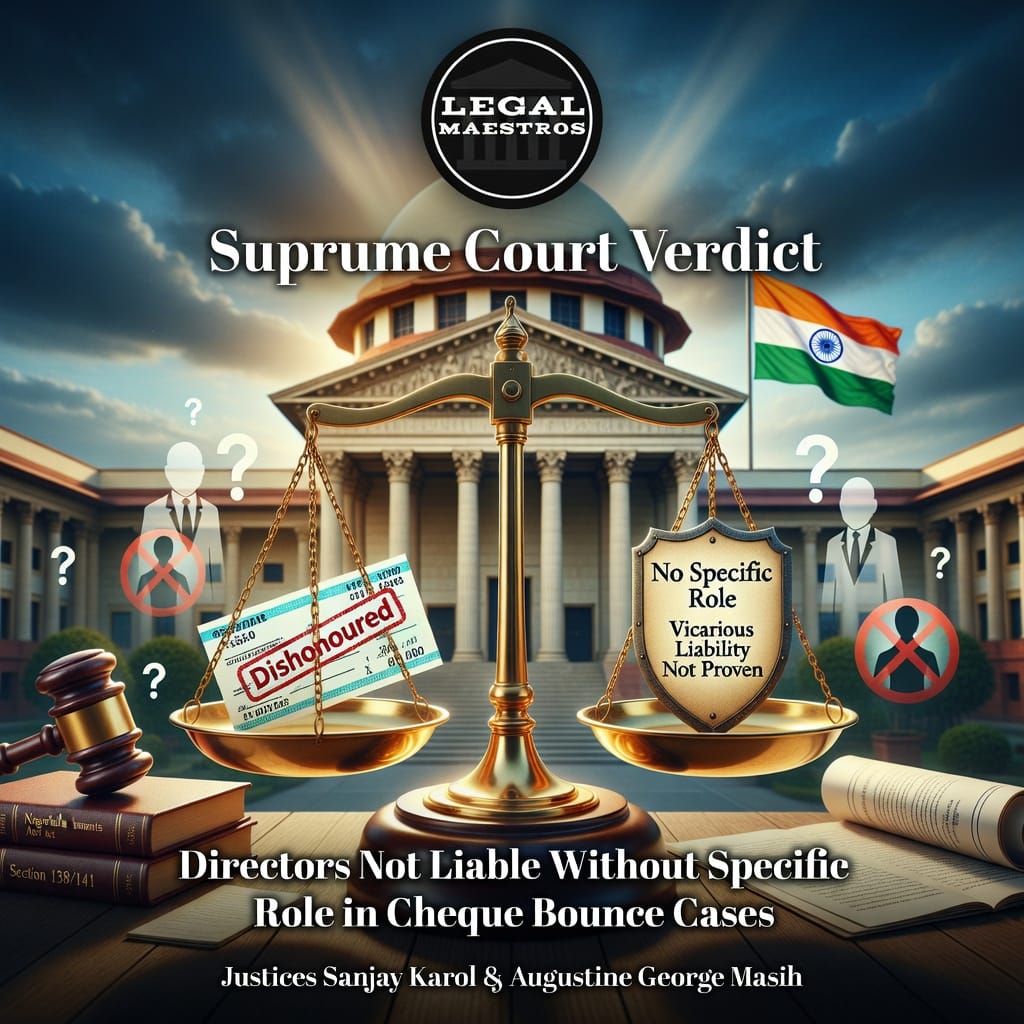
In the case Saroj Pandey vs Govt. of NCT of Delhi, the Supreme Court of India gave an important judgment that clarifies the law concerning the liability of company directors in cases involving cheques bouncing. Justice Sanjay Karol and Justice Augustine George Masih passed the judgment on 7 April 2026.
Such decision reinforces the alleviation of directors who do not participate in the daily operation of a company and eliminates the abuse of criminal law.
Background of the Case
The case originated as a complaint made in the stipulations of the Negotiable Instruments Act, 1881, especially in the Section 138 and 142, which address the issue of the dishonour of cheques.
The Projtech Engineering private limited, the accused company, had also given three cheques worth huge sums of money to make payment of iron and steel. Nonetheless, such cheques were not honoured because of signature noncongruency and forgery. Consequently, a lawsuit was filed against the firm and its directors, including Saroj Pandey.
The trial court summoned and both the High Court and the Sessions Court denied her request to quash proceedings.
Before the Court Via an issue.
The question of the Court was whether Saroj Pandey as a director of the company was liable under the Act in terms of the provisions of Section 138 with Section 141 of the Act in criminal proceedings, without any particular alleged involvement in the day-to-day running of the company.
Knowledge of the Directors Liability Law.
The Court has discussed Section 141 of the Negotiable Instruments Act which concerned an offence in which companies are involved.
It is made clear in the law that only individuals, who are in charge and responsible of the conduct of business of the company at the time of the offence, can be held liable.
The Court based its decision on the previous landmark cases like S.M.S. Pharmaceuticals Ltd. v. Neeta Bhalla and Gunmala Sales Pvt. Ltd. v. Anu Mehta that confirmed that to be criminally liable, it is not sufficient to be designated as a director.
Findings of the Supreme Court
The facts in question were carefully examined by the Supreme Court, and the sole allegation against Saroj Pandey consisted in the fact that she had signed a Board Resolution.
The Court noted that by signing a Board Resolution, a director is not supposed to be engaged in the day-to-day affairs of the company. Board Resolutions are more of a general decision made at a greater level and is not an indication of active involvement in the day to day running of the business.
Notably, the complaint lacked any particular statement indicating that she could be liable to the actions of the business of the company.
The Court decided that this lack of particular averments is lethal to the prosecution.
High Court mistake.
She had been refused a petition by the High Court under her Section 482 of the Code of Criminal Procedure and said that where a revision petition had been filed, the Section 482 was then narrowed.
This reasoning was not in agreement with the Supreme Court. It made it clear that the inherent powers of the High Court in Section 482 are independent and may be exercised to avert miscarriage of justice even where a revision petition has been already filed.
Final Judgment
Supreme Court permitted the appeal and stayed the criminal proceedings against Saroj Pandey.
It believed that the prosecution against her could not be pursued any further because there was no material on which to demonstrate her role in the day to day running of the company.
The Court also explained that the case it observes is restricted to her case and will not impact on the trial of other accused individuals.
Significance of the Judgment
This verdict has great significance to the corporate law and criminal law in India.
It spares the independent and non-executive directors the inconveniences of being dragged into criminal cases unnecessarily. It also establishes the fact that criminal responsibility is impossible to establish without definite and clear accusations.
The ruling makes sure that the provisions of the cheque bounce law are not abused as a means of harassment.
The decision taken in the case of Saroj Pandey indicates a moderate stand of the Supreme Court. Although the offences of cheque dishonour were taken seriously, the Court made sure that the innocent directors are not subjected to punishment without evidence.
This decision enhances legal transparency and fosters justice in corporate criminal responsibility.
Keywords
Saroj Pandey, Supreme Court case, bouncing of cheques, Negotiable Instruments Act, Section 138, Section 141, director liability, Justice Sanjay Karol, Justice Augustine George Masih, quashing of proceedings, criminal law, corporate law.