Introduction
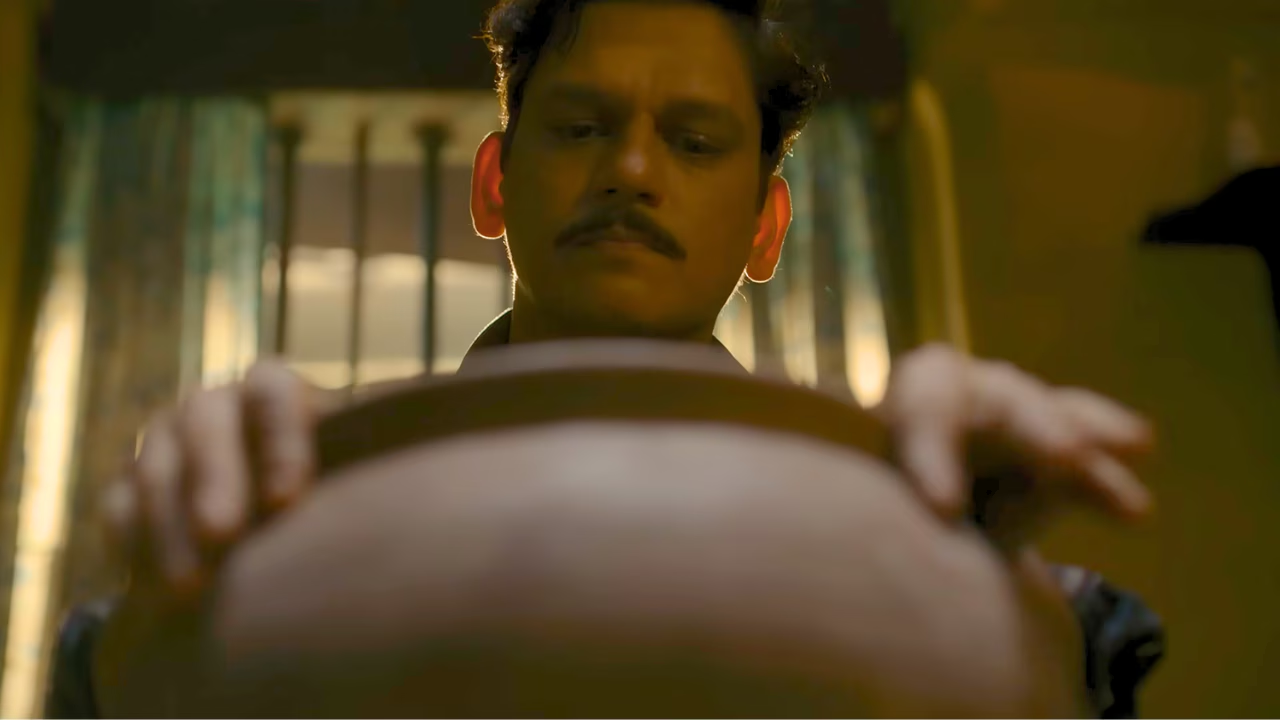
A new show Matka King, featuring Vijay Varma, has helped focus a new light on the long and tortuous relationship between India and gambling. Although the show is supposed to dramatise the emergence of the Matka gambling system, it also represents a greater legal and social fact- that India is still trying to control betting and gambling. Since the colonial days, when gambling was banned, and the new laws today seem to be divided and debatable, the law regarding gambling in India has changed and transformed.
What is Matka Gambling?
Matka is a type of lottery-like gambling which began in India in the 1960s. It started by gambling over cotton rates dispatched at the New York Cotton Exchange. Gradually it became a system of betting based on numbers, especially in the cities such as Mumbai.
Matka still exists in the underground networks though it is not legal and in many cases associated with organised crime. The fact that such systems are so popular shows the disconnect between law and ground reality.
Gambling Laws have Colonial origins.
The major gambling law in India is the Public Gambling Act, 1867, which originates back to the British colonial rule. This legislation was to be used in reducing the activities of gambling houses and betting by the people.
Nevertheless, this law was developed in a much different time frame and fails to cover present-day types of gambling, in particular online gambling and Internet applications.
Since independence, gambling was a state subject to the Constitution, that is; every state can regulate or prohibit it.
Post-Independence Legal Framework
Various states in India have taken different perspectives to gambling. Other states such as Goa and Sikkim have legalised some types of gambling that are strictly regulated such as casinos.
Strict bans are still enforced in other states by their respective laws. This has led to a piece meal legal system where gambling can be legal in a state and illegal in the other.
This discrepancy brings enforcement and compliance problems.
Skill vs Chance Debate.
Among the most notable legal differences in law over Indian gambling is the difference between games of skill and games of chance.
Indian courts have ruled that games where there is a high level of skill like rummy and horse racing can be legal. Conversely, games that are entirely dependent on luck such as Matka are usually not allowed.
This difference has been a source of a number of lawsuits, particularly with regard to online gaming platforms.
Online Gambling.
The recent years revealed the development of internet connection and mobile technology, which resulted in the rise of online betting and gambling platforms.
Quite a few of these platforms are based outside India, and it is hard to regulate them. Betting applications and websites are easily accessible to the users, usually circumventing local regulations.
This has led to the concern of addiction, financial fraud as well as inadequate consumer protection.
2025 Nationwide Crackdown
In reaction to the increasing vice, the governments of India have increased crackdown measures in 2025. The crackdown involves the raid of illegal gambling houses, the blocking of online betting websites, and tightening of financial operations.
The law enforcers have also been cracking down on organised groups that engage in Matka and other forms of illegal betting.
The crackdown indicates the desire of the government to introduce more control in gambling operations and safeguard the citizens against exploitation.
Juridical Problems in Implementation.
In spite of these initiatives, gambling laws are hard to enforce. Illegal betting is difficult to trace and eradicate due to its underground nature.
There is an added complexity with online platforms, which can frequently cross jurisdictions. This makes it challenging for authorities to take effective action.
Laws as well are not uniform and this provides loopholes that can be exploited.
Social and Economic Impact.
There are serious social implications of gambling. It may cause addiction, economic hardship and family issues. Meanwhile, controlled gambling may bring an influx of revenue to the government by way of taxes, and licensing.
This raises a policy question as to whether to totally prohibit gambling or effectively regulate it.
Influence of Popular Culture
Programs such as Matka King contribute to the formation of the opinion. Although they raise awareness about historical and social issues related to gambling, they can also romanticise crimes.
It is significant that creators demonstrate a well-balanced story that will show both hazards and facts of gambling.
Requirement to Legal Reform.
The gambling laws of India, according to many experts, should undergo a major overhaul. The present structure that is founded on colonial laws is not at a position to deal with the contemporary challenges.
The existence of a unified national policy, along with the effective rules regarding online platforms, would allow tackling these problems more efficiently.
Such reforms would be able to draw a clear line between bad gambling habits and legal gaming.
Matka King is not a simple story of entertainment, but the reflection of legal and social issues of gambling in India. Since the colonial-era Public Gambling Act, the response of the nation has been influenced by evolving realities and continual challenges.
With India still struggling to come to terms with the problem, there is a growing urgency to have an equal and contemporary legal system. It should be either by harsher implementation or by considerate regulation, but the end must be to safeguard people and respond to the realities of a fast-changing digital landscape.
Keywords
Vijay Varma, Matka King, gambling laws India, Public Gambling Act 1867, online betting India, gambling crackdown 2025, games of skill vs chance, Indian law gambling, betting regulation India, illegal gambling India.