It hit the state quickly. Gale force winds accompanied by persistent rainfall lashed across Uttar Pradesh on 13 May due to a large cyclonic circulation. It wasn’t the usual summer thunderstorm. The winds were so strong they uprooted large trees with roots that were several years old. Thursday morning, the death toll had climbed to more than 25 different districts, with a staggering 111 people dead
Prayagraj suffered the worst with more than 20 fatalities. The loss of life included in Bhadohi, Mirzapur and Fatehpur. The way the person died was very violent. On rural houses, heavy tin roofs were ripped off and made into flying blades. The vast brick wall was down and people were trapped inside. In Badaun, two young girls were killed just as that. Poles were broken and downed live high-voltage wires were scattered on wet roads. Hundreds of livestock animals were slaughtered in one fell swoop. The devastation was so widespread that the local communities were completely overwhelmed.
The relationship of breakdowns in communication and breakdowns in learning.
When weather-related loss of life reaches three figures, the question that’s always on everyone’s mind is why didn’t the warnings get issued earlier? The Indian Meteorological Department, in fact, issued an alert prior to the darkness in the sky. They said there was a possibility of thunderstorms and wind gusts reaching between a maximum of 60kmph.
However, the actual situation was much more severe than a typical weather report would indicate. The local administration just didn’t make that meteorological information into a siren for a large group of people. No mass evacuations took place. Agricultural workers paid by the day continued to work in the open agricultural fields. Truckdrivers continued to drive on the roads. In some villages, such as Kaushambi, in rural villages, the communication chain failed altogether between the high-tech weather radar screens in Delhi and the villages. After the storm destroyed 12 transformers in Tarsoura village, a major fire broke out and left several families without any homes at all to live in, in the dark.
The sueability of the Chief Minister.
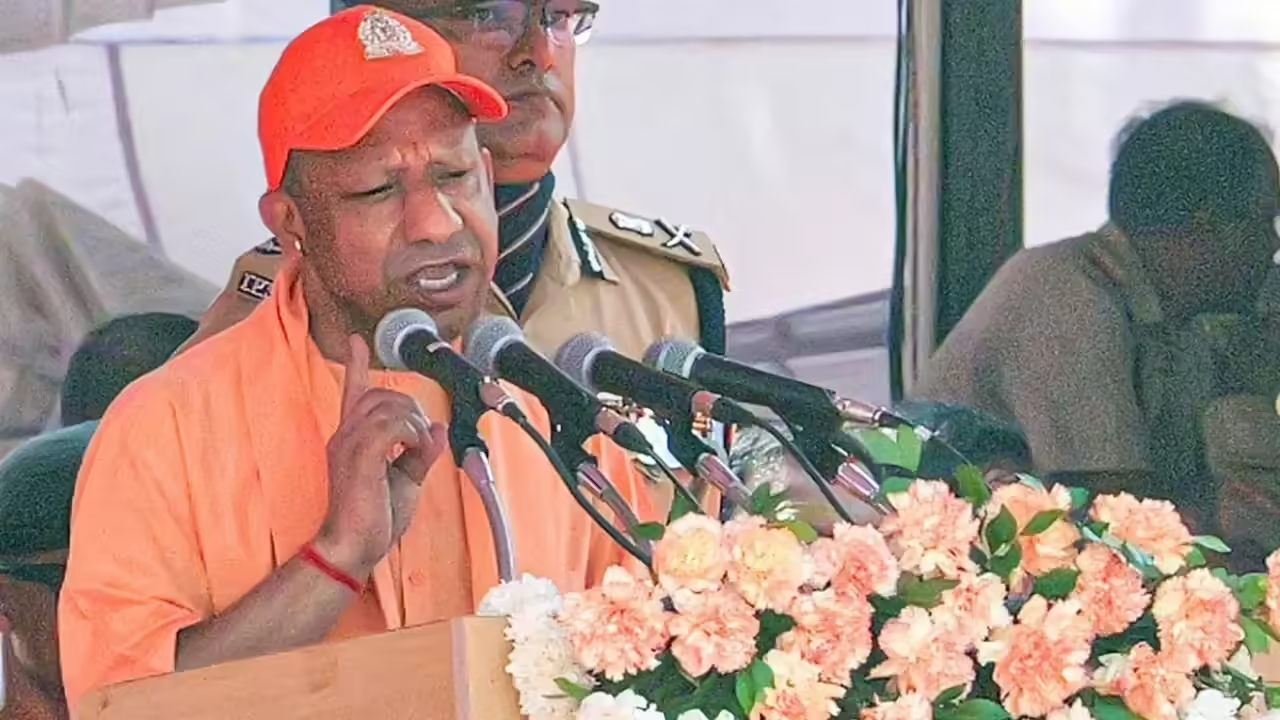
The public’s dismay is now directed at the State leadership. Legal activists are holding legal chief minister Yogi Adityanath to account. They are deeply criticizing his administration for its lax attitude towards disaster preparedness and lack of citizen protection. But challenging an incumbent Chief Minister in court during a disaster is a very high legal hill to jump.
The Chief Minister is the Chairman of State Disaster Management Authority under Disaster Management Act, 2005. The law puts him at the helm of administration of disaster response in Uttar Pradesh. Administrative oversight doesn’t necessarily mean criminal liability. In the Indian jurisprudence, it is difficult to prosecute someone as a political head for the action of nature. In order to find a negligence charge successful in court, a petitioner would have to establish that the duty was “absolutely” and “directly” neglected. They will have to prove that Adityanath had ordered to disregard the weather warnings or had removed rescue gears from a particular district.
This is very difficult to establish in court. The state system is structurally designed to take these types of hits on the bottom, not the top. The law takes into account the fact that UP is a large, uncentralized state. The lack of an alarm in the village doesn’t mean that the man in the Lucknow secretariat can go to jail.
After the Actual Chain of Command
The legal liability falls to the Chief Minister obviously if it doesn’t fall to him.If it doesn’t fall onto the Chief Minister, it falls onto him. Typically the courts focus on the specific local authorities that have the power at ground level.
The local power distribution company would be liable in a civil action if a poor-maintained electricity pole fell and killed a farmer. When a public works project’s retaining wall fails, the civil contractors and municipal engineers are swept into a tribunal. The State Disaster Response Force is closely watched for their on-time response. In times of crisis, the real power lies with the District Magistrates. The individual officer who refuses to comply with a direct red alert issued by the weather department and orders the markets or schools to remain open could be held to a severe standard by the court and suspended.
The state government is fully aware how these legal jeopardies operate. They quickly switched to their usual defense posture. The Chief Minister’s office ordered an unprecedented mass compensation in a rush within hours of the death toll hitting.
Deploying the Financial Shield
Adityanath started his attack on the administrative front. He gave his officials 24 hours to make the ex-gratia payments to the families of the deceased. He directed his cabinet members to come on foot to the disaster areas. He directed the district magistrates to update the rescue/relief process on social media platforms in public every three hours.
This quick monetary reaction has two reasons. Firstly, it of course gives immediate cash to families who have lost their main income and their home. Second, it serves as a huge legal defense. The state’s generous compensation is quickly dealt a devastating blow to the argument of “gross administrative apathy. The government machinery was mobilized soon after the public interest litigation has come in the sight of a judge. It makes for very hard lawyers to say that the State simply gave up and let its citizens die.
Changing direction towards infrastructure regulations.
This storm, as will the real, lasting legal battles to come, will not be led by high-profile politicians. These will be used to battle over mundane local building codes.
Attorneys are already contemplating the slew of structural failures. In just hours, almost 230 houses have suffered severe damage or destruction. The spotlight is now on the municipal corporation and village panchayats that give clearance to these shoddy structures. Temporary structures and tin roofs have virtually nonexistent safety guidelines in the rural belts. Petitions are already being prepared to ask for legal oversight of rural electrical systems. The people want to see the high tension wires safely underground rather than dangling risky wires on condemned wood or low quality concrete poles. There is increasing pressure to radically overhaul the local infrastructure laws.