Introduction
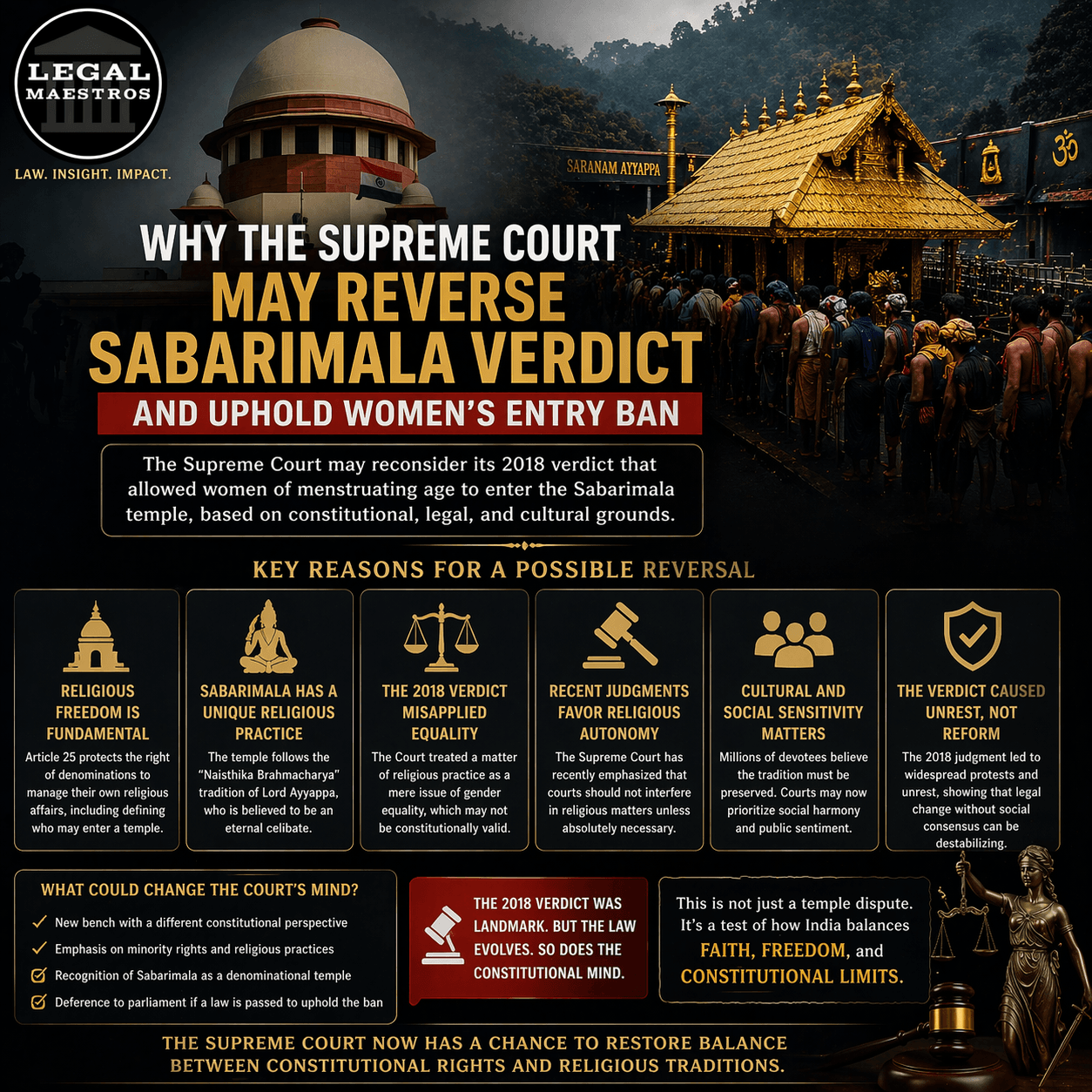
One of the most controversial cases in the Indian legal arena has been the Sabarimala temple case. It concerns the relation between the religious traditions and the constitutional rights. Although a previous decision in the Supreme Court permitted any woman of any age to enter the temple, there is considerable justification that the Court might redo so and may turn its decision over.
Case History.
Sabarimala temple in Kerala is a long-standing tradition of not allowing women aged between 10 and 50. This is done in association with the fact that Lord Ayyappa is a celibate deity.
In 2018, the Supreme Court decided that this limitation infringes the right to equality and admitted women to the temple. The decision however, caused protests and petitions of review.
Reasons why Reversal is possible.
Value of Religious Freedom.
The first is because of the safeguarding of religious freedom in the Constitution under Article 25. Some people say that religious organizations are to be allowed to run their own affairs and adhere to their customs without interference.
Essential Religious Practice Concept.
The Court will have an opportunity to revisit the issue of whether the restriction is an essential religious practice. In case it is established to be fundamental to the religion, the Court can permit the tradition to be maintained.
Honor Faith and Beliefs.
It is becoming increasingly argued that courts ought to honor the beliefs of the devotees, which might appear to be unreasonable to other people. Religion is usually founded on customary grounds and not on reason.
Equilibrium of Equality and Religion.
The Court can attempt to create a more balanced approach in the right to equality and the right to religious freedom. It can also make an effort to be more balanced in lieu of granting total priority to one right.
Influence on the Other Religious Practices.
The other issue is that the previous ruling may have an impact on the practice in other religions too. The Court can be cautious to prevent more extensive ramifications.
Larger Bench Consideration
A bigger bench of the Supreme Court has been referred to the case. A larger bench can reconsider the legal principles and give a new meaning.
Changing Judicial Approach
With time, the courts occasionally reverse their decisions due to new arguments, reactions of the society, and analysis. Such a shift may be seen in this case.
The case on Sabarimala is yet to be decided, but there are good grounds that the Supreme Court can revisit its earlier decision. The case brings out the intricate connection between the law, religion, and society. Regardless of the results, it will leave a lasting contribution to the way in which India will manage to strike a balance between constitutional rights and religious practices.
Keywords
Sabarimala case, Supreme Court of India, women entry temple, freedom of religion, Article 25, equality vs religion, essential religious practice, constitutional law of India, temple entry case, legal controversy.