Introduction
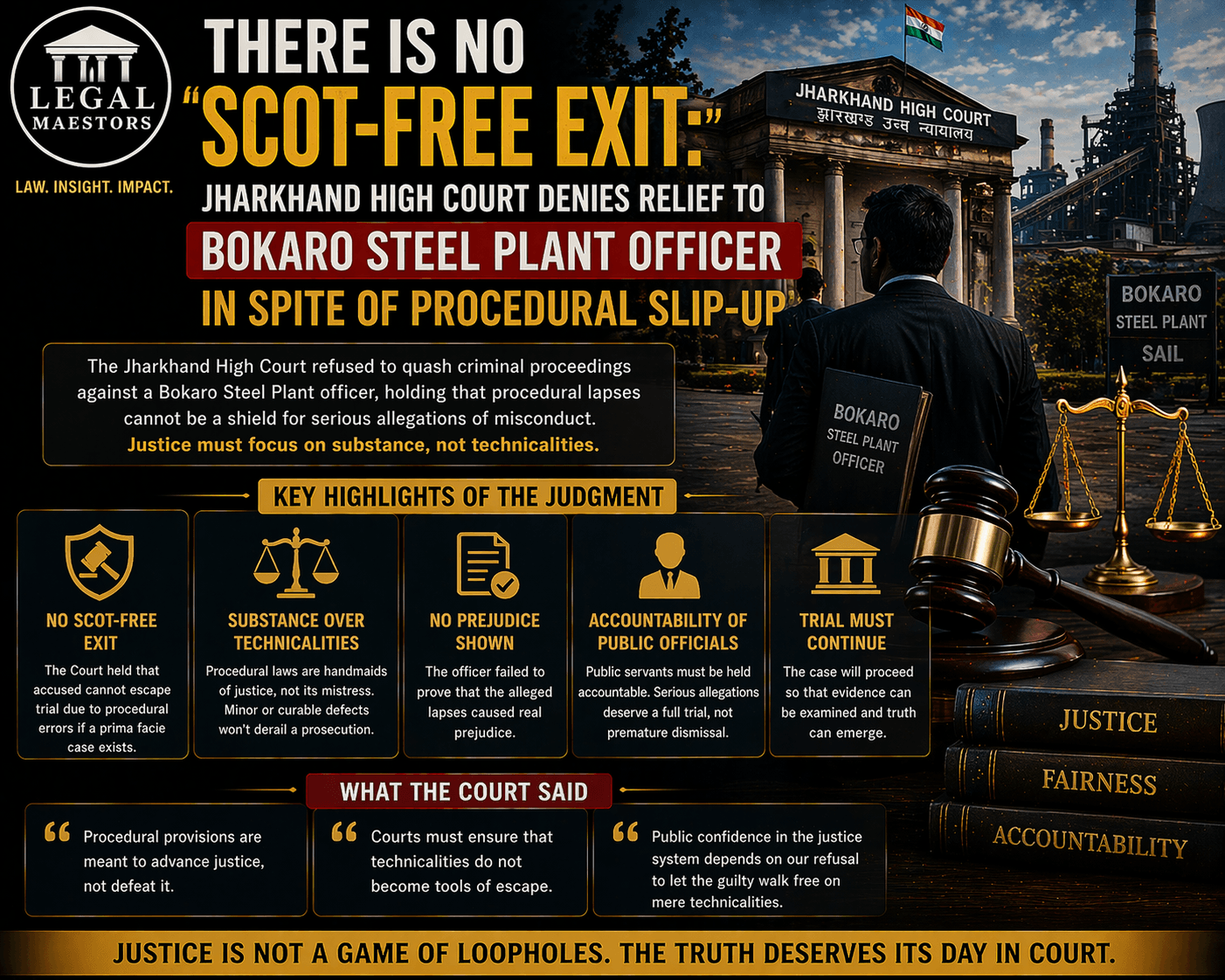
Jharkhand High Court issued a stern and balanced ruling that an accused should not be able to get off the hook simply because of lapses in the process.
The Court, in a case on an officer of Bokaro Steel Plant, denied the quash of proceedings although there are some technical flaws because justice should be applied on the basis of merits rather than form.
Case History.
The case was based on the complaint against one of the officers employed in Bokaro Steel Plant, which is a large industrial unit of Steel Authority of India Limited (SAIL).
The police officer was charged with misconduct which involved his official responsibilities. On these charges, a prosecution was commenced.
Nevertheless, as the case went on, the accused identified irregularities in its procedures and petitioned to quash the proceedings.
Grounds on which the Accused relied.
The officer claimed before the Court that the proceedings initiation had technical flaws.
He claimed that:
Some of the required processes were not duly followed.
Sanction or documentation lapses were present.
The whole case ought to be thrown out because of these mistakes.
Procedural safeguards were crucial in the defence because they believed that such lapses render the prosecution as unlawful.
Issue Before the Court.
The main question before the Court was whether the Court can quash criminal proceedings on the basis of procedural irregularities.
The Court had to decide whether such defects go to the root of the case or are merely technical in nature.
Court’s Observations
The Jharkhand High Court clarified the fact that:
Procedural laws are significant, which is to serve, rather than kill justice.
Minor or curable defects cannot be employed as a shield to escape trial.
Courts should consider the existence of real prejudice to the accused due to the irregularity.
The Court pointed out that technicalities must not be at the expense of the greater end of justice.
Substance Over Technicalities
The Court was pragmatic.
It observed that:
In case the accusations reveal a prima facie case the case ought to be taken to trial.
Sometimes, procedural mistakes can be remedied in the midst of proceedings.
That the accused should be released just on technical grounds would mean that people would lose confidence in the justice system.
This is representative of the principle that law cannot be too rigid or mechanical.
On Responsibility of State officials.
The duty of the public officials was also pointed out by the Court.
It stated that:
The officers in the position of power should be answerable to their actions.
A trial should allow investigating allegations of misconduct in detail.
The truth may not be forthcoming due to premature quashing of proceedings.
This fact supports the significance of transparency and accountability in the context of the public service.
The Plea is rejected.
The Court did not give relief to the officer after taking all factors into consideration.
It believed that the defects of the procedure mentioned were not critical enough to terminate the case at this point.
The Court ordered that the trial would proceed in order to have the evidence reviewed accordingly.
Importance of the Judgment.
This ruling is significant since it:
Explains that lapses in procedure do not necessarily mean that criminal proceedings are invalid.
Enforces the value of the fact that justice should be upheld through technicalities.
Makes sure that there are no legal loopholes that the accused may use.
Strengthens responsibility in government.
The ruling of the Jharkhand High Court sends a very strong message that courts will not permit people to evade trial on mere technical reasons.
The Court ensured the spirit of justice was served by placing importance on substance rather than procedure.
This verdict tells us that the legal system has to be just, yet practical and efficient to provide justice.
Keywords
Jharkhand High Court, Bokaro Steel Plant, SAIL, procedural mistake, criminal prosecution, public servant, responsibility, legal niceties, Indian judiciary.