Introduction
Sabarimala case is one of the most notable legal struggles in India over religion, equality and constitutional rights. The controversy is over the admission of women of menstruating age (1050 years) in the Sabarimala temple in Kerala. Although the Supreme Court had permitted entry, the Central Government subsequently came up with a stream of arguments that may overhaul the interpretation of religious practices under the Indian law.
Case History.
The Sabarimala temple, which is devoted to Lord Ayyappa, is based on an ancient tradition of not allowing women of a particular age group to enter the temple. This was courtly challenged as discriminatory and against right to equality.
In 2018, the Supreme Court decided that women should be admitted and the limit was unconstitutional. Nonetheless, the ruling sparked massive protests and controversies, with petitions of review being tendered.
Centre Appeals before the Supreme Court.
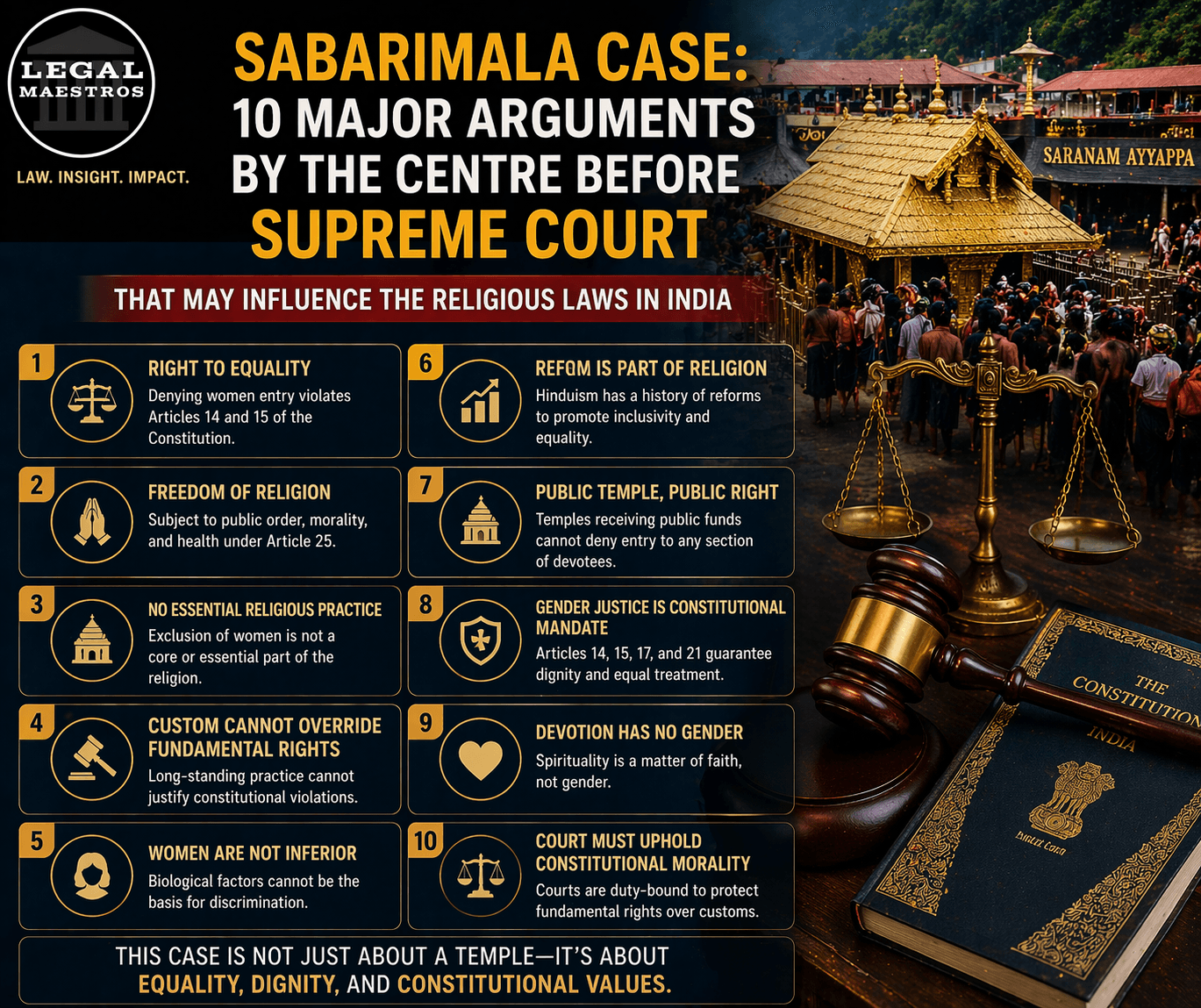
The Central Government has provided a number of reasons that it wants the reconsideration of the previous ruling. Such arguments are based on the consideration of constitutional rights and religious freedom.
- Freedom of Religion should be safeguarded.
The Centre contended that Article 25 of the Constitution ensures freedom of religion, which involves right to practice traditions without needless interference.
- Traditions Must not be tampered with easily.
Long-standing religious practices were said to be not to be altered unless it is evident that they are in contravention of the basic rights.
- Sabarimala Is a special Religious Initiative.
The Centre emphasized that the Sabarimala temple is unique and rituals cannot be paralleled with any common temples.
- Importance of the Key Religious Practices.
It was argued that the courts ought to establish whether a given practice is necessary to a religious belief before it is declared unconstitutional.
- Faith Is not always to be Ruled by Reason.
The Centre asserted that religion is founded on faith and not logic and that courts must not ignore this difference.
- Equality vs Religion.
It contended that the rights of equality had to be weighed against religious freedom, and not to knock it out of the field altogether.
- Broader Influence on other religions.
The Centre cautioned that the Sabarimala decision would have an implication on other religions unless it is addressed meticulously.
- Larger Constitutional Bench.
It implied that a bigger bench of the Supreme Court should have been utilized to make such a sensitive issue so that it is interpreted in a wider manner.
Protection of the beliefs of Devotees.
The Centre emphasised that faith of the devotees must be honoured and not rejected as discrimination.
- Judicial Restraints on Religious Issues.
Lastly, courts were argued to be restrained and not intrude too much on religious matters.
Importance of the Case
The Sabarimala case is not merely one case where a particular temple is the subject matter but more of a basic challenge to the ways in which India may juggle modern constitutional principles with the traditions.
Potential Implications on religious laws.
The ruling may affect the manner in which courts will handle religious activities in all societies. It can establish rules regarding when a court can intervene and when traditions are to be upheld.
The Sabarimala case presented by the Centre illustrates the intertwining of the law, faith, and society. This case can influence the religious and constitutional structure of India in the decades to come.
Keywords
Sabarimala case, Supreme Court of India, religious freedom, constitutional law, women entry temple, Article 25, essential religious practices, equality vs religion, India law, temple entry case.