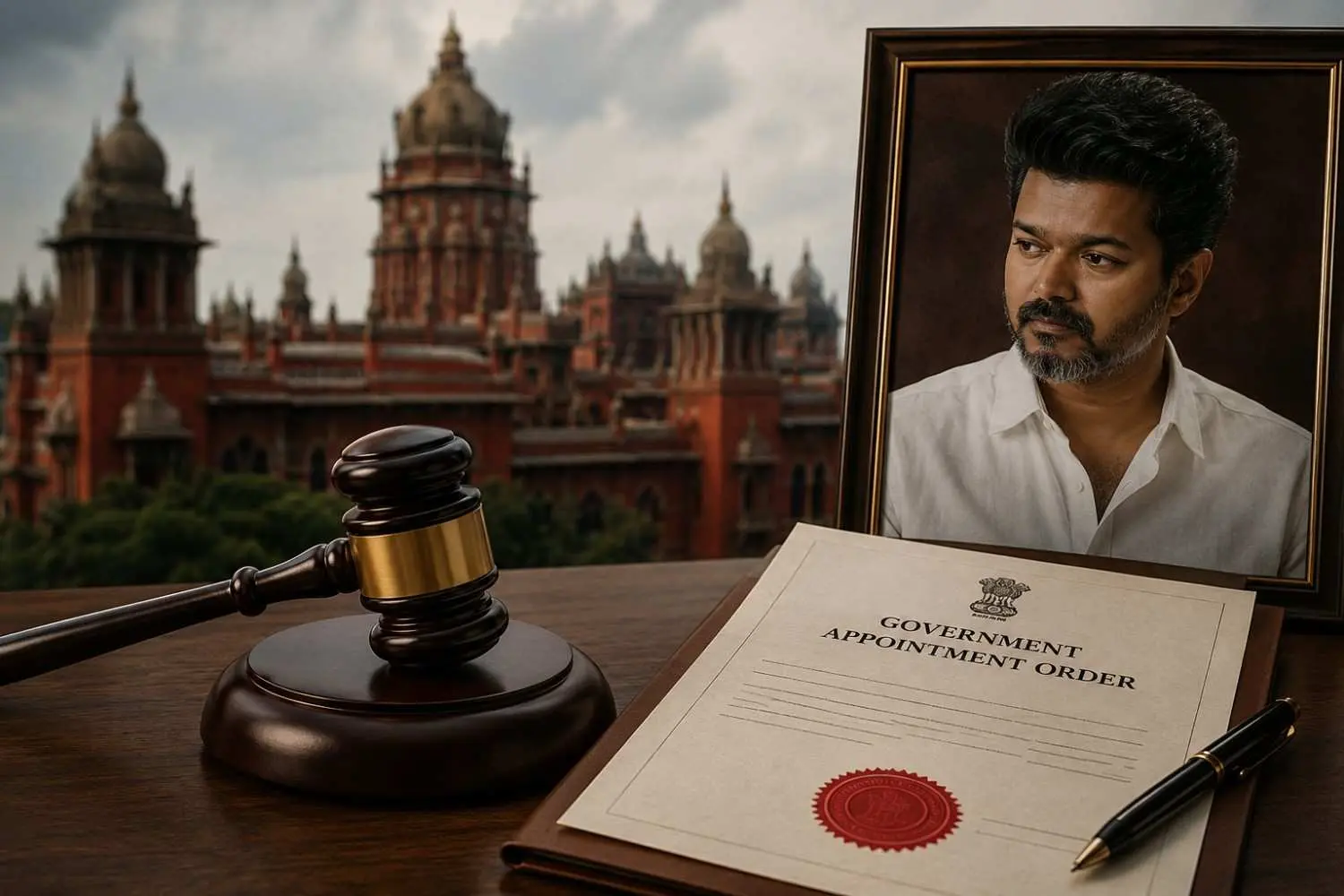
In the politics of the State of Tamil Nadu, which is in the process of becoming somewhat of an ironclad tradition, it is fine to pay devotion to whatever gods or heavenly alignments you wish to worship inside the walls of your prayer room, but once you set foot outside the walls of Fort St. George you’re supposed to bow down to the altar of rationalism. Well, you’re supposed to pretend to. But the “new era” Chief Minister C. Joseph Vijay, who went from the silver screen to the Secretariat with the promise of a “new era,” appear to have overlooked that memo. Vijay has not only raised eyebrows but put himself in the shoes of a private astrologer to the high-ranking post of Officer on Special Duty (OSD) – inviting the Madras High Court to audit the heavens
The obstacle the bench is facing right now is not only about one paycheck, or a gold medal that a friend won. A basic examination of government expenditures and the nature of “qualification” in a modern democracy. The High Court’s doubt was evident on Tuesday. The judges posed a seemingly easy, but chilling question: What, exactly, is the “special duty” of an astrologer in a government which is constitutionally bound to inculcate a scientific temper?
This was, as one might expect, a tour-de-force in governmental deflection. They said that the CM can do with his personal staff as he please. They state that the person in question is a “consultant” and is giving “strategic advice. But the court will not accept the semantic acrobatics. If it’s a state treasured post, then it is no longer a personal fancy but a public duty. It is not possible to simply recruit a man to read palms and label him a “Data Analyst” to please the auditors
The political shadow Vijay is trying to step out of can only be understood by looking at the friction that’s here. The Dravidian movement has been based for decades on a strident and sometimes theatrical condemnation of superstition. Even the most pious leaders typically made their trips to the temple very quiet or concealing them in “cultural appreciation. Vijay, however, has not been as protective. The move to bring a man from the stars to the public payroll is either a well-thought-out ploy to attract another audience or an obvious personal belief in the power of the zodiac, it is a jarring discord in the state’s political score.
The counter argument, whispered in the corridors of TVK party office, is that all leaders have their “fixers.” Under the previous regimes, it was the province of their Yoga Gurus, their spiritual advisors, and their trusted family “consultants” to hold unofficial positions of power. Why, asks the Vijay camp, should their guy be picked singled out when he happens not to have a job at a big corporate firm but has a celestial job? They say it’s an issue of judicial overreach; an effort to over-manage the CM’s office without facing the hundreds of other “special officers” who do little but drink tea and shuffle files
However, that’s no argument. Political adviser vs metaphysical adviser. A political advisor gets questioned on policy — a strategist gets fired for bad data. What do you do if a prediction doesn’t work out for an astrologer? If the rains don’t come or the scheme flops, can the High Court summon Mercury for a deposition?
The intervention of the Madras High Court is a good wake-up call. It’s a reminder that the “Officer on Special Duty” tag is not the personal loyalism of a gift-wrapped prize or the cosmic insurance agent. This is a job-position. The criteria for selection and for what is a public interest in this appointment are required by the court, restating the fundamental constitutional lesson that the state is a secular body.
Ultimately, it is likely that Vijay will have to pay a higher price than just his employee. It has made him out to be a youthful, modern, yet another old-world politician with his fears. To chart the direction of Tamil Nadu for the future he should focus more on the fine print of the Advocates Act and the Constitution, and less on the alignment of planets. It could be a stroke of luck, but in Court Room No. 1, only the law is important.