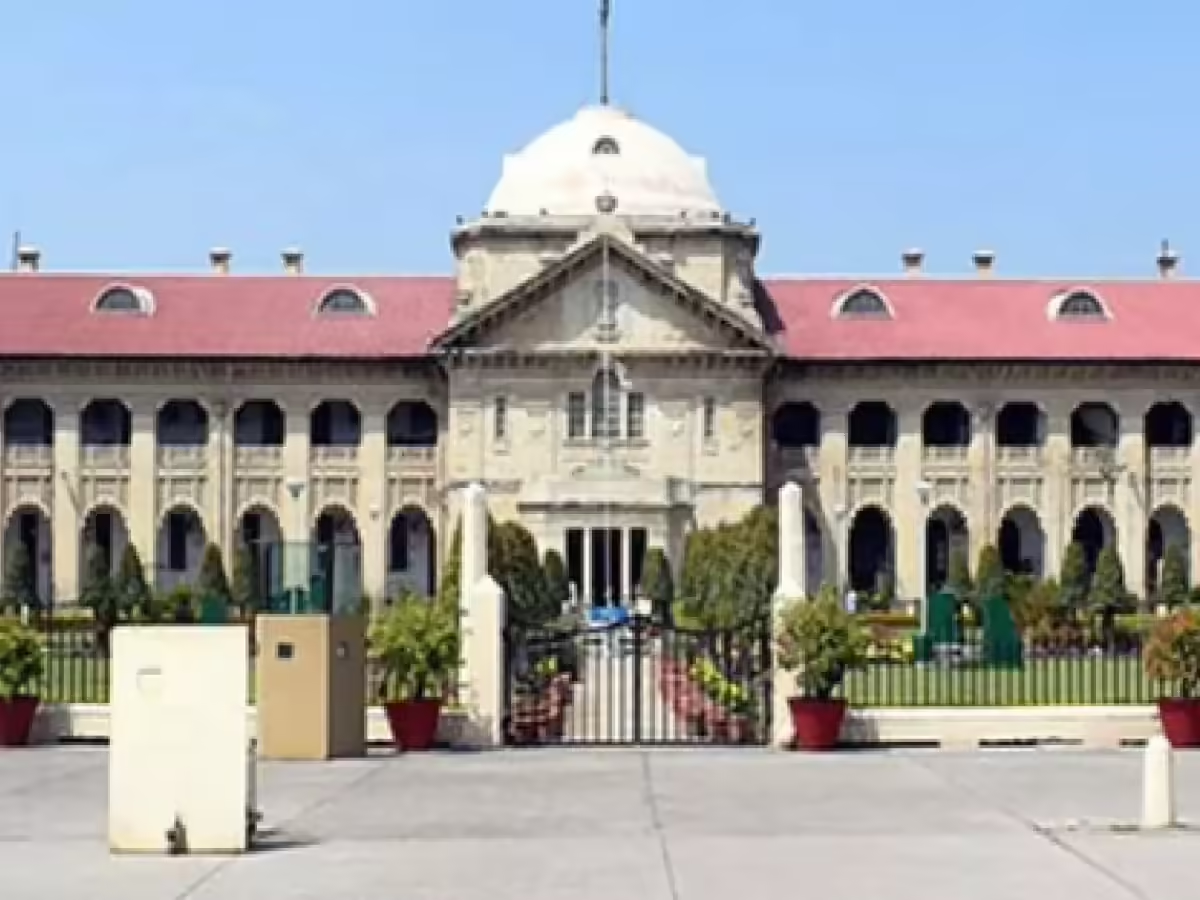
The Allahabad High Court to Uttar Pradesh Chief Minister Yogi Adityanath has sent a clear message that it’s time to put top bureaucrats and administrative shoulders of the various departments of the state administration under trial for their systemic failures in the various departments. It comes in the wake of the Justice Vinod Diwakar’s June 3, 2026, statement against the ‘tailor-made culture of impunity’ in the state’s executive machinery.
The court didn’t make its mark through the traditional, bureaucratic channels. Rather, it directed the Chief Secretary of the state to keep the judgment on his desk for his personal perusal. Justice Diwakar emphasized that the notion of “superior responsibility” should be introduced in Uttar Pradesh where those who commit a wrong should be held responsible even if it was their subordinates who did it.
This is a Delay Spun from Red Tape that was 18 years ago.
The harsh criticism was prompted by a regular case that got “trapped” in administrative limbo. The petitioner Awanish Kumar Agarwal of Bareilly, had appealed against the refusal of lower special court to grant him a No Objection Certificate (NOC) for renewal of his passport to the High Court. Both the denial was based on the old criminal cases pertaining to commercial tax fraud and Prevention of Corruption Act.
But the fact was the ridiculous time frame of the state’s investigations. In one case, the case had been left untouched for almost two decades. In the latter case, the state police had taken 18 years to submit a simple chargesheet, which was submitted in 2024.
Justice Diwakar said that it was unacceptable that the fundamental right to travel of a citizen should be put on ice for a generation due to the slow pace of government investigators. The lower court restriction was immediately quashed by the court and the passport authorities were directed to issue the new passport.
Violation of promises and defying orders.
But not only the late passport frustrated the court, so did the whole situation. The judgment criticized “a pattern of the State government disregarding clear court orders.
[2023 High Court Mandate] ──► Order to form High-Powered Committee on Corruption Cases
                                        │
                         (Two-Year Administrative Delay)
                                        ▼
[December 2025]            ──► Committee finally formed on paper
                                        │
                         (Three-Month Judicial Silence)
                                        ▼
[June 2026 Judgment]       ──► Court receives zero updates; slams bureaucratic "mindset"
A division bench in Manish Kumar Singh vs State of UP had earlier in the year 2023, ordered the State to set up a High-Powered Committee. The committee’s responsibility was to create some clear guidelines for investigations that are time limited and do not allow cases to languish in the system for years and years.
The committee was not established until December, 2025. More seriously, Justice Diwakar had acquired three months prior the judgement, a copy of this passport, to give the state an opportunity to show the result of this committee. When the ruling was read out, the state law enforcement officers said there was absolutely nothing new to break the news to the court.
The Bureaucratic Mindset is challenged by…
The court examined the reasons for these delays in depth, giving a considerable amount of weight to the culture among various executive bodies such as the Indian Administrative Service (IAS). The most challenging part to overcome is the attitude of some administrative wings in the context of judicial reforms,” Justice Diwakar said.
Many senior officials think that having discretionary power is enough and not necessarily for the public good, the court said. But the underlying cause of this red-tapism, which is paralysing the Indian law and executive systems is fear of losing control of personal authority.
Administrative Discretion ──► Fear of Losing Control ──► Red-Tapism ──► Decades of Delayed JusticeThe court pointed out that the Chief Secretary is a principal advisor of the Chief Minister and Cabinet on all issues of policy and civil administration of the State and reminded the State legal team of it. If the chief is lax, the executive system fails as a whole.
A General Pattern of Bureaucratic Ruckus.
The decision comes shortly after another harsh criticism from the same judge. Justice Diwakar in public slammed one of the most powerful officers (Additional Chief Secretary (Home) Sanjay Prasad) of UP on one day later.
In the other habeas corpus petition relating to recovery of a minor girl, the court observed that Prasad had also been “defiant” in the case of implementation of police reforms and investigative measures suggested by the bench. While the court said it was not trying to “cure the defects in the system,” the highest level of police infrastructure did not appear to be convinced as they treated the constitutional court’s orders as “mere directives.”
The High Court is putting pressure on the Chief Secretary to give this fresh judgment to Yogi Adityanath to get him to take a political step. Whether the state executive will take a step to change the rules of its internal system to take the blame of the delay of the junior IAS officers by the senior IAS officers for a criminal offense, remains to be seen.