The Crowded Street and the Law
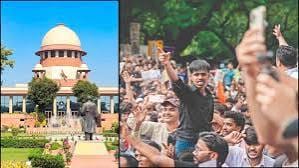
When thousands of young protesters poured onto the roads of Central Delhi in July 2026, police barricades went up almost immediately. Water cannons and teargas shells followed. The march was organized under the banner of the Cockroach Janta Party, a youth group that started as an online satire page after a comment from the Chief Justice of India. Within weeks, it turned into a massive physical protest over paper leaks and joblessness among graduates. The sight of students clashing with police near Parliament brought back an old, unresolved legal argument in India. Where does a citizen’s right to stand on a public street end, and where does the state’s power to clear the road begin?
Indian courts have spent over fifty years trying to draw this line. The Constitution gives every citizen the freedom to assemble peacefully without weapons under Article 19(1)(b). But that right was never written as an absolute promise. The state can put reasonable limits on it if public order is at risk. How those limits get applied in practice is where the legal friction happens every single time.
Himmat Lal and the Power to Regulate
The baseline for this debate goes back to 1972, when the Supreme Court decided the case of Himmat Lal K. Shah v. Commissioner of Police. Himmat Lal wanted to hold a public meeting on a street in Ahmedabad, but the police commissioner turned down his application using powers under the Bombay Police Act rules. The police rule effectively gave officers open-ended discretion to grant or deny permission for gatherings on public roads.
The Supreme Court stepped in and struck down that specific rule. The judges explained that streets have historically been places where people meet and share political views. The government has the power to regulate meetings so traffic keeps moving and safety is maintained. Regulate, however, does not mean ban completely. The court made it clear that police cannot hold arbitrary power to stop peaceful assemblies whenever they feel like it. That ruling established that prior permission rules must have clear boundaries rather than giving police total control.
Midnight Clearances and the Scope of Section 144
Decades later, the tension shifted from simple public meetings to overnight sit-ins. In June 2011, yoga teacher Baba Ramdev and his followers gathered at Ramlila Maidan in Delhi for a fast against corruption. Late at night, police swept into the ground, fired teargas, and forcibly cleared the sleeping crowd.
When the Supreme Court took up the Ramlila Maidan incident in 2012, it evaluated how authorities use Section 144 of the Code of Criminal Procedure. That section allows magistrates to issue quick orders banning gatherings to prevent danger or disorder. The court noted that while the state must keep order, using force on a sleeping, peaceful crowd in the middle of the night was disproportionate. The judgment pointed out that officers must exhaust gentler measures before turning to harsh action. It reminded authorities that a peaceful gathering does not automatically become an illegal mob just because it makes the government uncomfortable.
Designing Parks for Dissent
By 2018, the conflict moved to Jantar Mantar and the lawns around Parliament. For years, local police had kept orders active around Central Vista, banning all demonstrations in those high-security zones. Protesters were pushed into a narrow strip on Jantar Mantar Road. Eventually, local residents living on that street went to court complaining about constant noise, blocked driveways, and loudspeakers running from morning to night.
In the case of Mazdoor Kisan Shakti Sangathan v. Union of India, the Supreme Court tried to strike a balance between two competing interests. The judges acknowledged that residents have a right to quiet enjoyment of their homes. At the same time, they rejected the idea of a total, permanent ban on protests around the center of power. The court ordered the police and local municipal bodies to lay down proper guidelines. They created a framework where a limited number of protests could take place at designated spots like Jantar Mantar, with restrictions on noise and crowd size.
Blockades and the Shaheen Bagh Decision
The legal framework took another sharp turn during the 2019-2020 sit-in at Shaheen Bagh in Delhi. Demonstrators protesting the Citizenship Amendment Act blocked a major arterial road connecting Delhi and Noida for over three months. Commuters faced massive delays every day.
In Amit Sahni v. Commissioner of Police, decided in late 2020, the Supreme Court drew a firm line against occupying public transit corridors. The bench held that while the right to dissent is central to democracy, it cannot come at the cost of blocking public roads indefinitely. Demonstrations must be restricted to designated areas. The court stated that public spaces cannot be held hostage by one group, no matter how strong their grievance might be. That decision gave administration and law enforcement explicit authority to clear road blockades.
The Cockroach Janta Party and the Limits of Designated Sites
This legal lineage brings us directly to the recent Cockroach Janta Party demonstrations. The group spent weeks camped out at Jantar Mantar, which fits neatly within the designated protest model set up by past judgments. But when the organizers decided to step off the designated strip and march directly toward Parliament House, the situation changed.
Police invoked Section 163 of the Bharatiya Nagarik Suraksha Sanhita (which replaced the old Section 144) to halt the marchers. The resulting clashes left dozens of protesters and officers injured. From the police perspective, they were enforcing the rule from Amit Sahni: protests belong in designated spots, not on main roads blocking government functions. From the perspective of the young marchers, staying confined to a small alley far from decision-makers rendered their protest invisible.
The conflict highlights a recurring pattern in Indian constitutional law. Himmat Lal protected the right to gather without arbitrary police bans. Subsequent rulings pushed protests toward contained zones to keep urban centers running. When a movement grows large enough, like the Cockroach Janta Party rallies, the boundary between designated spaces and physical street marches breaks down in practice once again.