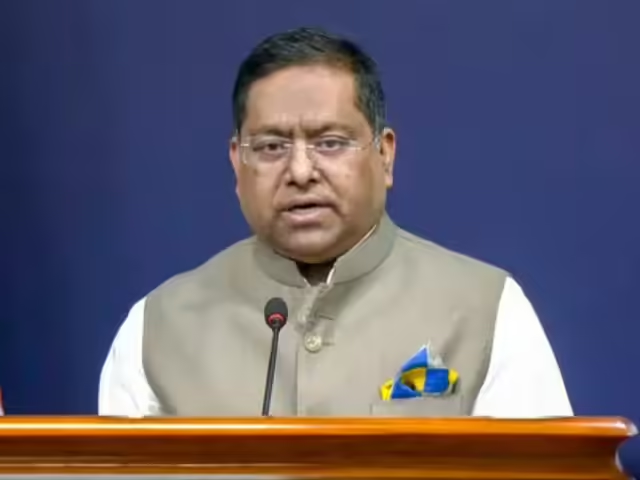
New Delhi, however, did not miss a beat this weekend. The Indian government utterly disregarded a brand new ruling of the Permanent Court of Arbitration in The Hague on Saturday. The external affairs ministry essentially dismissed the whole international tribunal as a sham
Randhir Jaiswal is the spokesperson for the ministry. He issued a very hard statement on the court’s “award” issued Friday, May 15. It was related to the storage of water as per the Indus Waters Treaty. Jaiswal was not being diplomatic in this regard. He categorically said that the court was illegally set up in India. The court is illegitimate in the eyes of the people of New Delhi, so any paper that it issues is entirely worthless. India has never accepted any jurisdiction of this particular arbitration forum and they won’t budge from it now either.
The central thrust of the MEA was clear. They seem to be ignoring the ruling of Friday.
The Fight Over Pondage
The court actually tried to order what? It’s about the concept of engineers, called “maximum pondage. It is the absolute cap on water volume behind India’s dam system on river systems
This new ruling is simply an addition. It’s tied to a wider, much more contentious ruling made by the same court in August of 2025. The earlier order sought to bind India to very stringent water collection and calculations on minimum discharges on a seven-day basis. For years, Pakistan has been demanding such limitations. They are very concerned about the huge infrastructure development projects in Jammu and Kashmir area in India. The actual tussles are at the Kishenganga and Ratle hydel projects. Islamabad says those dams are in breach of the 1960 accord, which says India must allow Pakistan to use the water as it sees fit.
The water is desperately needed by Pakistan. About 70% of their total agricultural irrigation is based on the Indus river system. They are terrified of any change upstream.
Two Different Courtrooms
It’s a big mess in the court of law. The reason for the anger of the Indians is that they have seen Pakistan play the legal game.
The initial 1960 treaty in itself clearly provides for a grievance procedure, which follows a step-by-step process. In case technical engineering issues are not agreeable, both parties are expected to appoint an independent Neutral Expert from the World Bank. When things escalate to gigantic legal treaty interpretations, it is to a Court of Arbitration.
India alleges that Pakistan has been trying to take two horses. Islamabad campaigned for the Neutral Expert, but at the same time they hurried to The Hague to establish the arbitration court. India saw this alternate path and protested. They say that it’s not possible to have two different international bodies conducting hearings on the same river at the same time. It is difficult to say that it doesn’t breach the basic structure of the treaty. This, therefore, rendered India to be completely unavailable before the arbitration court. They refused to appear before the hearings. They wouldn’t go en masse to The Hague with lawyers. In the meantime, the court ruled that it had jurisdiction anyway, and simply continued to hold sessions while India was out of the room.
A Treaty Put on Ice
But the law battle is far overshadowed by the raw political reality on the ground. The Indus Waters Treaty is barely alive.
The two countries’ ties fell apart totally last year. In April 2025, more than 2 dozen civilians and security personnel were killed in a horrific terror attack in the town of Pahalgam. New Delhi took no more. They directly blamed the violence on cross-border terrorism being funded by Islamabad. In reply, India played a historic diplomatic game. They formally declared all of the IWT “in abeyance.
It was more or less like they lifted the rules. That fact was strongly repeated by Jaiswal on Saturday. He reminded everyone that India’s decision to put the treaty in abeyance is valid today. The Indian government has made it clear that it doesn’t have to fulfil normal water-sharing obligations on their part when terror attacks come at them from their neighbour round the clock. They do not want Pakistan to be seen to close the militant networks and do it in a sincere and permanent manner before the issue of river levels is raised once again.
Tearing Up the Old Playbook
The 1960 agreement was to be permanent. It was brokered by the World Bank. It gave India complete access of the three eastern rivers, Sutlej, Beas and Ravi. The three western rivers were given to Pakistan. They are Indus, Jhelum and Chenab. However, India had the rights of using those western waters for non-consumptive purposes like electricity generation.
Now, the whole 65-year-old structure is falling apart. India is not only refusing to obey the arbitration court. They are relentlessly lobbying to amend the regulations. Formal notice was sent by New Delhi in the past few years, asking for the treatment to be repealed and amended. The Indian side’s view is that the world has changed in the sixties compared to now. The population exploded. The natural flow of the glaciers and rivers is being drastically changed by climate change. Energy needs of local population in J&K have skyrocketed.
India believes that the outdated treaty is an anachronism which binds its hands. For Pakistan it is a question of survival of the nation. The diplomatic impasse is real and right now, considering the treaty is suspended and international Courts giving verdicts which India is discarding, the diplomatic deadlock is absolute.