The controversy you shared with the headline is going on for a long time and is growing faster in India since mid-May, 2026. The phrase was inadvertently coined by a frustrated Supreme Court judge and then used to fuel an entire political movement, and one that was briefly extinguished online days later.
Here is a brief synopsis of what happened over the course of one week:
May 15, 2026: The Spark
The remarks by the chief justice Surya Kant about the “cockroaches” and “parasites” in his courtroom have caused anger online.
May 16, 2026: Satire Launched
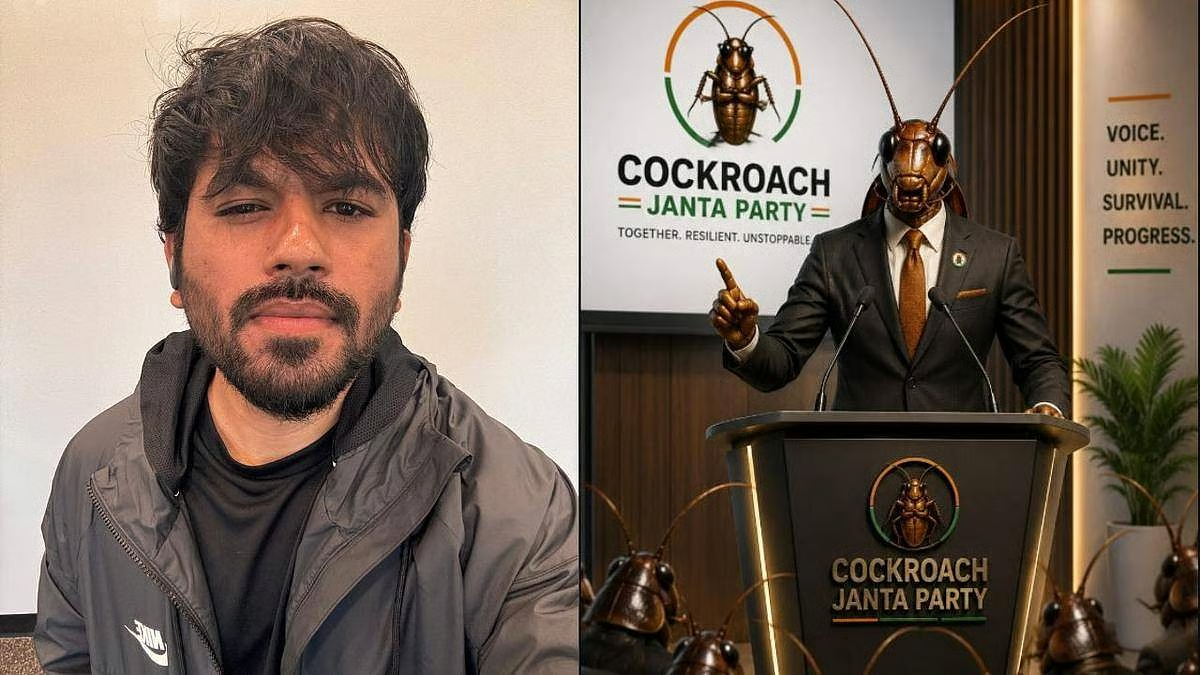
To poke fun at the comments, activist Abhijeet Dipke has set up the “Cockroach Janta Party” on the internet.
May 20-21, 2026: Viral Explosion
The movement reaches 20 million Instagram users and opposition politicians express their support.
May 21-23, 2026: Digital Clampdown
All the CJP’s Twitter and Instagram accounts are suspended and its official website is shut down.
May 24, 2026: Real-World Friction
A CJP-led ‘human chain’ protest in Bengaluru comes under threat of legal action by Bengaluru Police.
The CJI’s Remark: The Origin was written by the CJI.
During a hearing before the Supreme Court on May 15, the chief justice of India, Surya Kant, complained about people taking up jobs with bogus degrees. He said that these jobless youths “spread everywhere like cockroaches” and behave like “parasites” once they get into professions such as right to information (RTI) activism, media and law.
The CJI later clarified that his remarks were directed only towards those who have forged credentials as fraudsters and not at the young people in India as a whole, but the internet had already latched onto to the insult.
The emergence of the ‘Cockroach Janta Party’
In response, Abhijeet Dipke, who is 30 years old, is a public relations student and also the former volunteer for social media of the Aam Aadmi Party (AAP) started the Cockroach Janta Party (CJP). Taking up the judge’s job as a badge of honor, the satirical website called itself the “voice of the lazy and the unemployed.”
The CJP did this by creating memes, animations and a fake manifesto to tackle real-life issues that affect young people like the lack of jobs, exam paper leaks, and bleak economic prospects. It made a big splash:
Rapid growth: The CJP gained more than 20 million followers on social media within a few days, overtaking the online presence of the mainstream political parties in India.
Political backing: The movement got significant political support in the form of public statements made by political leaders, including Congress MP Shashi Tharoor, AAP’s Manish Sisodia and TMC’s Mahua Moitra, who saw it as a very effective and creative forum for youth disenfranchisement.
The Digital Crackdown
The CJP had made a dramatic transformation from an online joke to a real centre of political discontent and was suddenly subjected to a massive online cleansing.
Account Withheld: CJP’s official X (earlier known as Twitter) account got suspended in India, ostensibly due to the IT Act directions about “national security concerns.”
Platform Takedowns: Dipke said that the movement’s huge Instagram accounts – and his own backup accounts – were binned or hacked.
Official CJP website – an alleged 10 million member website was suddenly made unavailable.
Dipke promptly declared that the central government had engaged in “cowardice” with reference to its “fear of cockroaches,” after shutting down the satirical page of the meme.
It is the Free Speech Debate.It is the Free Speech Debate!
The war has now spread from social media. The Bengaluru Police have recently issued a public warning against citizens taking part in a “peaceful human chain” marked by CJP, claiming that the police will take action against those who assemble.
This rapid repression has sparked a sharp national debate on digital dissent. Some opponents to the crackdown say it reveals a government that is increasingly intolerant of political satire and freedom of expression. Meanwhile, political analysts have pointed out that the CJP’s meteoric rise—and its over-the-top response—is a textbook example of how the youth in India are finding alternative way to voice their distrust in the traditional political system through irony and meme culture.