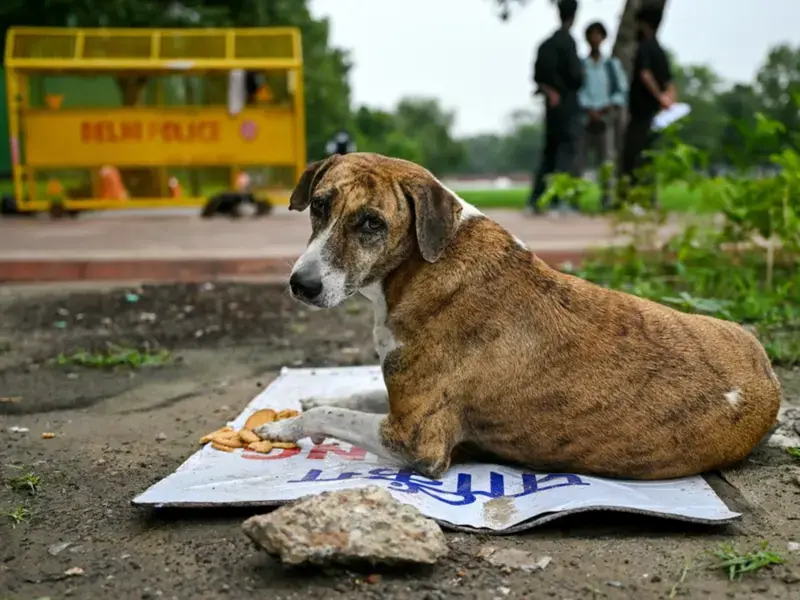
When it comes to the street dog crisis, nothing’s more important than public safety, the Supreme Court just said. A three-judge bench has decisively rejected any change to their earlier ruling on the rounding up and relocation of stray dogs from places with a high population of foot traffic. The judges who presided over the matter were Vikram Nath, Sandeep Mehta and NV Anjaria. They rejected a pile of petitions from animal rights groups and dog lovers demanding that the policy be eased.
The trial concluded with the bench giving a mammoth judgment of 131 pages on Tuesday. The judges said the state can’t just sit on the sidelines as a spectator as people are subjected to life-threatening situations on the streets. They have declared that the instructions they have given in November 2025 are fully valid. Stray dogs that are caught in highly sensitive areas are not allowed to be taken back to the exact location in any case.
The judges even mentioned a severe biological term in the reading. A Darwinian struggle of “survival of the fittest” appears to be unfolding on Indian streets, they noted. It is unacceptable that children and elderly people should be fighting to survive against aggressive packs when local authorities are not doing their duty.
First, no return to any public space.First, no return to public spaces.
The main disagreement is about where the dogs should go if they are caught. The standard capture, sterilize, vaccinate and release strategy has long been supported by animal welfare groups. However, the Supreme Court threw a spanner in the works for certain areas. This practice was suspended for high footfall premises such as schools, colleges, sports complexes, hospitals, bus depots and railway stations for November 2025.
The court reiterated that removal of any dog from such institutional premises was to be followed by the dog being placed in a shelter. It would effectively negate the idea of having safe public spaces if released back to the exact locations where patients, young children and commuters converge.
The bench also threw out challenges against the Standard Operating Procedure designed by the Animal Welfare Board of India. Actually the judges explained the list of prohibited places is not only restricted to schools or transportation centers. It’s also for other overcrowded public places such as parks, tourist attractions, faith buildings, and recreational areas. The judges even noted that stray dogs have been seen in the terminals and runways of Indira Gandhi International Airport in Delhi! They said that it was a gigantic security lapse that erodes public trust in civil administration
Euthanasia is given a legal green light.
The Supreme Court is making a radical change in the law of medicine: it expressly permits euthanasia under certain conditions. If a stray is discovered to be rabid, incurably ill, or clearly dangerous and aggressive, the authorities can kill it, the bench said, adding that they should refrain from killing a stray if it had not been found to be rabid. This action should be supported by a suitable assessment by competent veterinary experts
The judges made it clear that if there is a balance between human life and animal welfare, it is always human life which gains the upper hand. They said there are various definitions for the term “walk freely” in Article 21 of the Constitution that ensures the right to life and dignity, which means that every citizen should not be afraid of being attacked by someone at any time.
Animal populations, especially in urban environments, have become more feral,” the court said. Due to the number and severity of the attacks over the last few years, it is legal to take extraordinary measures under the Prevention of Cruelty to Animals Act and the newer 2023 Animal Birth Control Rules
Numbers Show a Grim Reality
The judges did not make their judgments on the basis of abstract notions. They did review a mountain of disturbing statistics from different states. The numbers revealed that the dog bite problem has reached indeed shocking proportions in India.
The bench, for example, relied on reports to conclude that in the initial months of 2026, only Udaipur recorded more than 1750 cases of dog bites. In Bhilwara, 42 persons were targeted and bitten by street dogs in one day. The figures emerging from Tamilnadu were even more staggering: The state reported more than 240,000 bites this year, and this month alone, 71,000 bites were reported and 34 people died of rabies.
The court rebuked the apathy of the state governments and union territories in history. They noted that although the law for animal birth control has been in existence for more than 2 decades, it has been implemented sporadically, with little funding, and very unevenly. No long-term plans have been made for the expansion of infrastructure in response to the increasing number of dogs.
Addressing the Future in a strict manner
The Supreme Court issued new, tough directives to remedy the damaged infrastructure. All states and UTs have to set up at least one fully functional Animal Birth Control centre in each district. These centers must be well prepared with surgical facilities, staff and proper veterinary logistics in order to conduct large scale sterilization drives. It is also the responsibility of the local bodies to keep anti-rabies vaccines and immunoglobulins on regular supply in public hospitals.
The court even gave a tongue lashing to organisations feeding stray dogs within institutional premises without actually taking any responsibility. All animal welfare and student run organisations that feed dogs on educational premises will now have to submit a formal affidavit. They will be subject to the “tortious liability” that makes them responsible for the dog’s bite and liable for any resulting injury to the person.